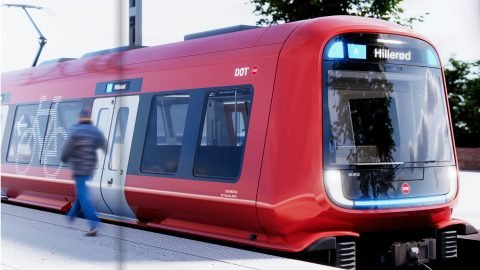
DENMARK: National passenger operator DSB has awarded Hitachi Rail the Support Systems contract to design, supply and maintain a range of systems intended to support the conversion of the København S-Bane suburban rail network to unattended driverless operation. Siemens Mobility had also been shortlisted for the SuSy contract, which covers an IT network, SCADA, a passenger announcement and information system and CCTV,. Also covered are platform emergency stop buttons and a maintenance management system,. Hitachi will supply a HMAX AI-driven digital asset management suite and an Obstacle Detection System – Platform designed to detect people, animals or large objects that enter the track area within stations. Hitachi Rail said these systems would provide the operator with enhanced visibility and decision-support capabilities while improving communication and information services for passengers. DSB selected obstacle detection as a cheaper option than retrofitting platform screen doors to the stations. Hitachi Rail said the ODS-P will be a ‘critical enabler’ of the automation programme, and development would strengthen railway expertise in Denmark and create valuable experience for future automation projects elsewhere. ‘SuSy is much more than a collection of support systems; it provides many of the operational, passenger-facing and safety-enabling capabilities that will help make future automated railway operations possible’, said Hannes Boyer, Vice-President North Central & Eastern Europe at Hitachi Rail, on September 25. He said the technologies for DSB’s Future S-Bane vision would help to give Denmark ‘one of the world’s most innovative automated railway systems’. In 2022 Siemens Mobility completed the deployment of CBTC on the 170 km S-bane network under a contract awarded in 2011, and in 2024 DSB and infrastructure manager Banedanmark awarded the company a €270m contract to modify the onboard and lineside equipment to support unattended operation. Earlier this year, a consortium of Siemens Mobility and Stadler was selected to supply at least 226 driverless 1.5 kV DC EMUs for the automation project. See also Automation: Delivering low-cost obstacle detection for København S-Bane Consortium selected to supply driverless suburban trains for København Siemens to upgrade København S-bane for driverless operation Siemens wins København S-bane signalling contract
Bot Auto has picked Lenovo’s AD1 autonomous-driving domain controller, built on Nvidia Hyperion, as the production computer for its Class 8 driverless trucks. The Houston company announced the deal Tuesday. The AD1 goes into Bot Auto trucks starting in the first quarter of 2027. Bot Auto expects the full hardware bill of materials for its autonomy system, compute and sensors included, to run $50,000 per truck. That is three to eight times less than other systems, Bot Auto said. The comparison rests on “Self-Driving Truck ROI: Costs and Benefits Explained,” a Heavy Duty Journal cost guide that puts a complete autonomous truck at $350,000 to $600,000, a range the company said implies $150,000 to $400,000 for the autonomy system alone. Bot Auto now moves about 350 loads a month across Texas. The company said revenue grew 270% from May to August as it increased its focus on commercial freight and fleet utilization. In April it ran its first fully humanless commercial load, a 231-mile overnight trip on Interstate 45 from Houston to Hutchins, just south of Dallas, with no safety driver, remote operator or in-cab observer. It had 12 tractors at the time of that run. Founder and CEO Xiaodi Hou has tied fleet growth to the computer inside each truck. “Standard servers can take you a long way during development, but they are not the architecture we want to replicate across hundreds or thousands of commercial trucks,” Hou said. Bot Auto’s driverless trucks run today on a single Nvidia GeForce RTX 4090 per server, a setup Hou credits to the efficiency of the company’s neural networks. “The AD1 takes that efficiency into a production automotive platform with the compute, safety, reliability, and manufacturing characteristics required for scale with better unit-economics per truck,” he said. Rated for Class 8 duty The AD1 is rated for continuous operation from minus 40 to 85 degrees Celsius (minus 40 to 185 degrees Fahrenheit) and built for the shock and vibration of a heavy-duty chassis. It runs on Nvidia DRIVE AGX Thor and Nvidia Halos OS and delivers up to 2,000 FP4 teraflops of AI compute. The unit carries two Thor compute domains and two safety controllers, each on independent primary and backup power, so the system can isolate a single fault without going offline. Lenovo designed it to support the ISO 26262 functional-safety standard up to ASIL D and the ISO 21434 automotive cybersecurity standard. Dedicated liquid cooling holds performance steady under sustained load. Lenovo also folded vehicle control, networking and inertial sensing into the one box, which cuts the parts count on every truck. Other driverless truck developers are building on the same Nvidia hardware. Aurora said in January 2025 that its primary computer would use a dual DRIVE Thor configuration, and in September Einride agreed to build its next-generation driver on Hyperion. Lenovo’s vehicle computing business Lenovo builds the AD1 at automotive volumes. Its other announced AD1 partners include WeRide, whose GXR robotaxi debuted a computing platform built on the controller in July 2025, and autonomous-driving company Nuro, which announced a collaboration with Lenovo in March 2025. “Our collaboration with Bot Auto marks another milestone for Lenovo Vehicle Computing in the U.S. as we expand our footprint in the critical commercial transportation market,” said Peter Xu, vice president of Lenovo and general manager of vehicle computing. Bot Auto and Lenovo plan to show the system at CES 2027 in Las Vegas in January. Deployment widens across Texas and the Southwest Bot Auto will expand the AD1 rollout as it adds autonomous capacity across Texas and the Southwest. The company has set a goal of 1 billion autonomous miles by 2031. Until now, the company said, it has held back significant capital from fleet expansion while it validated its driving system and its freight operation. Hou said in September 2025 that Bot Auto had spent $41 million to reach its first driverless run, a hub-to-hub validation trip in Houston. “We made a deliberate choice not to scale our fleet until the compute platform itself is scalable,” Hou said. The post Bot Auto taps Lenovo, Nvidia, pegs autonomy hardware at $50,000 appeared first on FreightWaves.
The US has passed 80,000 public EV fast-charging ports, and new charging stops are getting bigger and packing more power. That’s good news for drivers looking for an open stall. The price story is more mixed: Most networks are holding steady, but Tesla Supercharger costs have gone up. more…
Lectric eBikes has spent the last several years steadily expanding from its original folding fat-tire e-bikes into just about every corner of the affordable electric bicycle market. Now the company is returning its attention to the commuter category with the new Lectric XPress Lite, a lighter and more affordable version of its popular XPress2 urban e-bike. more…
Netradyne on Tuesday expanded the lineup of AI agents running on its Netradyne Intelligence platform. The update adds a Campaign Agent for driver coaching, a builder that lets fleet managers create their own agents, and conversational answers drawn from live fleet data. The capabilities are available to direct Netradyne customers in the U.S. and Canada. “Fleet teams are pressed for time to configure reports and piece together answers,” said Avneesh Agrawal, CEO of Netradyne, in the announcement. “Agents give managers an easy and scalable way to draw on Netradyne Intelligence. They describe what matters and agents bring it to them, with people staying in control. The impact is already clear: customers created more than 250 agents within a month of release.” The San Diego-based driver safety and fleet management company unveiled Netradyne Intelligence in June, built on more than 30 billion miles and 150 billion minutes of real-world driving data. Agrawal said then that fleets had invested in visibility into their operations, but “the real challenge now is execution.” Coaching and incident response agents were available at launch. Netradyne added a Collision Management Agent and an MCP connector in August. At the June launch, Chief Product Officer Pramod Akkarachittor said the agents “reason about context, execute multi-step workflows, and follow through on behalf of managers.” Tuesday’s update lets managers decide what that work is. Campaign Agent scores driver competitions The new Campaign Agent turns coaching into a competition. Managers choose the safety priorities and the driver groups. The agent runs the scoring, daily standings and driver updates. Comparisons from before, during and after a campaign show where drivers improved and where they still need support. The new agent joins two ready-made agents that Netradyne says take on fleets’ most time-consuming safety work. The Collision Management Agent handles incidents from first report to resolution. The Coaching Agent, according to the June release, identifies which drivers need attention based on goals managers set. It prepares each session with driver history, top alerts and a recommended improvement plan. Managers build their own agents To build a custom agent, a manager describes in plain language what it should do, such as compiling a shortlist of drivers for recognition or preparing fuel-efficiency coaching packs. The manager then picks the driver groups, conditions and schedule. The agent delivers updated findings and recommendations in the Netradyne portal or by email. That gives each customer analysis shaped to its own priorities without rebuilding reports, the company said. Answers from live fleet data Managers can also ask questions about their fleet and get answers from live data. Follow-up questions dig into what changed and why, broken out by driver, group, behavior or time period. When an answer proves useful, the manager can turn it into an agent that runs on a schedule. Those questions also work outside Netradyne’s portal. The MCP connector, which Netradyne describes as a secure bridge to fleet-specific insights, extends fleet context into AI tools such as ChatGPT and Claude. Teams can ask questions and build agents inside those tools. Netradyne will show the capabilities at the American Trucking Associations’ Management Conference & Exhibition, which runs Oct. 17-20 at the Charlotte Convention Center in Charlotte, N.C. The post Netradyne expands AI Agent lineup for fleet safety teams appeared first on FreightWaves.
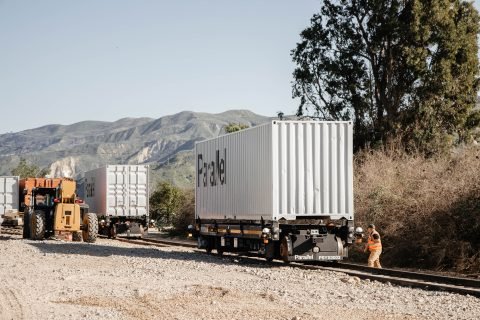
USA: Autonomous battery-electric wagon technology company Parallel Systems has raised $100m in new capital. This will support commercialisation and at-scale manufacturing of its third-generation Panther vehicle, which aims to combine the flexibility of a lorry with the cost and environmental efficiencies of rail. The company has so far raised more than $200m. Since closing its Series B round in 2025, Parallel has successfully transitioned from initial prototyping to live commercial deployment under regulatory test approval. ‘Closing our Series C round is a major inflection point for Parallel and as well as the short-haul logistics industry, and is the strongest market signal to-date that autonomous freight rail is ready for its moment’, said CEO Matt Soule, a former SpaceX engineer who co-founded the company in 2020. ‘With the FRA-approved pilot proving our platform in real-world corridors, this capital will directly fund the production scale-up of our Panther vehicles and accelerate our entry into international markets hungry for lower cost, more resilient supply chains.’ New investors include AVP which led the round, Hillspire, Agility Global and Cobalt Capital, with participation from existing investors including Anthos Capital, Congruent Ventures, Riot Capital and Collaborative Fund. From ‘if’ to ‘how soon?’ A pilot project is underway with Genesee & Wyoming in Georgia, operating under Federal Railroad Administration supervision, and Parallel says ‘a number of major railroads’ are now under contract to deploy the technology to transport commercial freight. Parallel has ‘built a proven, viable and scalable autonomous freight rail platform that has generated significant commercial interest among the major rail companies in the US and globally’, said Executive Chairman Arun Gupta on October 7. ‘We are now past the question of “if” and fully onto “how soon?”’ Parallel Systems and Abu Dhabi listed logistics investor Agility have announced a strategic collaboration to develop, commercialise, finance and deploy autonomous rail freight technology across the Europe, the Middle East and Africa. The collaboration aims to combine Parallel’s technology with Agility’s market access, logistics expertise, infrastructure development capabilities, relationships with regional stakeholders and reach across the freight and supply chain ecosystem. ‘With major rail and port projects advancing across the GCC, now is the time to build technology into the region’s infrastructure and resilience plans’, said Tarek Sultan, Agility Chairman. ‘Autonomous rail could help unlock additional port capacity and improve container flows.’ Read Railway Gazette International’s interview with Parallel Systems co-founder and CEO Matt Soule.
SWITZERLAND: Federal transport office BAV has granted planning approval for the proposed Bern – Ostermundigen tram line, which will replace the heavily used eastern branch of Bernmobil bus Route 10 to increase capacity on a corridor which currently carries more than 8.5 million passengers/year. The project had received the backing of voters in the city of Bern, Ostermundigen municipality and the canton of Bern ahead of the granting of planning approval in September. A project company, Tram Bern Ostermundigen, has been established by Bernmobil, the city of Bern and Ostermundigen to oversee implementation. The cost is estimated at SFr264m, to be shared by the federal government, canton, city of Bern, Ostermundigen and local utility companies. The 4.5 km line will connect Viktoriaplatz in Bern with Oberfeld in Ostermundigen, running partly on dedicated infrastructure and partly in mixed traffic. There will be 12 stops, all with 456 m long platforms with step-free access. Eight stops will offer interchanges with other public transport services. An interchange at Ostermundigen station will bring together tram, bus and rail services to create a transport hub where ridership is expected to increase by two-thirds by 2040. The project also includes extensive reconstruction of the streetscape, with pedestrian crossings to be provided at roundabouts and stops and almost continuous cycle lanes provided in both directions. Preparatory utility works began in 2024. The main construction programme had originally been expected to start in early 2026, but this timetable could not be maintained because of organisational and logistical issues and delays in the approval process. The construction period is expected to be four to five years once the main works get underway.
EUROPE: More than 40 representatives of rail freight organisations including train operators, wagon keepers and policymakers came together in Bern on October 7 to discuss a potential overhaul of the General Contract of Use for Wagons. The GCU is a multilateral contract which sets out the mutual rights and obligations of Wagon Keepers and Railway Undertakings with regard to the use of wagons in Europe and beyond, based on the COTIF 1999 convention and its Annex D. Since it came into force in July 2006 the GCU has grown to an network of around 840 signatories across 20 countries, with around 600 000 wagons currently declared in the GCU database. However, the European Rail Freight Association says the GCU is now overdue for reform to ‘reflect the business model and needs’ of operators and wagon keepers today. ERFA says operators, wagon keepers and entities in charge of maintenance need clearly defined roles to ensure that they understand pre-departure checks the same way. ERFA is also concerned about liability: it says operators too often have to prove that a wagon defect was not their fault, and latent defects make this worse. It also says too little data is flowing between operators, ECMs and keepers, or it is ‘lost in translation’. Wagon keepers’ association UIP has told RailFreight.com that a slightly increase in the €300 annual contribution paid by signatories could ‘improve the functioning of GCU immensely’, enabling the establishment of a dispute resolution system, improving standardisation and increasing efficiency. A larger meeting is planned for later this year to discuss what any changes to GCU could look like in practice. A version of this article was first published by Railway Gazette International’s sister title RailFreight.com.
North American cross-border trucking capacity is expected to remain constrained into 2027 despite softer freight demand. Executives at logistics provider TRAFFIX told FreightWaves driver shortages, regulatory restrictions and rising operating costs could limit the number of trucks available to haul goods between the U.S., Mexico and Canada. The challenges are being compounded by higher interest rates and tighter lending conditions that are discouraging new trucking companies from entering the market, preventing the kind of capacity expansion that followed the freight rate surge during the COVID-19 pandemic. “We’re only four or five years later and we’re not seeing that,” Alex Fuller, vice president of commercial intelligence at TRAFFIX, told FreightWaves in an interview. “And it’s like, OK, well, what’s different?” Fuller said two factors stand out: tighter regulations governing who can operate commercial trucks and the increased cost of purchasing equipment. During the pandemic, prospective owner-operators could finance trucks with relatively inexpensive loans and government stimulus funds. Today, Fuller said, financing costs can reach 8% to 9%, making it much more difficult for drivers to enter the industry or established carriers to expand their fleets. “Because of that, yeah, rates are going to stay higher for longer,” Fuller said. “And we’re not going to see the immediate drop like we saw a couple of years ago in rates.” The comments follow the release of TRAFFIX’s October North American Cross-Border Index, which measures freight market pressures along the U.S.-Mexico and U.S.-Canada corridors. The index registered 57 for Canada and 54 for Mexico, down one point each from September. Readings above 50 indicate tighter market conditions, including elevated costs, limited truck capacity and regulatory challenges. Although shipment volumes remain relatively soft, TRAFFIX said available truck capacity has shown little improvement, leaving shippers with fewer alternatives when contracted carriers are unable to cover loads. The index tracks four components — transportation costs, capacity, demand and trade policy — using more than 10 economic, freight and trade indicators. Fuller said the index relies primarily on publicly available government and trade data, which TRAFFIX compares with its internal freight activity to assess whether the findings reflect conditions experienced by its customers and carriers. As of Oct. 11, FreightWaves SONAR’s Outbound Tender Volume Index (STVI.LRD) for Laredo has climbed sharply from 39.95 in mid-September to 51.95, indicating a solid uptick in cross-border freight demand. This demand push is reflected in the SONAR Weighted Rejection Index (SWRI), which flipped from -0.74 last week to +0.65, confirming that capacity in Laredo and its adjacent areas is actively tightening. Mexico faces driver shortages, visa restrictions Patricio Gutierrez, TRAFFIX’s Manzanillo, Mexico-based carrier sales manager, said the country’s cross-border trucking industry is confronting a combination of driver shortages, U.S. immigration restrictions and structural bottlenecks at border crossings. “I think that the main issue here is a lack of qualified drivers,” Gutierrez said, pointing to Mexican drivers holding valid B-1 visas and the limited number of trucks authorized to operate in the United States. He said cross-border operations require drivers and equipment that meet specific regulatory requirements, reducing the number of carriers able to handle international shipments. Border delays and longer transit times further restrict usable capacity by keeping trucks occupied longer, even when overall shipment demand remains relatively stable. Gutierrez also highlighted Mexico’s longstanding difficulties recruiting younger truck drivers. He said many drivers are in their 50s and 60s, while younger workers are reluctant to enter the profession because of security concerns and relatively low compensation. “The shortage of drivers in Mexico is a real problem,” Gutierrez said. The capacity constraints are especially important at major commercial gateways such as Laredo, Texas, where large concentrations of cross-border freight make certain routes particularly sensitive to equipment and driver availability. A separate October freight market report from C.H. Robinson supports concerns about Mexico’s shrinking pool of qualified cross-border drivers. The company’s Edge Report said U.S. authorities have withdrawn visas from approximately 25,000 Mexican freight drivers, citing Mexican trucking association CANACAR. C.H. Robinson said continued B-1 visa withdrawals and temporary border disruptions reduced usable truck capacity during September, even as load-to-truck ratios and freight volumes remained relatively stable at major Texas crossings. The report also highlighted restrictions on southbound empty-truck crossings at Eagle Pass and Brownsville, Texas, from Sept. 9-14. During the disruptions, daily commercial crossings reportedly fell from approximately 1,000 to between 300 and 400, while nearly 700 tractors were stranded on the U.S. side of the border. Some carriers were forced to reposition equipment through Laredo, adding mileage, fuel costs and transit time. C.H. Robinson warned that qualified driver availability could tighten further as fourth-quarter shipping volumes increase. Canada carriers struggle with imbalanced freight flows On the U.S.-Canada border, TRAFFIX executives said trade tensions and changing freight patterns are creating a different set of challenges. Lance Halliday, TRAFFIX’s Toronto-based regional director of carrier sales, said trucking companies are struggling with an imbalance between freight moving from Canada into the United States and shipments returning north. He said demand for Canadian exports remains relatively strong, but weaker south-to-north freight flows make it difficult for drivers to find return loads. “There’s still a severe lack of inbound,” Halliday said. “So there’s not a lot of freight coming in from the U.S. into Canada right now.” That imbalance has made some carriers unwilling to accept shipments into certain U.S. markets without significantly higher compensation. Halliday singled out Florida as an especially challenging destination because drivers may have to wait days for a return shipment or travel hundreds of miles empty to find another load. “Florida is a no-go zone,” Halliday said. “Guys just won’t go because they’re getting stuck down there for days.” He said carriers are also increasingly reluctant to accept freight into markets where the cost of returning empty equipment could eliminate profits. The imbalance is contributing to rising transportation rates, particularly on lanes where shippers have limited carrier alternatives. Halliday said rates on some corridors have climbed 25% to 35% over roughly the past month to month and a half, although he did not identify specific lanes or provide a marketwide average. Contract freight shifts toward spot market TRAFFIX executives also described a growing shift toward transactional freight as carriers reject previously negotiated contract rates. Halliday said some carriers are returning freight commitments because rates established months earlier no longer cover their operating costs. That has forced shipments farther down shippers’ carrier-selection lists, increasing reliance on spot-market transportation. “We’re seeing a lot of that contractual freight handed back by their primary carriers,” Halliday said. He said the volume of transactional freight opportunities TRAFFIX is seeing on the Canadian side has surpassed levels experienced during the COVID-19 freight market, based on his observations of the company’s operations. Gutierrez said similar conditions are emerging in Mexico, where rising diesel costs and capacity restrictions are pushing carriers to seek higher rates. He said some Mexican shippers remain reluctant to accept higher transportation costs, creating tension between carriers trying to maintain profitability and customers accustomed to lower contract pricing. Both executives said the situation reflects broader structural challenges rather than a temporary increase in diesel prices. Halliday pointed to higher driver wages, insurance expenses and reduced access to financing as additional pressures preventing carriers from expanding. Capacity constraints could extend into 2027 Looking ahead, TRAFFIX executives said they expect cross-border truck capacity to remain tight through the end of 2026 and into next year. Halliday said he does not expect significant relief over the next three to six months, citing continuing driver shortages, trade uncertainty and seasonal capacity reductions. “I think that in the short term, it’s going to continue to tighten up,” Halliday said. “I don’t think that there’s any way that this changes over the next three to six months.” Gutierrez said Mexico faces similar longer-term challenges unless the industry finds ways to recruit drivers and improve cross-border operating efficiency. Fuller said the lack of new capacity entering the market could keep freight rates elevated even without a substantial recovery in demand. Unlike the pandemic-era trucking boom, when high rates encouraged new carriers to purchase equipment and enter the industry, today’s financing environment is discouraging that response. Why it matters: Shippers face the prospect of elevated freight rates and fewer carrier options even as shipment demand remains relatively soft, TRAFFIX executives say. More FreightWaves articles by Noi Mahoney: Texas trucking firm sued over age limits on drivers New Jersey CDL school lawsuit questions evidence behind FMCSA shutdown TA Services acquires 2 Texas cross-border carriers, adds 133 trucks The post Mexico trucker shortages, visa restrictions squeeze cross-border capacity appeared first on FreightWaves.
Tesla told a Quebec court that car fires are “generally” caused by misuse or vandalism. The judge didn’t buy it, and Tesla Canada now has to cover the C$161,700 an insurer paid out for a Model X that burned in Montreal. An expert report traced the fire to an electrical failure in the dashboard of the 2020 Model X, which was still under Tesla’s warranty. Tesla offered no data to support its theory, and the court called it out for that. more…