Breaking
Advertisement

Transportation

Category Added in a WPeMatico Campaign

Transportation

Nebraska deputies recover $250K stolen copper load 50 miles past Iowa destination

A Nebraska traffic stop uncovered more than $250,000 in stolen copper inside a semi-truck on October 7. Lancaster County’s Criminal Interdiction Unit stopped the vehicle around 2 p.m. on Interstate 80. Deputies saw the trailer leaning heavily after the load shifted toward the passenger side. The driver could not provide vehicle registration, a bill of lading or basic freight details. Authorities identified the driver as 22-year-old Raman Pal of Tracy, California. Pal could not explain what he hauled, where pickup occurred or the destination. Deputies received consent to search the truck and trailer. Inside, they found 11 pallets of copper wire weighing 43,937 pounds and two bolt cutters. Copper load had passed Iowa destination Deputies found a bill of lading during the vehicle search. It listed Imperial Metal Group in Chicago as the pickup location. Court records identify Imperial Metal Group as the owner of the stolen copper. Lakeside Auto Recyclers, a Carter Lake, Iowa, recycling company, was the listed destination. Investigators stopped Pal near Lincoln after the truck had already passed Carter Lake. Lakeside Auto Recyclers confirmed the vehicle was off route while traveling westbound. The affidavit does not explain why Pal continued beyond the listed destination. The affidavit states Get There Real Quick LLC should have delivered the shipment. FMCSA records list the Illinois carrier under USDOT 4381300 and MC 1717529. Get There Real Quick operates interstate with six power units and 10 drivers. Lakeside Auto Recyclers told deputies Nawab Xpress Inc. should not possess the load. Pal’s truck displayed Nawab Xpress and USDOT 4172559. FMCSA records list the California company as an interstate carrier. Nawab Xpress operates with one power unit and one driver. The affidavit does not explain how Nawab Xpress obtained the shipment. Investigators contacted Imperial Metal Group President Zach Spellman during the stop. Spellman confirmed the copper belonged to his company. He told deputies the shipment was stolen because the correct carrier did not possess it. The trailer also lacked the load lock and seal Imperial required. Spellman told investigators this was Imperial Metal Group’s fourth stolen metal load this year. He said all four disappeared “in the same fashion.” The combined value exceeded $1 million, according to the sheriff’s briefing. Records do not establish whether the same people handled those losses. Investigation could extend nationwide Court records show prosecutors charged Pal with criminal impersonation and theft by unlawful taking over $5,000. The complaint identifies the stolen property as belonging to The Imperial Group LLC. Deputies also found two identification cards carrying different names inside the cab. One matched Pal’s actual California identification, according to the affidavit. The affidavit does not identify a freight broker or explain how Pal obtained the shipment in Chicago. It also does not describe a fictitious pickup or name any federal agency involved. Deputies placed the truck and trailer on a criminal hold after Pal’s arrest. Investigators continue working to determine how the load changed hands. FreightWaves contacted the Lancaster County Sheriff’s Office, Imperial Group and Lakeside Auto Recyclers for additional information. None had responded before publication. Investigators have not established whether the same people were involved in Imperial Metal Group’s four thefts. “There’s a lot more people involved in this than just the 22-year-old,” the sheriff’s office told reporters. Why it matters The case shows how a high-value load can leave the proper carrier’s control and keep moving without immediate detection. That gap can turn a single pickup failure into a six-figure cargo loss before anyone realizes the shipment is off course. CFCO In my opinion, Certified Fraud Compliance Officer training can help teams catch carrier, driver and document mismatches before releasing a load. A repeatable verification process creates another checkpoint before high-value freight leaves the shipper’s control. Click here for more articles on cargo theft and freight fraud by Phil Brink. Freight Fraud Awareness Day returns as strategic cargo theft reshapes trucking – FreightWaves Man gets 2 years for $3.5M Amazon fraud using 23 trucking accounts – FreightWaves LAPD uncovers $1M in stolen BNSF and Union Pacific rail cargo at Los Angeles–area shoe retailer – FreightWaves The post Nebraska deputies recover $250K stolen copper load 50 miles past Iowa destination appeared first on FreightWaves.


Transportation

LTL rates hit new high in Q3, moving higher in Q4

Less-than-truckload rates hit a new high in the third quarter and are expected to finish the year even higher, according to a report from AFS Logistics and financial services firm TD Cowen. The LTL rate-per-pound component of the TD Cowen-AFS Freight Index finished the third quarter 78.8% above its January 2018 baseline. That was 11.9 percentage points higher year over year and 1.1 points above the second quarter. The dataset is expected to end the fourth quarter 82.5% above the 2018 benchmark, which would be 14.7 points higher y/y. High diesel fuel prices and extant “carrier pricing power” are driving the increases. The 80%-plus rate jump over an eight-year period also highlights the severity of cost inflation across carrier P&Ls (wages, health insurance, liability insurance, maintenance, etc.). The dataset’s fuel surcharges were 79% higher y/y in September. Actual retail diesel prices were up y/y by 31% in July, 46% in August and 68% in September. (Less-than-truckload fuel surcharge mechanisms include a step function as diesel prices rise, resulting in margin accretion.) Large public carriers have been able to capture mid-single-digit contractual rate increases through the downturn. Many are also pulling forward general rate increases given favorable sector fundamentals. Rate hikes on noncontractual LTL business used to occur annually. The cadence had been shortened to 11 months in recent years. Saia (NASDAQ: SAIA) installed a 7.1% GRI on July 6, which was 120 basis points higher and three months earlier than its 2025 increase. The report showed LTL cost per shipment declined 2.8% sequentially (5.3% higher y/y) in the third quarter, as weight per shipment fell 3.4% (down 2.3% y/y), implying rate per pound was 0.6% higher (7.6% higher y/y). Linehaul rates were 1.2% higher sequentially in the quarter even though length of haul declined 2.2%. Public carrier data has diverged from the index somewhat in recent months. Tonnage among publicly traded LTL companies inflected positively y/y in March, with growth rates continuing to accelerate since. Mid-quarter updates from the group also showed y/y increases in weight per shipment during July and August, with XPO (NYSE: XPO) being the lone outlier. XPO’s freight mix now includes more shipments from SMBs, which tend to be smaller but carry better margins. The group has indicated that the improved shipment weights result from freight previously lost to the truckload market returning to LTL networks as TL rates rise. Also, manufacturing activity has remained in growth territory in every month this year. The Institute for Supply Management’s Manufacturing PMI registered a 54.5 reading in September, with the new orders dataset logging a 55.3 reading. (A reading above 50 signals expansion, while one below 50 indicates contraction.) Supply-side correction fueling TL rate surge The TL rate-per-mile component of the index was 19.7% above the January 2018 baseline in the third quarter, 13.7 points higher y/y and 3.3 points above the second quarter, “as continued regulatory action, carrier exits and fuel shocks squeeze available capacity.” The index is expected to increase to 23.4% above the benchmark during the fourth quarter, which would be 15.8 points higher y/y and the highest level registered since the 2022 first quarter. The third-quarter earnings season begins Thursday when J.B. Hunt Transport Services (NASDAQ: JBHT) reports results after the market closes. AFS Logistics is a non-asset-based 3PL providing audit and cost management services, managed transportation, and freight brokerage. It manages over $11 billion in transportation spend. Why it matters? The TD Cowen-AFS Freight Index provides a rare look at past and future LTL rates. The dataset confirms key industry trends, including LTL rates hitting new highs in the third quarter and expected increases in the fourth quarter, driven by high fuel prices and carrier pricing power. More FreightWaves articles by Todd Maiden: Cass: TL linehaul rates up 10% in September, shipment counts remain positive Yellow Corp., Teamsters settle on WARN Act claims LTL survey: Old Dominion, Daylight Transport take home top honors again The post LTL rates hit new high in Q3, moving higher in Q4 appeared first on FreightWaves.

Transportation

Parcel shipping costs approach record high as extra charges stack up

Sharp increases in rates and extra fees have continued into the fourth quarter, putting 2026 on track to be the most expensive year on record for parcel shipping as carriers strive to maximize revenue, according to the latest market snapshot from investment bank TD Cowen and AFS Logistics. Analysts say the onslaught of surcharges is spurring businesses to diversify their vendor pool and helping alternative carriers gain market share from the large legacy carriers. Why It Matters: Fuel surcharges are a major cost driver this year for businesses that purchase parcel transportation. Diesel fuel prices have soared since the start of the Iran war in February, which slowed crude oil and refined fuel traffic through the Strait of Hormuz, but repetitive carrier changes to the formula that sets fuel surcharges have more to do with elevated rates than the actual rise in fuel prices, the companies said in the benchmark report. Carriers have frequently reindexed surcharge tables since 2021 to not only capture additional revenue as fuel prices rise, but keep fuel surcharges high even as actual fuel prices fall, according to the TD Cowen/AFS Freight Index released on Tuesday. The fuel surcharge has increased from 7.75% of the transportation rate in the first quarter of 2021, when the average diesel fuel price was $2.91 per gallon, to 30% in September, when diesel peaked at $6.53 per gallon. Nearly three quarters of the increase is the result of carrier adjustments to fuel surcharge tables, not the price at the pump, the report said. Even if fuel prices returned to the 2021 level, the current fuel surcharge would be 23.75% — about three times higher than five years ago. The TD Cowen/AFS Freight Index has pointed all year to tinkering with the fuel-surcharge mechanism as a major cause of shipping inflation. “While diesel and jet fuel are major costs for ground and express parcel, the fuel surcharge has become a revenue lever for carriers in addition to a pass-through mechanism for covering the cost of doing business,” said Mingshu Bates, chief analytics officer and president of parcel at AFS Logistics, in a news release promoting the report. “Even if crude oil normalizes and fuel prices recede, the effective fuel surcharge will not show a material decrease.” AFS Logistics uses transactional data to help companies manage their parcel, less-than-truckload and truckload freight costs. New FedEx surcharges Fuel isn’t the only area where large carriers make pricing changes that often go unnoticed by customers. Carriers have replaced predictable annual hikes with continuous, targeted pricing to protect margins even as overall demand growth slows, and are able to do so with limited pushback because most shippers still plan annually, industry practitioners say. From the start of 2025 through mid-summer, FedEx implemented or announced more than 50 pricing changes, including general rate increases, delivery area surcharges, customs fees and demand surcharges, parcel spend management firm LJM previously reported. For the fourth consecutive year, FedEx (NYSE: FDX) last month announced a 5.9% average general rate increase, effective Jan. 4. Embedded in the new pricing policy is a change that reclassifies 2,533 ZIP codes from extended delivery area surcharge to remote DAS — the most expensive tier. The change was much more extensive than an earlier one in which 102 ZIP codes were added to the standard delivery area surcharge tier, 74 moved from standard to extended area and 63 moved from extended to remote area. For packages destined for ZIP codes reclassified from extended to remote, the DAS fee will jump to $17.75 — roughly doubling the fee for residential deliveries and more than tripling it for commercial destinations, the TD Cowen/AFS report said. Shippers with high residential volume, rural deliveries, lightweight packages, or heavy accessorial exposure, the effective increase can expect materially higher shipping increases than 5.9%, warned Charles Moore, vice president of parcel solutions at Transportation Insight, on LinkedIn. Ground pricing has flattened across zones, with increases almost uniform across all regions instead of just for long-haul routes. Lightweight e-commerce shipments take the biggest hit, with packages in the one-to-five pound range getting increases of nearly 6.5%, making small parcel shipping more expensive for many retailers. The FedEx Ground minimum charge is set to increase to $12.70, representing a compounded increase of more than 12% over the last two years. Additional handling fees are increasing between 7% and 7.6%, he pointed out. And FedEx is introducing a $25 Paper Document Fee and a $5 Paper Air Waybill Fee to reinforce the carrier’s push toward fully electronic shipping and trade documentation. DHL eCommerce recently posted its peak season surcharges UPS (NYSE: UPS) has similarly hiked a broad spectrum of surcharges, including new cubic-volume rules, in recent years. Amazon, the U.S. Postal Service and more independent carriers are beginning to follow suit. So far, DHL eCommerce, Amazon Shipping and OnTrac, besides FedEx, UPS and the USPS, have announced peak season surcharges. DHL eCommerce’s surcharge has three pricing windows, starting in late October. The highest charges are between Nov. 22 and Dec. 26, when package volume is at its most. Fees also change by distance. Consultancy LJM recommends DHL customers model peak costs by shipping week, product, weight and zone. A single average per-package surcharge will no longer provide an accurate forecast, it said on its website. “Introduced with unprecedented frequency and often with little warning, [accessorial] charges are now a preferred lever for increasing revenue-per-package. . . . A fundamental change is to blame. Carriers that for years pushed to gain market share now only want the shipments which are most profitable in their networks” and are implementing pricing strategies accordingly, wrote Josh Dunham, co-founder and CEO of shipping intelligence platform Reveel, in an online column. He recommended shippers expand their rotation of parcel carriers. Q3 parcel rates With peak shipping season and demand surcharges around the corner, the index for ground parcel rate per package in the fourth quarter is projected to reach a record of 43.3% above the January 2018 baseline — up 5.8% year over year and up 3.2% from the previous quarter, TD Cowen and AFS Logistics said. Similarly, the express parcel index is estimated to set a record for the fifth consecutive quarter, reaching 20.3% this quarter, a 13.8% increase year over year. Third-quarter express parcel cost per package increased 1.1% from the prior quarter on higher billed weight, more premium service mix and increased accessorial fees. The average billed weight continued to increase, reflecting an ongoing decline in the share of lightweight shipments and carrier rating rule changes that raise billable weight. The report’s authors said FedEx and UPS have more room to offer deeper customer discounts this year as their network streamlining and efficiency programs lower operating costs and boost margins. FedEx is moving further than UPS, with discounting skewed strongly toward large customers, while UPS increases were concentrated in the small and medium segments. UPS has repeatedly stated that one of its strategic target markets is small-and-medium businesses, which often don’t have the wherewithal to manage all their logistics needs internally and can benefit from a carrier with value-added services. Meanwhile, ground parcel cost per package declined 2% quarter over quarter as lower fuel surcharges, reduced accessorials and deeper discounting offset continued rate pressure, according to TD Cowen/AFS Logistics. The average effective fuel surcharge paid by shippers fell 4.7%, as diesel moderated through the first two months of the quarter before reaching a record-high in September. With discounts, FedEx and UPS both favored large shippers over small and medium ones. With diesel prices reaching a historic-high late last month, the Freight Index predicted carriers are likely to make further fuel-related adjustments to capture the revenue windfall. Click here for more FreightWaves/American Shipper stories by Eric Kulisch. Write to Eric Kulisch at ekulisch@freightwaves.com. RELATED STORIES: Fuel surcharges push parcel shipping rates near record high Fuel surcharges trigger spike in parcel shipping costs FedEx, UPS peak season surcharges could drive shippers to competitors The post Parcel shipping costs approach record high as extra charges stack up appeared first on FreightWaves.

Advertisement
Transportation

ADB backs DC to AC conversion at Azerbaijan Railways

AZERBAIJAN: The Asian Development Bank is providing national railway ADY with a US$350m loan to support the conversion of the 192 km line from Bilajari in Baku to Yalama on the Russia border from 3 kV DC to 25 kV 50 Hz electrification and install modern signalling and telecoms. Aims include reducing energy consumption, CO2 emissions and maintenance costs, enabling faster and more efficient operation of the line as a key link in the Central Asia Regional Economic Co-operation network and boosting trade through Baku. A separate component of the loan package announced on October 6 is aimed at improving employment opportunities for women in technical, supervisory and management roles at ADY. ‘Modernising the railway infrastructure in Azerbaijan will help make the country’s rail transport network more competitive, energy-efficient, and environmentally sustainable’, said ADB country director for Azerbaijan Sunniya Durrani-Jamal. ‘The project will enable safer rail operations, reduce transportation costs and strengthen regional connectivity.’ ADB has previously supported ADY through its 2016 Sector Development Programme which financed the modernisation of a 166 km section of the Sumgayit – Yalama line, and has supported reform of corporate governance, financial management and operational efficiency.

Transportation

Pilot, Tesla open first Megacharger site, 12 more underway

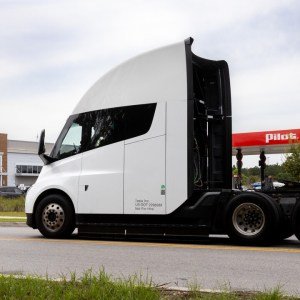
Pilot Travel Centers and Tesla have opened their first Megacharger site for heavy-duty electric trucks, Pilot said Oct. 8. The site, at a Pilot travel center in Ellabell, Ga., has six charging stalls. Twelve more heavy-duty sites are under construction, and three are nearly finished: a Flying J in Tulare, California, which opened Oct. 9; a Flying J in Fort Stockton, Texas; and a Pilot in North Las Vegas, Nevada. Each site will have four to eight stalls running Tesla’s V4 cabinet technology. According to Tesla, each stall can deliver up to 1.2 megawatts, enough for a Tesla Semi to recover 60% of its charge in 30 minutes. Pilot, a Berkshire Hathaway subsidiary based in Knoxville, Tennessee, operates more than 900 locations in 43 states and five Canadian provinces. The Megacharger network is planned for select locations along I-5, I-10, and other major freight corridors in California, Georgia, Indiana, Nevada, and Texas. “Pilot is proud to bring heavy-duty charging directly to key trucking routes and pair it with the services and amenities drivers rely on,” said Shannon Sturgil, senior vice president of alternative fuels at Pilot. Ellabell’s opening came later than Pilot projected. When the companies announced the partnership in January, Pilot said construction would begin in the first half of 2026 and the first sites would open in the summer. The January announcement also named New Mexico among the initial states. The October release drops it and lists Indiana. The chargers are arriving as Tesla moves the Semi into high-volume production, which began at its Sparks, Nevada, factory on Sept. 24. Tesla has said it expects more than 30 charging stations and over 200 megawatt-capable charging posts to be operating by year-end, including the Pilot sites, and that the factory is designed to build 50,000 trucks a year, FreightWaves previously reported. Pilot said the heavy-duty sites build on its passenger EV charging network and its renewable diesel and biodiesel offerings. “With these initial locations, we’re making fleet electrification a more accessible option for long-haul transportation,” Sturgil said. The post Pilot, Tesla open first Megacharger site, 12 more underway appeared first on FreightWaves.

Transportation

The Tesla Roadster could have stayed vaporware

For a car that's supposed to be one of the fastest ever made, the new Tesla Roadster certainly took its sweet-ass time getting here. It's been nearly a decade since Elon Musk made the surprise announcement about plans to build a next-gen Roadster. Now, the Tesla Roadster is finally making its production-ready debut at an event in Waco, Texas, Thursday - and the timing couldn't be worse. The new Roadster is set to arrive in an EV market beset by high energy prices, political turmoil, and consumer uncertainty. The tax-credit-fueled exuberance of the post-covid years has since given way to slower sales and fewer options. Automakers are scalin … Read the full story at The Verge.

Advertisement
Transportation

New chief for DP World Americas

DP World has appointed Morten Johansen as chief executive officer of its Americas region, placing a longtime ports and logistics executive in charge of the company’s operations across North America, South America, and the Caribbean. Johansen made the announcement in a LinkedIn post Oct. 13. He succeeds Brian Enright, who served in the dual positions since Oct. 22. Johansen has more than 25 years of experience in integrated port and logistics businesses. He joined Dubai-based DP World in 2011 and previously served as CEO of DP World Dominicana. He later became chief operating officer of DP World Americas, with responsibility for ports and terminals, logistics services, economic zones, and maritime operations throughout the Western Hemisphere. In that role, he has emphasized integrating physical infrastructure with ports, inland transport, customs processes, economic zones, and digital platforms. The appointment comes as DP World continues to expand its Americas footprint. The company entered exclusive negotiations with the Port of Corpus Christi in June 2026 to design, build, and operate a container terminal under a long-term lease. If completed, it would be DP World’s first container-terminal development on the U.S. Gulf Coast and its first U.S. container-terminal development in roughly two decades. The proposed facility could ultimately handle about 1 million TEUs annually. No construction start date, final capital commitment, or definitive lease terms have been announced. Other Americas initiatives include a $760 million port and free-trade-zone development in the Dominican Republic, which the company says is intended to increase cargo capacity and support nearshoring-related investment. Prior to DP World, Johansen’s background includes senior roles at APM Terminals, Maersk, and Sociedade Gestora de Terminais. A native of Denmark, he has been based in Charlotte, N.C., in his Americas leadership role. Read more articles by Stuart Chirls here. Read more: Philadelphia ports sets $837 million expansion, first new berth in 50 years Despite new record, Port of LA chief warns of tariff-driven planning risk Shippers waiting an extra week for US-bound containers 1 million boxes set new Los Angeles port record Retailers say extended peak shipping season winding down The post New chief for DP World Americas appeared first on FreightWaves.

Transportation

Philadelphia ports sets $837 million expansion, first new berth in 50 years

Pennsylvania will spend more than $371 million at the of Philadelphia, a commitment that officials say will unlock $466 million in federal grants and private investment as part of a $837 million expansion described as the largest in the hub’s history. The plan is expected to increase container capacity by 122% and automobile capacity by 18%, add more than 6,000 jobs, and generate $45 million in annual state and local tax revenue. PhilaPort will use the state funding, together with two U.S. Department of Transportation grants, to build a new 2,000-foot berth at Southport Marine Terminal—the port’s first new berth in more than 50 years. “PhilaPort has a long and storied history that spans back over 300 years to the very founding of our Commonwealth,” said Gov. Josh Shapiro, at a press conference Tuesday. “It was here where goods produced in Philadelphia embarked for destinations around the globe, and today, the port remains a major player in global trade and a critical piece of our economy. This is a game changer for PhilaPort and it builds on our work to grow the economy and create real opportunity for Pennsylvanians.” window.googletag = window.googletag || {cmd: []}; googletag.cmd.push(function() { var gptSlot = googletag.defineSlot('/21776187881/FW-Responsive-Main_Content-Slot1', [[300, 100], [320, 50], [728, 90], [468, 60]], 'div-gpt-ad-1709668545404-0').defineSizeMapping(gptSizeMaps.banner1).addService(googletag.pubads()); googletag.pubads().enableSingleRequest(); googletag.pubads().collapseEmptyDivs(); googletag.enableServices(); setInterval(function() { if (!document.hidden) { googletag.pubads().refresh([gptSlot]); } }, 60000); }); googletag.cmd.push(function() { googletag.display('div-gpt-ad-1709668545404-0'); }); As a specialized mid-Atlantic gateway, Philadelphia handled a record 889,268 TEUs in 2025, compared with 8.9 million TEUs at New York-New Jersey and 5.7 million TEUs at Savannah. PhilaPort currently supports more than 8,000 jobs and contributed nearly $1.2 billion in economic output across Pennsylvania in 2025, according state data. The expansion is projected to lift port-related employment to about 14,000. The program also includes dredging at Southport, land acquisition, infrastructure improvements, and new cranes and cargo-handling equipment. Project components include $31 million for Southport dredging, $145 million for reclamation work at Southport Berth II and the North Wharf, and $58.1 million for cranes and other equipment. Private commitments include $100 million each from terminal operator Holt Logistics and vehicle-processing company Glovis America. The expansion would transform the 152-acre Mustin Yard parcel adjacent to Southport for container and automobile cargo, while the new berth would add vessel capacity at Southport. Officials told local media that auto capacity gains would amount to more than 100,000 additional vehicles annually. Construction is expected to begin once permitting and contracting are complete, with port officials projecting a ground-breaking in early 2027. The announcement positions Philadelphia to compete for additional container and automobile business as East Coast ports seek to expand capacity. State officials said the investment is intended to strengthen PhilaPort’s role as a global trade hub and support future cargo growth. window.googletag = window.googletag || {cmd: []}; googletag.cmd.push(function() { var gptSlot = googletag.defineSlot('/21776187881/fw-responsive-main_content-slot3', [[728, 90], [468, 60], [320, 50], [300, 100]], 'div-gpt-ad-1665767553440-0').defineSizeMapping(gptSizeMaps.banner1).addService(googletag.pubads()); googletag.pubads().enableSingleRequest(); googletag.pubads().collapseEmptyDivs(); googletag.enableServices(); setInterval(function() { if (!document.hidden) { googletag.pubads().refresh([gptSlot]); } }, 60000); }); googletag.cmd.push(function() { googletag.display('div-gpt-ad-1665767553440-0'); }); Read more articles by Stuart Chirls here. Read more: Despite new record, Port of LA chief warns of tariff-driven planning risk window.googletag = window.googletag || {cmd: []}; googletag.cmd.push(function() { var gptSlot = googletag.defineSlot('/21776187881/fw-responsive-main_content-slot4', [[300, 100], [320, 50], [728, 90], [468, 60]], 'div-gpt-ad-1709668086344-0').defineSizeMapping(gptSizeMaps.banner1).addService(googletag.pubads()); googletag.pubads().enableSingleRequest(); googletag.pubads().collapseEmptyDivs(); googletag.enableServices(); setInterval(function() { if (!document.hidden) { googletag.pubads().refresh([gptSlot]); } }, 60000); }); googletag.cmd.push(function() { googletag.display('div-gpt-ad-1709668086344-0'); }); Shippers waiting an extra week for US-bound containers 1 million boxes set new Los Angeles port record Retailers say extended peak shipping season winding down US West Coast container rates edge lower The post Philadelphia ports sets $837 million expansion, first new berth in 50 years appeared first on FreightWaves.

Transportation

København metro operating contract signed

DENMARK: København metro authority Metroselskabet and KBH Metro Partner have formally signed the next contract for the operation and maintenance of lines M1 to M4. Metroselskabet said its ambition is to make the transition seamless so that passengers ‘continue to experience the metro as the familiar, reliable and efficient means of transport they depend on every day’. KBH Metro Partner is a joint venture of the Paris transport operator’s RATP Dev business and Singapore’s ComfortDelGro. The new contract valued at DKr17bn runs for 12 years from the expiry of the current agreement with Metro Service on September 28 2027, with an option to extend it by a further three years. Mobilisation A mobilisation and transition process will now take place in collaboration with Metro Service, which is owned by Milano municipal transport company ATM. Metroselskabet said Metro Service employees have developed a unique understanding of the technical systems and passengers’ needs, and retaining them and their expertise under the Danish Transfer of Undertakings Act will be essential to a successful transition and future development. The metro ‘is known for its high reliability and efficiency, and that comes with a responsibility’, said Søren Boysen, Director of Operations & Maintenance at Metroselskabet, on October 13. ‘The new contract gives us a strong foundation for further enhancing this high standard.’ KBH Metro Partner The selection of KBH Metro Partner followed a competitive tender process which attracted seven applications to prequalify, of which three were selected for detailed negotiations. KBH Metro Partner was selected on an overall assessment of price and quality. The joint venture partners have experience operating and maintaining metro systems in Singapore, Paris, Riyadh, Lyon and Doha. They also have experience of carrying out technical upgrades while maintaining day-to-day operations; citing the example of RATP’s modernisation of Paris Line 14, Metroselskabet said this will be important as it undertakes a comprehensive modernisation of lines M1 and M2 by 2035, including replacing the rolling stock and upgrading the signalling. Managing Director & Group CEO Cheng Siak Kian said ComfortDelGro ‘brings deep experience in delivering safe, reliable and customer-focused rail services’, and ‘together with RATP Dev, we look forward to combining our expertise in automated metro systems as well as network modernisation and renewal to support the continued success of the København metro’. RATP Dev CEO Hiba Farès said the immediate priority will be ‘to ensure a seamless transition while maintaining the high standards that passengers rely on every day’. Looking ahead, ‘we will draw on RATP Dev’s extensive experience in modernising complex metro systems, including major transformation programmes delivered while maintaining passenger services’.

Advertisement
Transportation

Urban rail industry news round-up

This week’s round-up of news from the global urban rail transport sector. DT – Výhybkárna a Strojírna has dispatched the final turnout assemblies for the third and final phase of the reconstruction of the Nürnberg U-Bahn’s Langwasser depot. The Czech company has supplied operator VAG and contractor Rhomberg Sersa Bahntechnik with 38 turnout assemblies worth €3.5m in 2024-26. All the turnouts are laid on recycled-plastic sleepers reinforced with steel bars, combining stiffness with low thermal expansion. ‘With this final shipment, we are completing a project that was exceptional not only in its scale and technical requirements, but also in the quality of the co-operation’, said CEO Marek Smolka. On October 7 Egypt’s National Authority for Tunnels and Hyundai Rotem signed a memorandum of understanding to explore the possible use of 44 hydrogen-powered trams in the new capital city. Systra is to prepare a detailed project report to support plans to increase multimodal integration with buses, taxis, suburban rail and other modes within a 500 m radius of the 41 stations on the Chennai Metro’s Blue and Green lines. Plans include more accessible pavements, shaded walkways, pedestrian bridges, easier access to stations, reorganisation of parking areas and drop-off zones, and the relocation of bus stops closer to station entrances. On September 29 Comunidad de Madrid announced that Line 3 of the tramway network, Metro Ligero Oeste, would be extended by two stops from Puerta de Boadilla to the fast-growing residential suburb of Valenoso in Boadilla del Monte at an estimated cost of €25m. A surveying team working on the Dubai Metro Blue Line project has used a Topcon CR-P1 laser scanner and Collage Site software to capture high-accuracy data of existing metro stations and infrastructure. This has provided positional accuracy under 5 mm and delivered detailed point clouds to support the design and construction of the 30 km Blue Line, which is being built by the Mapa Limak CRRC consortium of Turkish and Chinese companies for opening in September 2029.