#fwtv_QMA94oozxhk .fwtv-panel{border:1px solid #d0d0d0;padding:18px;border-radius:6px;line-height:1.6}#fwtv_QMA94oozxhk .fwtv-panel p{margin:0 0 12px}#fwtv_QMA94oozxhk .fwtv-note{font-style:italic;color:#666;margin-top:16px;padding-top:12px;border-top:1px solid #e0e0e0}The SONAR Truckload Rejection Index is skyrocketing, hitting an unexpected 14% in October – a significant development outside normal seasonal patterns. This isn’t driven by a demand spike, but rather by persistent market imbalance and insufficient supply across the country. Key regions like Los Angeles, Harrisburg, and Atlanta are showing unusual disruptive activity, with spot rates rising in critical areas. Discover where the tightening is happening and what it means for capacity heading into peak season.The SONAR Tender Rejection Index climbed to 14.17% this week — an unusual mid-October spike that Zach Strickland, who presented the data in a SONAR Market Update, called a significant and unexpected development. What makes the move notable is what is not behind it: the SONAR Tender Volume Index shows no demand-side surge, meaning the tightening is being driven entirely by a supply shortfall. “The only explanation is that we still have continued market imbalance,” Strickland said. “Supply is still not sufficient to cover demand in terms of truckload capacity.” Strickland noted that mid-October is typically a brief breathing period before the holiday rush, making the breadth of the current disruption all the more striking. The SONAR Weighted Rejection Index is flashing elevated readings across a wide swath of the country simultaneously — including Knoxville, Harrisburg, Memphis, Atlanta, Green Bay, Des Moines, Los Angeles, Ontario (Calif.), and El Paso. Distribution-center-heavy markets such as Columbus, Harrisburg, and Atlanta are particularly notable because those hubs usually absorb inbound capacity from westbound lanes, not repel it. “To see this as broad and stretched across the country is something that is worth noting,” Strickland said. “The weighted rejection index jumping up in all these places all at once is weird because a lot of that freight ends in those markets.” Los Angeles and Ontario are receiving special attention. Record import volumes moved through the Port of Los Angeles in September, Strickland noted, and he described the maritime peak this year as a “prolonged plateau” rather than a traditional spike. Lean retailer inventories — the product of just-in-time ordering strategies — are now triggering a broad replenishment push that is stretching truckload capacity from the West Coast eastward. Los Angeles van rejection rates are up 1.87 percentage points week over week, with spot rates running well above contract and 38% of the market’s top 50 lanes showing spot-market tightening signals. Spot rates have not yet responded to the rejection surge, but Strickland said he expects the National Truckload Index, the Regional Truckload Index, and possibly the Flatbed Truckload Index to move higher within the coming week. Tender lead times are running 3.5 to 4 days, while spot freight is being booked a day or less out — a lag that explains why the rate indexes have not yet caught up to the tightening signals. On the loosening side, Houston is showing the strongest softening signals in the van market, partially offsetting the national picture. In the refrigerated segment, Milwaukee is posting the tightest conditions among major reefer markets, while Stockton, Calif., is showing the softest signal. Strickland cautioned that despite lower overall demand, the market remains volatile heading into the holiday season. “This market is still very unstable and you really can’t fall asleep on it just yet,” he said.SONAR Tender Rejection Index hit 14.17% in mid-October with no demand-side spike, signaling a pure capacity shortfallLos Angeles van rejections rose 1.87 percentage points week over week, with spot rates well above contract on 38% of top 50 lanesSpot rate indexes (NTI, RTI, FTI) have not yet reacted but are expected to move higher within the coming week as the tightening works through the marketThis Summary is generated thanks to a transcription of the interview, for the full interview please enjoy the video above. The post Freight Market Alert: Why October’s Tender Rejections Hit 14% Unexpectedly appeared first on FreightWaves.
Orange is the new green at the University of Tennessee, which deployed a new McNeilus Volterra ZFL electric garbage truck at its Knoxville campus this week, bringing together advanced, battery-electric waste collection technology and Made-in-Tennessee manufacturing. more…
Our midweek Green Deals edition is being led by Lectric’s newest 46-pound Xpress Lite e-bike that just launched at $1,099, which coincides with the bundle for $336 in FREE gear on the XPress2 Cruiser/Commuter e-bikes at $1,299 continuing over from the Better-Than-Prime sale. Right behind that we have two options for EcoFlow’s 572Wh RIVER 3 Max Expanded Power Station at a new $303 low or getting a FREE $40 tool pegboard at Amazon for $319. From there, we have two cordless electric snow blower deals on EGO’s 21-inch model with 2x 6.0Ah batteries at an $899 annual low, or the 80V Greenworks 20-inch model at a new $450 low. There’s also Worx’s newest 40V 3-in-1 Trivac Cordless Leaf Blower/Vacuum/Mulcher with either 2x or 4x battery bundles starting from $260, as well as more deals to get you through fall and winter below. You’ll also find the hangover deals from the last two days at the bottom of the page, like the yesterday’s EcoFlow TITAN series whole-home backup system early-bird deposit deals or the brand’s latest flash sale lineup ending tonight, and more. Head below for other New Green Deals we’ve found today and, of course, Electrek’s best EV buying and leasing deals. Also, check out the new Electrek Tesla Shop for the best deals on Tesla accessories. more…
Repeated Houthi missile and drone attacks on Saudi Arabia’s airports and energy infrastructure have sharply escalated the Saudi-Houthi conflict, raising the prospect of renewed disruption to Red Sea shipping as the 2027 contract-tendering season gets underway. Saudi Arabia has vowed a “serious response” after strikes on Riyadh’s King Khalid International Airport killed at least 14 people and injured more than 300. The airport remains closed until at least October 17, airlines have canceled flights, and the Houthis have threatened further attacks on Saudi airports, and military targets. The Yemen-based militia overnight hit the headquarters of Aramco, the Saudi oil producer, with missiles. The attacks follow Houthi attempts beginning in July to close the Bab el-Mandeb Strait to Saudi-linked traffic, including vessel attacks into August after nearly nine months of relative quiet. The ‘other’ Mideast strait guards the Red Sea’s southern entrance to the Gulf of Aden. The latest escalation increases the likelihood that Red Sea transits could again become more dangerous, although no broad closure of the waterway has been confirmed. window.googletag = window.googletag || {cmd: []}; googletag.cmd.push(function() { var gptSlot = googletag.defineSlot('/21776187881/FW-Responsive-Main_Content-Slot1', [[300, 100], [320, 50], [728, 90], [468, 60]], 'div-gpt-ad-1709668545404-0').defineSizeMapping(gptSizeMaps.banner1).addService(googletag.pubads()); googletag.pubads().enableSingleRequest(); googletag.pubads().collapseEmptyDivs(); googletag.enableServices(); setInterval(function() { if (!document.hidden) { googletag.pubads().refresh([gptSlot]); } }, 60000); }); googletag.cmd.push(function() { googletag.display('div-gpt-ad-1709668545404-0'); }); For container lines, the immediate effect is uncertainty rather than a confirmed capacity shock, said analyst and SONAR data contributor Freightos (NASDAQ: CRGO). Carriers had gradually increased Asia-Europe transits through the Red Sea since June, helping expand effective vessel supply; a renewed wave of attacks could reverse that trend and support rates. Asia-Europe Rates Still Elevated Spot rates on Asia-Europe lanes have fallen steadily since July, driven primarily by the post-peak demand slowdown and by carriers’ gradual return to Red Sea routings. Yet prices remain well above year-ago levels: both major Asia-Europe trades were above $3,000 per FEU last week, roughly 70% higher than in October 2025. Some carriers have already announced October general rate increases. Asia-Mediterranean spot prices rose 7% to $3,800 per FEU last week, a move that could help establish a higher benchmark ahead of annual contract negotiations. The market’s underlying support is fragile. Lingering congestion in Northern Europe and the Far East has absorbed capacity, while a threatened German port strike that could have worsened European delays was recently averted. Contract negotiations face uncertainty Shippers and carriers are entering tendering season for 2027 annual contracts with conflicting signals. Carriers enter talks with rates still historically elevated, but there are reasons shippers may resist locking in current levels. window.googletag = window.googletag || {cmd: []}; googletag.cmd.push(function() { var gptSlot = googletag.defineSlot('/21776187881/fw-responsive-main_content-slot3', [[728, 90], [468, 60], [320, 50], [300, 100]], 'div-gpt-ad-1665767553440-0').defineSizeMapping(gptSizeMaps.banner1).addService(googletag.pubads()); googletag.pubads().enableSingleRequest(); googletag.pubads().collapseEmptyDivs(); googletag.enableServices(); setInterval(function() { if (!document.hidden) { googletag.pubads().refresh([gptSlot]); } }, 60000); }); googletag.cmd.push(function() { googletag.display('div-gpt-ad-1665767553440-0'); }); Newbuild deliveries expected next year would expand fleet capacity, while continued growth in Red Sea transits would further increase effective capacity by shortening Asia-Europe voyages. Those factors have led some shippers to expect rates to ease in 2027 and to hesitate over long-term commitments at present levels. Trans-Pacific peak may be ending The trans-Pacific trade has held near peak-season levels since July, supported by sustained demand and Asia congestion. But the first signs of easing are emerging: Far East-U.S West Coast rates dipped 2% to $8,150 per FEU, potentially signaling the start of a post-Golden Week decline. The National Retail Federation’s latest U.S. import forecast points to a sharp seasonal slowdown, projecting November ocean arrivals to fall 11% month over month. Even so, full-year 2026 imports are projected to be just 1.4% above 2025 and 1.2% above 2024, approaching the record volume set in 2021. Outlook window.googletag = window.googletag || {cmd: []}; googletag.cmd.push(function() { var gptSlot = googletag.defineSlot('/21776187881/fw-responsive-main_content-slot4', [[300, 100], [320, 50], [728, 90], [468, 60]], 'div-gpt-ad-1709668086344-0').defineSizeMapping(gptSizeMaps.banner1).addService(googletag.pubads()); googletag.pubads().enableSingleRequest(); googletag.pubads().collapseEmptyDivs(); googletag.enableServices(); setInterval(function() { if (!document.hidden) { googletag.pubads().refresh([gptSlot]); } }, 60000); }); googletag.cmd.push(function() { googletag.display('div-gpt-ad-1709668086344-0'); }); Rates may continue to soften through the remainder of the quarter as peak-season cargo tapers. The principal upside risk is geopolitical: A sustained Houthi campaign against Saudi targets, or renewed attacks on commercial shipping in the Red Sea, could tighten effective capacity and complicate carriers’ efforts to defend rate levels heading into 2027 contract talks. Read more articles by Stuart Chirls here. Read more: New chief for DP World Americas window.googletag = window.googletag || {cmd: []}; googletag.cmd.push(function() { var gptSlot = googletag.defineSlot('/21776187881/fw-responsive-main_content-slot5', [[728, 90], [468, 60], [320, 50], [300, 100]], 'div-gpt-ad-1665767778941-0').defineSizeMapping(gptSizeMaps.banner1).addService(googletag.pubads()); googletag.pubads().enableSingleRequest(); googletag.pubads().collapseEmptyDivs(); googletag.enableServices(); setInterval(function() { if (!document.hidden) { googletag.pubads().refresh([gptSlot]); } }, 60000); }); googletag.cmd.push(function() { googletag.display('div-gpt-ad-1665767778941-0'); }); Philadelphia ports sets $837 million expansion, first new berth in 50 years Despite new record, Port of LA chief warns of tariff-driven planning risk Shippers waiting an extra week for US-bound containers 1 million boxes set new Los Angeles port record window.googletag = window.googletag || {cmd: []}; googletag.cmd.push(function() { var gptSlot = googletag.defineSlot('/21776187881/fw-responsive-main_content-slot6', [[728, 90], [468, 60], [320, 50], [300, 100]], 'div-gpt-ad-1665767872042-0').defineSizeMapping(gptSizeMaps.banner1).addService(googletag.pubads()); googletag.pubads().enableSingleRequest(); googletag.pubads().collapseEmptyDivs(); googletag.enableServices(); setInterval(function() { if (!document.hidden) { googletag.pubads().refresh([gptSlot]); } }, 60000); }); googletag.cmd.push(function() { googletag.display('div-gpt-ad-1665767872042-0'); }); The post Houthi attacks add new geopolitical risk to softening container rates appeared first on FreightWaves.
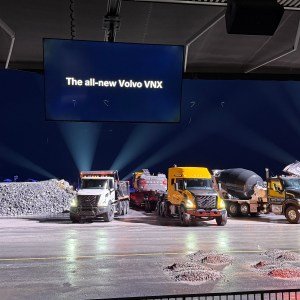
SHIPPENSBURG, Pa. — Volvo Trucks North America unveiled the all-new VNX on Wednesday, a vocational and heavy-haul truck built for a segment where Volvo is looking to expand its market reach. Peter Voorhoeve, president of Volvo Trucks North America, put the company’s share of North American vocational sales at 2% to 3%. The VNX shares an electrical architecture with the long-haul VNL and regional-haul VNR, the result of what Volvo said was a $3 billion investment in product development and manufacturing. Vocational work makes up about a quarter of the North American truck market, Voorhoeve said at a preview event at Volvo Construction Equipment’s Customer Center. Long haul accounts for half and regional haul for the remaining quarter. “We don’t really play in that vocational segment. We have like a two or three percent market share,” Voorhoeve said. “In the largest market of the world, apart from China, why would we not play in a segment that we are so rooted in the rest of the world?” Volvo’s FMX holds about 30% of the vocational market in both Europe and Brazil, he said. In North America, Volvo has sold the VHD since 2000. Voorhoeve said its customers are loyal, but the truck has covered a limited range of applications. Volvo built the VNX around feedback from VHD owners, its vocational business abroad and the job-site experience of Volvo Construction Equipment, which has built and sold machines in the U.S. for more than 50 years. “Growth in vocational is a natural next step for Volvo Trucks, right as we’re seeing stable demand for trucks on construction sites, infrastructure projects and industrial builds across the country,” Voorhoeve said in a statement. Remote steer and a terrain brake Remote Steer gives an operator control of the VNX from outside the cab at speeds up to 5 mph, Volvo said, aimed at mixers, cranes, vac units and other work that needs precise movement. “Basically what we’ve done is we’ve made a giant RC truck,” said John Moore, product marketing manager at Volvo Trucks North America. “If you ever try to drive a mixer and back it in real close to a building or where they’re pouring concrete, you pretty much have to have a person to guide you. Remote steer lets a mixer be backed in with one person.” Terrain Brake holds the truck in place on steep, rocky ground the moment the driver lifts off the accelerator, stopping forward or backward lurches faster than the driver could reach the service brakes. A direction-change feature lets drivers switch between forward and reverse without touching the brake. Moore said it targets dump truck drivers who shuttle back and forth all day. Configurations and powertrain The VNX comes as a 300 day cab and a 440 with a 42-inch sleeper, each available as a tractor or straight truck, plus a 640 tractor with a 62-inch midroof sleeper. Every model is offered in axle-forward and axle-back configurations, and the heat-treated steel frame rails are rated for 160,000 pounds gross vehicle weight. The truck runs on Volvo’s D13, rated up to 540 horsepower and 1,950 pound-feet of torque and certified to EPA 2027 emissions standards in all 50 states. Moore said that rating puts the VNX within 60 horsepower of the 600-horsepower big-block engines at the top of the class. The 2027 D13’s engine brake climbs to 630 braking horsepower, up from 500 and above the engine’s 540-horsepower output. “Typically engines rate their engine brake the same as their horsepower. This one is different—we have extra braking,” Moore said. That matters on steep downgrades, where service brakes can overheat. The new I-Shift transmission shifts 30% faster, he said, and comes in 13- and 14-speed versions with crawler gears. Safety and connectivity Standard forward pedestrian detection scans from 23 to 230 feet, joined by blind spot detection on both sides and a 360-degree camera. The cab uses one-third more ultra-high-strength steel than Volvo’s legacy vocational trucks. Volvo said standard driver-side curtain airbags make it the only OEM in North America to offer them on a vocational truck. Every VNX ships with a factory-installed 4G telematics gateway for remote diagnostics and over-the-air programming. Volvo said it will announce the start of sales later this year. The post Volvo takes aim at vocational trucks with 540-hp VNX launch appeared first on FreightWaves.
Edge Logistics has sued rival freight broker Freight Tec Management Group and four former employees, alleging they diverted customers through a scheme involving confidential information and kickbacks funded by inflated freight charges. The 51-page federal complaint, filed Sept. 30 in the U.S. District Court for the Northern District of Illinois, alleges that the employees secretly established competing businesses while still working for Edge Logistics and arranged to transfer customer accounts to Utah-based Freight Tec before resigning. Edge alleges its expedited-freight division declined 66.4% within weeks of the employees’ departures in May 2026, while the rest of its business grew 8.5%. The lawsuit does not specify whether those figures measure revenue, shipment volume or another metric, nor does it identify the precise comparison period. The lawsuit names Freight Tec Management Group Inc., former Edge employees Nicholas Daglas, John Harlan, Andre Apiquian and Alexis Hersh, and three companies allegedly established to operate as Freight Tec brokerage agents: Parlay Expedited LLC, Thorndale Logistics LLC and Freight Redefined LLC. Todd Rowden, a partner at Taft Stettinius & Hollister LLP representing the four former employees and three related LLCs, disputed the allegations. “My clients dispute plaintiff’s allegations, and the legal sufficiency of its claims, and have no further comment regarding the complaint,” Rowden said in an emailed statement to FreightWaves. Freight Tec did not provide a substantive response to FreightWaves’ requests for comment before publication. Lawsuit alleges employees planned departures while still on payroll According to the complaint, the four employees worked in Edge’s expedited-freight division, arranging urgent and time-sensitive shipments using straight trucks, box trucks, cargo vans and other equipment. Edge Logistics, headquartered in Chicago, was founded in 2014. The logistics provider has around 120 employees, according to Built In Chicago. Bountiful, Utah-based Freight Tec Management Group is a privately held freight brokerage founded in 1997. The company provides truckload, less-than-truckload and expedited freight services through a network of independent freight agents. Freight Tec has between 51 and 200 employees, according to LinkedIn. Edge alleges the employees had access to confidential customer information, including shipping rates, pricing strategies, freight lanes, customer preferences and business relationships. Rather than leave Edge and independently establish competing businesses, the employees allegedly worked with Freight Tec to develop a plan to transfer existing Edge accounts to the rival brokerage. The lawsuit alleges that Freight Tec’s leadership knew the employees were subject to restrictive employment agreements and reviewed those agreements before engaging them. Edge claims in court filings that Freight Tec’s CEO met with Daglas approximately three to five times before the employees departed to discuss their agreements, paperwork and the legality of their planned business arrangements. The employees allegedly agreed to operate through independent agency businesses under Freight Tec’s brokerage authority, receiving a share of gross profits generated by the customers they brought to the company. Three of the defendants established limited liability companies in April, according to the complaint: Apiquian registered Freight Redefined LLC in Florida on April 20. Harlan registered Thorndale Logistics LLC in Illinois on April 22. Daglas registered Parlay Expedited LLC in Illinois on April 23. Edge alleges all three companies were established while their owners were still employed by the brokerage. The complaint further alleges the employees staggered their resignations to conceal the coordinated nature of their departure. Daglas submitted his resignation May 8, telling Edge he was stepping away from the freight industry to focus on family, according to the lawsuit. Harlan allegedly told colleagues he was leaving to work for a friend in Las Vegas, while Apiquian said he wanted a local, office-based position. Edge claims those explanations concealed plans to continue working in freight brokerage through Freight Tec. Customer emails allegedly established before departures Among the lawsuit’s most detailed allegations are descriptions of customer-specific Freight Tec email accounts appearing in Edge shipment communications before the employees left the company. On May 9, while Daglas and Hersh were still employed by Edge, an email account associated with Freight Tec and dedicated to an Edge customer identified as Customer A appeared in a shipment-related email thread, according to the complaint. Five days later, on May 14, a second Freight Tec email account dedicated to Customer B appeared in a rate-request thread involving Daglas and Harlan’s Edge email addresses. Edge contends those communications demonstrate that the defendants were preparing to service existing Edge customers through Freight Tec before their employment ended. The complaint also describes subsequent transactions allegedly involving the same customers. On June 28-29, Apiquian allegedly arranged an expedited shipment for Customer B through Freight Tec and Freight Redefined LLC, identifying himself as Freight Tec’s key accounts manager. Hersh, identified in the complaint as a Freight Tec strategic account manager, allegedly coordinated delivery and confirmed the shipment’s final rate. On Aug. 18, a representative of Customer A requested a transportation quote from Apiquian at his Freight Tec email address, with an Edge email address also included in the correspondence, according to the lawsuit. Apiquian allegedly responded with a freight rate. Edge also claims freight postings appeared on a load board for lanes previously handled by its brokerage, using Freight Tec addresses associated with Daglas and Harlan. Alleged kickbacks funded by inflated freight rates The complaint includes a separate allegation that former Edge employees arranged to pay kickbacks to a shipping customer’s decision-maker in exchange for directing freight to Freight Tec. According to the lawsuit, the arrangement developed around April 2026, when representatives associated with a customer identified only as Customer C visited Chicago. Edge alleges that the former employees informed an East Coast contact at Customer C about their plans to establish a competing operation through Freight Tec. The customer contact allegedly agreed to direct shipments to the new operation but demanded kickbacks financed by adding money to freight charges. The complaint alleges the defendants subsequently handled Customer C freight under that arrangement. Edge contends the alleged payments gave Freight Tec an improper competitive advantage by influencing the customer’s freight-routing decisions rather than winning business through pricing or service. The complaint does not identify Customer C, specify the amount of any alleged payments or include underlying invoices or payment records establishing the alleged kickbacks. The allegations have not been proven in court. Edge seeks injunction, damages and return of confidential information Edge’s lawsuit contains 11 counts, including breach of contract, breach of duty of loyalty, tortious interference with contractual and prospective business relationships, aiding and abetting, civil conspiracy and unfair competition. The company alleges the employees violated employment agreements containing confidentiality, noncompetition and nonsolicitation provisions. Edge is asking the court to prohibit the defendants from using or disclosing its confidential business information and to restrict certain competitive activities and customer solicitation. The company also seeks the return of confidential documents and electronic information, preservation and forensic imaging of electronic devices and accounts, monetary damages, disgorgement of allegedly improper profits and attorneys’ fees. The complaint does not specify a dollar amount in damages. Court documents indicate that attorneys for Daglas and Harlan previously challenged the enforceability of certain employment agreements, arguing that the agreements lacked sufficient consideration. The complaint also acknowledges that Daglas’ employment agreement contains an arbitration provision. Edge says it is seeking injunctive relief against him in federal court at this stage and intends to pursue monetary claims through arbitration, subject to circumstances described in the complaint. No court has ruled on the merits of Edge’s allegations or determined whether the disputed employment restrictions are enforceable. Former employees have until Dec. 1 to respond The four former employees and three related LLCs waived formal service of the complaint, according to court records filed Oct. 6. Their responses to the lawsuit are due Dec. 1. An initial status hearing is scheduled for Dec. 2 in Chicago. As of the latest docket reviewed by FreightWaves, no defendant had filed a substantive response to the complaint, and the court had not issued a ruling on Edge’s allegations. Why it matters: The Edge Logistics LLC v. Freight Tec Management Group Inc. case highlights the legal and financial risks freight brokers face when employees leave with valuable customer relationships and establish competing operations. More FreightWaves articles by Noi Mahoney: Mexico trucker shortages, visa restrictions squeeze cross-border capacity Texas trucking firm sued over age limits on drivers New Jersey CDL school lawsuit questions evidence behind FMCSA shutdown The post Freight broker alleges customer theft, kickbacks in lawsuit against rival appeared first on FreightWaves.
Volvo is already calling the EX60 a “game changer” as its highest-range, fastest-charging EV to date. After delaying US deliveries, Volvo’s new midsize electric SUV will remain limited, at least for now. more…
Tesla Powerwalls did most of the heavy lifting as California’s home batteries set a new grid record last week. On October 6, more than 85,000 Powerwall owners sent over 600 MW to the grid, the bulk of a combined 745 MW dispatch that Sunrun announced today. That’s 28% more than the 580 MW record the two companies set less than a month ago. And it’s bigger than most gas peaker plants in the state. more…
PORTUGAL: Construction of Portugal’s first high speed line was formally launched with a ceremony on October 12. Diogo Ferreira Nunes reports from Aveiro. The north-south high speed rail corridor linking Porto Campanhã station with Lisboa Oriente, 290 km to the south, is to be built in three phases. The double-track line will largely be built on a dedicated alignment using Iberia’s 1 668 mm gauge to allow easy integration with the conventional rail network. The route is being designed for operation at up to 300 km/h. First section of line The first section of the high speed line will run over a 71 km section from Porto to Oiã, near Aveiro. It is being built by the AVAN consortium (previously known as LusoLav), which is led by Mota-Engil and includes Teixeira Duarte, Alves Ribeiro, Casais, Conduril and Gabriel Couto. Construction will involve 4 000 workers, with completion planned by the end of 2030 to enable the section to open in 2031. It will include eight tunnels and 15 viaducts, including a road and rail bridge across the River Douro. The line will pass below the town of Vila Nova de Gaia in a tunnel, where a station with 405 m long platforms will be located 60 m below the city centre. This station will offer connections to Metro do Porto’s Yellow Line and the future Rubi Line, and will have two above-ground office buildings on the northern and southern sides as well as 475 parking spaces. PPP concession The first section is being developed under a 30-year public-private partnership concession with a total budget of €2.651bn, of which only €628m is to be provided by the state. The AVAN consortium members are investing €165m in the project, and a syndicate of 13 commercial and institutional lenders is lending €1bn for 25 to 28 years. The European Investment Bank is providing a 28-year loan of €844m, and the EU is contributing €450m from the Connecting Europe Facility. There is also mezzanine funding of €52m. ‘The Portuguese PPP model here for Lisboa – Porto is undoubtedly one of the best practices that we want to bring forward in the future’, said Philippe Chantraine, head of the transport investment unit at the European Commission’s Directorate-General for Mobility & Transport, at the groundbreaking ceremony. ‘This approach enables continued infrastructure development and strategic investments in the structural foundations of the economy while minimising reliance on public funds, limiting pressure on budgets and avoiding additional public debt burdens.’ Next sections National operator CP has prequalified Alstom and Talgo for a contract to supply 12 high speed trains, and expects to award the contract by the end of Q1 2027. Rail infrastructure manager Infraestruturas de Portugal hopes that the second and third sections of high speed line running 60 km from Oiã to Soure near Coimbra and 130 km from Soure to Carregado near Lisboa will be completed by 2032. Once completed, the journey time from Porto to Lisboa is expected to be cut from 2 h 48 min to 1 h 20 min. See also Portugal to request use of broad gauge for Porto – Lisboa high speed line First Porto – Lisboa high speed line concession package awarded Porto – Lisboa high speed project and Rail Baltica lead latest Connecting Europe Facility grant allocations
ORLANDO, Florida — For 18 months, United Parcel Service management has talked about shedding unprofitable e-commerce volume to concentrate on more complex, premium services in sectors like B2B distribution, healthcare, automotive and small enterprises. Many hear that to mean UPS intends to walk away from lightweight B2C delivery space, now crowded with lower-cost competitors, especially after phasing out 50% of its business with Amazon. Meanwhile, the shipping giant recently issued a news release in which it described a new global operating model centered on providing integrated logistics services as the company continues its “evolution” from a small package carrier. Analysts question whether UPS (NYSE: UPS) can successfully morph into an integrated logistics provider if it shrinks parcel volume. And industry consultant Satish Jindel suspects there are other motives behind the messaging, arguing the company has no intention of exiting any part of the parcel business. “I think it’s a very difficult needle to thread. They’re a parcel carrier. Plain and simple,” Richard Metzler, an industry veteran who has held high-level executive positions at companies like DHL Express, Greatwide Logistics, XPO and uShip, said in a phone interview. “Is Supply Chain Services a serious logistics business? For sure. But in my opinion, it will be tough to backfill what they exit in parcel with just logistics, small-and-medium businesses, heavyweight and healthcare.” window.googletag = window.googletag || {cmd: []}; googletag.cmd.push(function() { var gptSlot = googletag.defineSlot('/21776187881/FW-Responsive-Main_Content-Slot1', [[300, 100], [320, 50], [728, 90], [468, 60]], 'div-gpt-ad-1709668545404-0').defineSizeMapping(gptSizeMaps.banner1).addService(googletag.pubads()); googletag.pubads().enableSingleRequest(); googletag.pubads().collapseEmptyDivs(); googletag.enableServices(); setInterval(function() { if (!document.hidden) { googletag.pubads().refresh([gptSlot]); } }, 60000); }); googletag.cmd.push(function() { googletag.display('div-gpt-ad-1709668545404-0'); }); And since Amazon is rapidly moving to serve those market segments with its third-party freight, distribution, fulfillment and parcel shipping service, under the Amazon Supply Chain Services banner, profit margins won’t be safe in logistics either, he added In early August, Jindel warned negotiations on the next contract for more than 300,000 van and truck drivers and package handlers will turn into a tectonic clash that reshapes the parcel shipping sector, with either UPS becoming the top dog or getting overlapped by rival couriers, depending on how the talks play out. UPS’s labor costs are so out of whack with the rest of the industry because of the lucrative 2023 contract the Teamsters secured that UPS is becoming unaffordable for retail shippers, according to many industry watchers. Jindel is now going further, predicting that UPS will welcome a strike by the Teamsters union and its combative boss Sean O’Brien, who is already drawing red lines that could easily trigger a work stoppage in 2028, so it can reset its cost structure. The emphasis on revenue quality over sheer parcel volume is actually a smokescreen to keep parcel delivery competitors, like FedEx and Amazon, off guard so they don’t prepare for a driver exodus when Teamsters workers go on strike, enabling UPS to hire drivers from competitors and reset its cost structure. That would allow UPS to again dominate the parcel market like it did in the 1990s, he opined in an interview. Although UPS downsized its domestic parcel network — eliminating 150 sort centers, 30,000 positions and 50 million labor hours — to align with lower volumes from shedding Amazon business, it wouldn’t be investing more than $8 billion over four years to automate facilities, if it planned to stop delivering from fulfillment centers to consumers’ doorsteps, Jindel explained. UPS is trying to make people believe they are pulling out of short-haul parcel delivery. “They are not. This is a Trojan horse to misguide competitors and the Teamsters,” the founder and president of ShipMatrix told FreightWaves. window.googletag = window.googletag || {cmd: []}; googletag.cmd.push(function() { var gptSlot = googletag.defineSlot('/21776187881/fw-responsive-main_content-slot3', [[728, 90], [468, 60], [320, 50], [300, 100]], 'div-gpt-ad-1665767553440-0').defineSizeMapping(gptSizeMaps.banner1).addService(googletag.pubads()); googletag.pubads().enableSingleRequest(); googletag.pubads().collapseEmptyDivs(); googletag.enableServices(); setInterval(function() { if (!document.hidden) { googletag.pubads().refresh([gptSlot]); } }, 60000); }); googletag.cmd.push(function() { googletag.display('div-gpt-ad-1665767553440-0'); }); ShipMatrix supports hundreds of shippers with parcel visibility, analytics, invoice processing, auditing and carrier selection. Jindel has a strong track record of predicting industry events or making recommendations that eventually are adopted, including the spinoff of FedEx Freight and retailers’ overreaction to consumer interest in free, superfast delivery. In the Aug. 31 news release downplaying the parcel operations, UPS also named Matt Guffey as chief U.S. domestic officer, with responsibility over all parcel and delivery business units: small package, non-union subsidiaries Roadie and Happy Returns, The UPS Stores and Mail Innovations (the company’s consolidation program with the U.S. Postal Service for lightweight parcels). UPS purchased Roadie in 2021 for $548 million. The carrier handles same-day, urgent shipments that don’t go through the parent company’s parcel sortation network. Instead, the crowdsourced delivery platform instead picks up orders from brand-name stores and delivers them to homes and businesses, with independent drivers providing their own vehicles. Jindel said the reorganization under Guffey suggests that UPS intends all five units will eventually utilize non-union workers because, for the first time, management has brought all the parcel services under one executive. It will allow use of a fully integrated parcel network to meet customers’ needs at the lowest cost by placing the right parcel in the right network. The reorganization aligns with a scenario he floated last November, in which UPS proposes that Roadie carry out all B2C deliveries from UPS Stores, while Teamster drivers handle shuttle runs between package hubs and the UPS retail outlet — a nonstarter for the Teamsters that would likely tee up a strike. UPS will be able to manage a strike without huge damage if Roadie has plenty of freelance workers signed up on its app in advance to deliver packages and management bringing packages to the UPS Stores. window.googletag = window.googletag || {cmd: []}; googletag.cmd.push(function() { var gptSlot = googletag.defineSlot('/21776187881/fw-responsive-main_content-slot4', [[300, 100], [320, 50], [728, 90], [468, 60]], 'div-gpt-ad-1709668086344-0').defineSizeMapping(gptSizeMaps.banner1).addService(googletag.pubads()); googletag.pubads().enableSingleRequest(); googletag.pubads().collapseEmptyDivs(); googletag.enableServices(); setInterval(function() { if (!document.hidden) { googletag.pubads().refresh([gptSlot]); } }, 60000); }); googletag.cmd.push(function() { googletag.display('div-gpt-ad-1709668086344-0'); }); UPS officials privately caution not to read too much into the Aug. 31 statement: Small package is not going away. Core competency is now directed at transportation moves that require multiple services, but also feed into the small package network, where the driver still needs to deliver the product to a home or business, and customers view UPS as a partner in the end-to-end logistics process. “Our number one priority is to move the right packages and the right mix of volume through our network. The market has changed and we’re adapting to it,” CEO Carol Tomé said in the company’s second quarter earnings briefing. “We’re overturning the old industry assumption that scale alone drives profitability. Instead, we’re focused on premium segments. … Our strategy is working. We’re seeing favorable mix improvements with small-and-medium business and B2B volume representing a larger share of total U.S. volume and … meaningful revenue per piece growth. … We’re winning through innovative and differentiated capabilities,” she said. Being selective about which shipments to accept means lower revenue, but UPS — and FedEx, for that matter — is partly making up for that money by frequently introducing a broad range of surcharges throughout the contract year, a relatively new tactic for increasing revenue-per-package. Mixed opinions on strike chances The fact that Teamsters chief Sean O’Brien has used inflammatory language to disparage UPS and insist it accept more union demands in the next contract, while suggesting a labor stoppage is almost inevitable, is striking two years before the current labor contract expires. Not everyone is convinced as Jindel that a strike will occur, while seeming to acknowledge it will be a close call. Their comments reflect a broader nervousness across the carrier and shipping community that a UPS shutdown is possible. window.googletag = window.googletag || {cmd: []}; googletag.cmd.push(function() { var gptSlot = googletag.defineSlot('/21776187881/fw-responsive-main_content-slot5', [[728, 90], [468, 60], [320, 50], [300, 100]], 'div-gpt-ad-1665767778941-0').defineSizeMapping(gptSizeMaps.banner1).addService(googletag.pubads()); googletag.pubads().enableSingleRequest(); googletag.pubads().collapseEmptyDivs(); googletag.enableServices(); setInterval(function() { if (!document.hidden) { googletag.pubads().refresh([gptSlot]); } }, 60000); }); googletag.cmd.push(function() { googletag.display('div-gpt-ad-1665767778941-0'); }); James Cochrane, chief executive officer of the Package Shippers Association, said UPS has to do something to rebalance its costs with the market. “The last [contract] didn’t end well for them. Their cost to serve went very high. The people that deliver are hardworking individuals, but there’s such a difference between people that are delivering packages making $50,000 a year and those making $150,000. I don’t know how sustainable that is,” he said during a keynote address at Parcel Forum 26 here last month. The Teamsters strike of UPS in 1997 was damaging to the company because it took time to regain business from FedEx, he recalled. “I don’t think there’ll be a strike, but I don’t envy UPS having to negotiate that one because very rarely do things [contract terms] move backwards. They’re at a high number now, and so I worry about their long-term longevity with that kind of cost. I would love to see them maybe get a distributed environment where some of the new employees have a lower base for a period of time,” Cochrane said. window.googletag = window.googletag || {cmd: []}; googletag.cmd.push(function() { var gptSlot = googletag.defineSlot('/21776187881/fw-responsive-main_content-slot6', [[728, 90], [468, 60], [320, 50], [300, 100]], 'div-gpt-ad-1665767872042-0').defineSizeMapping(gptSizeMaps.banner1).addService(googletag.pubads()); googletag.pubads().enableSingleRequest(); googletag.pubads().collapseEmptyDivs(); googletag.enableServices(); setInterval(function() { if (!document.hidden) { googletag.pubads().refresh([gptSlot]); } }, 60000); }); googletag.cmd.push(function() { googletag.display('div-gpt-ad-1665767872042-0'); }); Teamsters drivers cost about $65 per hour — total compensation when all healthcare and other benefits are included with the $49 hourly rate for senior drivers — compared to FedEx drivers who earn about $35 to $39 per hour on average for total compensation. Regional carriers that heavily rely on contract fleets or gig workers spend about $15 per hour, or less, on last-mile delivery drivers, experts say. “The real battleground in 2028 might be a show down over Roadie. UPS spent $548 million to buy Roadie and the time may be approaching to pull it off the shelf. Decoupling middle-mile Teamster haulage from gig-based final-mile delivery isn’t just an option for UPS — it is probably the only mathematical reality that allows them to remain competitive,” wrote Metzler in the comment section of a FreightWaves article about UPS. Vincent D’Amato, chief sales officer at startup carrier Gofo, said his attitude toward a potential strike is colored by previous cries of wolf that never materialized when UPS contracts came up for renewal. “I’m not saying there’s zero chance. I”m saying I don’t really buy into the hype because I spent 17 years at FedEx and every cycle it would come up and we’d be told to go out to the customer base and tell them they need to lock in volume now because if it gets closer we’re not going to take volume. And it never really happened,” he said on the sidelines of the conference. “I just feel as though there’s always talk about the strike. I just don’t think it’s a significant likelihood that it would happen, enough where it would create a panic in the market.” If UPS workers did walk off the job it would severely hurt businesses and create shipping delays, he added. “It would be catastrophic for the parcel market. Most of these alternative providers can’t handle that volume. They would be inundated. FedEx would be very disciplined about what they would and wouldn’t take at what price,” said D’Amato. “Maybe Amazon or the USPS could absorb some of it.” Can UPS ignore last-mile delivery? Despite UPS’s public position about being very intentional in only accepting high-margin, multi-zone, specialized shipments that fit their profile, analysts say the company can’t afford to abandon a key segment of the market when its goal is to provide integrated logistics solutions. Integrated logistics, by definition, means having one’s own assets and network, said Jindel. “It can’t be either, or, especially because consumers and businesses require both” B2C and B2B shipping capabilities that, for example, can get pharmaceuticals to someone’s house or to a hospital, said Joanne Strong, senior manager and warehouse management system practice lead at Deloitte, during a panel discussion. “The market is very dynamic and there are all these operating models going after the same customer based on what that means for them at that moment.” Metzler agreed that cherry picking a big piece of the market won’t work because shippers won’t give all of the quality packages to one carrier. “Carriers are going to go after where the biggest margins are. But you have to be able to offer those [last-mile] services to really make it work. They have got to build their physical networks with freight. They need volume to make those operationally successful,” Chris Kina, senior director analyst for logistics, customer fulfillment and network design at Gartner, said at the event. New technology, added, is going to enable more carriers to expand their service offerings. Focusing on premium market segments is risky when the line between commerce and package delivery is disappearing, as platforms like DoorDash and Uber expand from restaurant and grocery delivery to deliver orders from big and small stores, including brands like Costco and Ace Hardware, while retailers like Walmart deliver more packages on their own, said Nate Skiver, the founder of LPF Spend Management, on LinkedIn. The amount of available package volume for pure-play couriers will shrink, as a result. “Which begs the question: Is there enough ‘premium’ volume for both UPS and FedEx?” he said. D’Amato said that UPS would have to significantly scale down its network if it were going to push out B2C delivery. “They may have painted themselves into a corner with the last Teamsters contract. Plus, Sean O’Brien has made it abundantly clear the next contract will be no fun and will close the gaps on Roadie, UPS Stores and Supply Chain Services” Metzler said. “With the fixed cost of the UPS network, it is hard to see how they can get to the Promised Land with lower package density on any given route.” Not too early for contingency planning Some businesses are beginning to realize the need for contingency plans as awareness increases about the strong potential of a strike at UPS, and the chain reaction it could set off across the parcel industry, parcel shipping consultants say. Jindel said customers are asking about how to prepare for any potential labor disruption, including how to incorporate alternative carriers in their automated manifesting and label-generation systems, after reading his Aug. 11 commentary warning about the UPS-Teamsters negotiating cliff. Analysts say the proliferation of surcharges for peak season, fuel, large packages, non-urban delivery areas and other conditions has irritated shippers, making them more open to using alternative carriers. “Carrier diversification is already a focus for many shippers because of rising costs and service concerns, and the potential for another UPS strike adds to that conversation,” Robyn Meyer, senior vice president, parcel strategy and solutions at Transportation Insight, told FreightWaves. “It’s not a major concern just yet. I think the biggest lesson from 2023 is that shippers can’t wait until the last minute. Alternative carriers have limited capacity, and building those relationships takes time,” she said. Shippers should be engaging with other carriers so that their warehouse management and transportation management systems are integrated and ready to exchange information if that becomes necessary, the ShipMatrix chief recommended. Carriers will be overwhelmed onboarding new accounts if shippers wait until 2028. “Your packages will be piling up. You won’t be able to ship,” Jindel said. Parcel shippers also have to worry about the financial impact of shifting volume away from UPS and potentially affecting existing contract incentives. “I expect we’ll see more conversations around this throughout 2027, especially among larger shippers with significant UPS volume,” said Meyer. Some shippers, in an effort to maintain flexibility to divert packages if a labor disruption occurs, are asking UPS to include clauses in contract renewals that waive volume requirements for discounted rates, Jindel said. RELATED STORIES: Dual labor shocks in 2028? UPS, West Coast port bargaining to overlap Teamsters president throws down gauntlet to UPS: Strike coming in 2028 Analyst: UPS-Teamsters 2028 showdown will unleash parcel industry tsunami Fuel surcharges trigger spike in parcel shipping costs The post Is UPS parcel pivot a strategic winner or a ‘Trojan horse’? appeared first on FreightWaves.