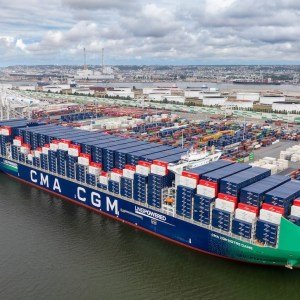
Samsung Electronics America is seeking at least $186 million from CMA CGM in a Federal Maritime Commission complaint alleging the ocean carrier imposed unlawful container charges and failed to fulfill inland transportation commitments. The French carrier disputes the allegations and has asked the commission to dismiss the case. The dispute centers on “store-door” shipments, under which CMA CGM agreed to transport Samsung’s containers from overseas origins through U.S. ports to designated inland destinations. Samsung argues that the carrier passed along costs arising from delays in transportation it was responsible for arranging, while requiring the electronics company to take over parts of the delivery process. According to the complaint, CMA CGM began handling Samsung containers under store-door bills of lading in January 2020. Samsung alleges that, beginning around the middle of that year, the carrier repeatedly failed to remove containers promptly from marine and intermodal terminals and deliver them to their inland destinations. Samsung says it paid more than 121,000 demurrage, detention and associated charges, including more than 26,000 individual demurrage charges and over 94,000 detention-type charges. The company alleges that the bills resulted from delays outside its control. The requested reparations include approximately $148 million in disputed demurrage, detention, rail storage and related charges and costs; at least $8.1 million in additional expenses incurred carrying out inland transportation obligations and mitigating disruptions; and approximately $30 million in prejudgment interest. Samsung also seeks other compensation, including legal fees, meaning its total demand could exceed $186 million. Samsung challenges cargo holds and delivery changes Samsung alleges that CMA CGM used cargo and finance holds to compel payment of disputed invoices, sometimes withholding the movement, release or delivery of containers unrelated to the charges in dispute. The company also accuses CMA CGM of converting some store-door shipments to container-yard arrangements without its approval. Those changes left Samsung responsible for arranging inland transportation that it says CMA CGM had already agreed to provide. One example cited in the complaint involves a container shipped from Busan, South Korea, through the Port of Long Beach to The Colony, Texas, in 2021. Samsung alleges that the container accumulated approximately $162,800 in rail storage charges after its delivery arrangement was changed from store-door to container-yard service. Samsung contends the carrier’s conduct violated Section 41102(c) of the Shipping Act, which requires common carriers to establish and follow just and reasonable practices related to receiving, handling, storing and delivering cargo. It is asking the FMC to award reparations and order CMA CGM to cease the allegedly unlawful practices. CMA CGM disputes liability CMA CGM has characterized the dispute as arising from the exceptional operating conditions of the Covid-19 pandemic and maintains that it complied with its contractual obligations and applicable regulations.“CMA CGM disputes Samsung Electronics America’s allegations of Shipping Act violations and has filed its response with the Federal Maritime Commission, requesting dismissal of the complaint,” a company representative said in an email to FreightWaves. “CMA CGM’s position is set out in its filing. As the proceedings are ongoing, we will not comment further on the substance of the dispute.” This article was updated Oct. 8 to add comment from CMA CGM. Read more articles by Stuart Chirls here. Read more: Zim lifts profit forecast 72% on strong demand New submarine plant planned at Baltimore multimodal hub Xeneta: US-bound container rates peak, but sharp collapse unlikely DP World plots US port comeback with Corpus Christi container terminal Dockworkers protest at Port of Vancouver over automation, AI The post Samsung seeks $186M from CMA CGM in container charges dispute appeared first on FreightWaves.
Tesla spent months pushing the Dutch vehicle regulator RDW to scale back its review of “Full Self-Driving (Supervised),” including disputing a €365,000 bill, according to emails obtained by Reuters. RDW later approved the system and is now asking the EU to do the same. That Dutch approval is the foundation of Tesla’s entire FSD push in Europe. Eight EU countries now allow the system, and a bloc-wide vote could come as early as December. more…
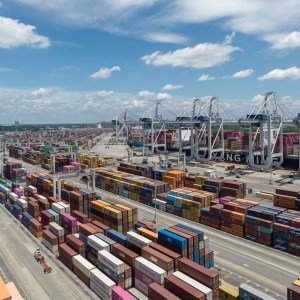
The Port of Savannah handled a record 504,015 TEUs in September, up 3.7% from a year earlier, as rising imports and weather-related cargo delays extended the peak shipping season, the Georgia Ports Authority said. Loaded imports increased 5.5% compared with September 2025, leading the port’s container growth. GPA attributed the gains to strong consumer spending and typhoon-related delays at Asian ports that pushed peak-season shipments into September. The result brought container volumes for the first quarter of GPA’s fiscal year to more than 1.5 million TEUs, an increase of 40,560 TEUs, or 2.7%, from the same period a year earlier. GPA said the quarter ranked second only to the first quarter of fiscal 2023. Volumes at the Appalachian Regional Port rose 13% during the quarter. Terminal and road investments advance GPA said its $1.6 billion renovation of Savannah’s Ocean Terminal is more than 60% complete. The project will increase the terminal’s annual container capacity from 200,000 TEUs to 1.75 million TEUs. The authority also highlighted the Brampton Road Connector, a Georgia Department of Transportation project that opened in July. The road provides a third high-volume truck corridor to Garden City Terminal’s Gate 3, allowing trucks to avoid neighborhood roads and at-grade railroad crossings. “The capital investments we’ve made are now paying off in service levels for our customers and fluidity for our trucking partners,” GPA President Kevin Price said. GPA also said volumes will benefit from improving water conditions at the Panama Canal. According to the release, the Panama Canal Authority plans to restore capacity to a maximum of 10 Neopanamax vessel transits per day on Oct. 15, bringing total daily transit capacity for all vessel sizes to 33. The maximum draft for Neopanamax vessels stood at 49 feet as of Sept. 28. Brunswick cargo declines despite machinery gains At the Port of Brunswick, total roll-on/roll-off cargo fell 22% year over year to 43,415 units in September. Heavy machinery shipments rose nearly 12% to 3,754 units, compared with 3,359 a year earlier, but that growth did not offset the overall decline. GPA said global market conditions for vehicle manufacturers remained competitive as tariffs and rising interest rates have damped retail vehicle sales. Read more articles by Stuart Chirls here. Read more: Samsung seeks $186M from CMA CGM in container charges dispute Zim lifts profit forecast 72% on strong demand New submarine plant planned at Baltimore multimodal hub Xeneta: US-bound container rates peak, but sharp collapse unlikely DP World plots US port comeback with Corpus Christi container terminal The post New monthly mark for Savannah container volume appeared first on FreightWaves.
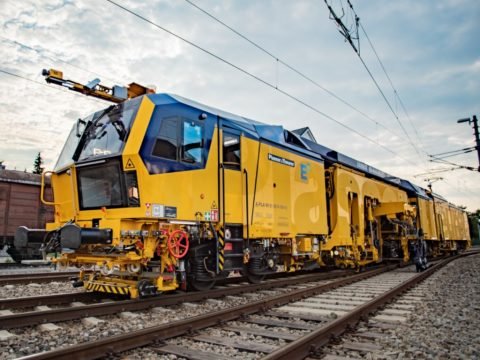
INTERNATIONAL: Plasser & Theurer has announced a restructuring of the investments held by the Max-Theurer family, affecting the holding company model for the track machine producer as well as the ownership of Robel, Matisa and Speno. Under the change, Plasser & Theurer, Robel, Matisa, and Speno are being brought together under the umbrella of a joint holding company known as JMT Industrie Holding GmbH, domiciled in Austria. The four sub-groups expect to generate consolidated revenues of around €1.7bn in 2026 and employ around 7 900 people worldwide. Their respective areas of focus will be: Plasser & Theurer Group (headquartered and registered in Austria): A global railway construction and track maintenance machine specialist, bringing together all the international Plasser companies under a single corporate entity. Robel Group (Germany): A specialist manufacturer of machines and a service provider for the construction and maintenance of rail infrastructure, with future growth focused on automation and rail treatment. Matisa (Switzerland): A producer of highly specialised and heavy-duty machinery for railway construction and track maintenance, with a strong market position in Europe especially. Speno International (Switzerland): A specialist in rail grinding and rail care. A clearer structure Plasser & Theurer said that until now, the companies have been held in separate corporate entities in Austria, Liechtenstein and Switzerland. The reorganisation is intended to deliver a uniform and clear group structure comprising four independently-managed business units for track construction and maintenance machines. It also brings together all the international Plasser companies under the Plasser & Theurer brand based in Austria. The newly formed Plasser & Theurer Group expects to generate revenues of around €1.1bn and employs around 5 600 people worldwide. Independent companies A Plasser & Theurer spokesperson told Railway Gazette International that Robel, Speno and Matisa have been part of the owning family’s investment portfolio since the 1990s, and that they will continue to be run as fully independent companies. All four companies will retain their brands, management, sites and customer relationships. Global Rail Group, the Max-Thuerer family’s independently-owned training and consultancy business, is not affected by the restructuring. ‘We have achieved a great deal over the past two years, despite the challenging circumstances. To build on this success, we are now putting the right structure in place. We are restructuring all our companies and, in doing so, building a future-ready, high-performing organisation — the foundation for further growth’, commented Johannes Max-Theurer, owner and CEO of the Plasser & Theurer Group. The company also said that it would remain wholly owned by the Max-Theurer family, and that there were no plans to sell, bring in investors or pursue a stock market listing. The restructuring is expected to be completed by the end of 2026.
AUSTRALIA: Technology company 4Tel has commissioned digital movement authorities for the Australian Rail Track Corp on more than 1 500 km of its network across New South Wales, replacing a highly manual workflow. The routes covered are controlled by ARTC’s Train Management & Control System. Network Controllers in the control centres at Junee and Broadmeadow have been able since September 21 to use TMACS to issue a digital movement permission, or Electronic Authority. This is delivered as an encrypted electronic data message to the screen of the secure radio fitted in the cab of a locomotive. Prior to implementing EAs, a movement authority was issued by a Network Controller via a voice call to the train driver. According to 4Tel, the movement authority was read out to the driver, who would write it on a form and read it back to confirm the details required for voice-based Train Order Working. ‘Digital movement authorities substantially increase network efficiency by simplifying the communication of daily activities, which helps to improve operational bottlenecks’, explains Tony Crosby, Chief Executive Officer of 4Tel. ‘Systems interoperability has been achieved via software without the need to fit any new equipment to the locomotive fleet.’ TMACS EAs improve driver situational awareness by presenting a Proximity Warning on the cab radio screen when the train is approaching its authority limit, and an Out of Authority Alarm if the train exceeds this limit. These warnings and alarms are automatically generated and presented on the screen with no action required by control centre staff. The details are automatically recorded to support operational review. TMACS can also be integrated ARTC’s eTAP engineering possession application, also developed by 4Tel. Worksite safety staff use eTAP to obtain and manage track access instead of recording authority details on a paper form. The company says that a combination of EAs and eTAP significantly reduces the voice communications workload for routine tasks, and the ‘telephone queue’ from the field back to a control board, allowing control centre staff more time for non-routine operational jobs. ‘Electronic Authorities are a practical example of how we can make rail safer, simpler and more efficient for our customers’, says Geoff Wickens, ARTC’s Acting Group Executive for Safety & Systems. ‘Freight trains travel thousands of kilometres across different networks and operating environments. Every time we can remove unnecessary complexity and make those systems work better together, we make it easier to move by rail.’ Implementation of TMACS EAs is also in progress on two more ARTC lines, the east-west corridor from Tarcoola in South Australia to Kalgoorlie in Western Australia, and the Benalla – Oaklands line between Victoria and New South Wales.
EUROPE: The European Union Agency for Railways has acknowledged that ERTMS specifications were put into EU law before they were mature, contributing to repeated changes and national variants. ‘It’s not the fault of ERTMS, it’s our fault’, said Executive Director Oana Gherghinescu, who said that mature specifications should be ‘frozen’ long enough to industrialise deployment. Speaking at the UNIFE Dialogue Forum on the European Rail Traffic Management System at InnoTrans 2026, Gherghinescu first stressed that ERA still had reason to be proud of ERTMS itself, describing it as Europe’s ‘flagship for safety, capacity and punctuality’. The problem, she argued, lay in how Europe had developed and implemented it. ‘I think we can align by being humble and accepting what we haven’t done right, because again it’s not the fault of ERTMS, it’s our fault’, she said. ‘So I’m eating the humble pie on the agency side.’ With only 17% of the EU core network equipped by the end of 2024, ‘that is not a good KPI for an organisation which calls itself the ERTMS system authority’. ‘Make ERTMS boring’ The first ERTMS technical specifications were produced by the UNISIG group of signalling suppliers in 2000 and incorporated into EU rules for control-command and signalling on high speed railways in 2002; conventional rail followed in 2006. Gherghinescu said those early specifications had inevitably developed through trial and error. ‘Was it good at the beginning, was it complete? No. Was it good that it started? Yes’, she said. ‘We had to start somewhere.’ The mistake, Gherghinescu argued, was putting the system into legislation while that process was still underway, meaning changes on the technical side then had to be reflected in the rules. ‘We were enthusiastic, we wanted to go for it, we built a solution and we put it into law’, she said. In hindsight, she argued, that had been a mistake. Companies outside the institutions had then treated that legislation as a stable basis for long-life investments, she stated. Every time the CCS TSI, the EU’s technical rules for train control and signalling, was subsequently amended to correct errors or introduce improvements, ‘someone in the outside world was suffering’, Gherghinescu admitted. Nor did the early specifications contain everything needed to turn the European rules into complete onboard and trackside products. ‘People took that as a menu and started to cook in their own organisations’, she said, producing national and project-specific variants that were compatible with the rules on paper but not necessarily interoperable in practice. ERA is now working towards harmonised engineering and operational rules that could be ‘copy and pasteable’ into procurement documentation, said Gherghinescu. ‘As boring as this might sound, I think we need to make ERTMS boring from that perspective.’ Rail suppliers reject EU claim that ‘limited competition’ is driving ETCS cost surge The best and worst pupils The admission came as European ERTMS Coordinator Matthias Ruete presented figures illustrating the scale of the deployment gap. Against a legal requirement for full rollout by 2030, current member state plans point to only around 50% completion by then, Ruete said, adding that he was ‘not quite sure whether we will even make the 50%’. He described Belgium and Luxembourg as among the ‘best pupils in the class’; SNCF Réseau Deputy Managing Director Estelle Masclet later joked that France represented ‘one of the worst’. Ruete said that the difference was partly political, pointing to countries where serious accidents had forced governments, infrastructure managers and the wider sector to align behind long-term programmes. In Belgium, the 2010 Buizingen collision, which killed 19 people, helped prompt a legal commitment to equip the entire network with ETCS by 2025. ‘When the driver is safety, you get politics, technical level, stakeholders all together, you get a multi-annual budget and you move ahead’, Ruete said. Belgium ultimately reached 100% ETCS coverage by the end of 2025, but only after a rapid final push: Infrabel equipped around 1 000 km of its roughly 3 000 km network with Level 2 in the final year alone. For COO David Van De Sype, the experience showed that the benefits come only after sustained upfront investment. ‘You have to invest first, and then later on you can have the fruits’, he said. From safety to ATO With the network equipped, Infrabel is now pushing the system further. Railway signalling, Van De Sype said, had originally developed as a means of increasing capacity, and ‘it’s still about capacity’: the aim was to run trains as little as a 1 min apart over the same infrastructure. But that throughput also had to be robust, he added, with punctuality providing the test; performance has risen from 87% in 2021 to around 93%. If everybody moves forward with ETCS, with EU links, with standardised systems, well, that’s the way to decrease price. He cautioned that ETCS could not account for the improvement alone, but Infrabel now planned to build on that performance. That would include replacing ageing interlockings and migrating further towards Level 2, allowing lineside signals to be removed and making Automatic Train Operation easier to introduce. Around Bruxelles-Central, where the six-track layout of the cross-city tunnel is a major bottleneck, it is already looking at ATO. Van De Sype pointed to London’s Thameslink core, where ATO over ETCS Level 2 could support up to 24 trains/h through central London, as an example of what could follow. Yet Belgium’s experience has also exposed the unresolved question of cost and ERTMS. Van De Sype said the hardware itself was relatively cheap compared with the final system price. ‘I guess there’s €10 000 of components, but the prices are in the million range’, he said. His broader lesson was that those costs would only come down if deployment moved beyond isolated national programmes. ‘You can beat about the bush, keep discussing, but finally you’ll have to do something’, he said. ‘If everybody moves forward with ETCS, with EU links, with standardised systems, well, that’s the way to decrease price.’ Five Ss and a C Ruete brought that task down to industrialising ERTMS at European scale. He condensed the requirements into five Ss — standardise, synchronise, stabilise, simplify and scale up — accompanied by one C: coordinate. That meant phasing out national Class B systems and regulatory ‘gold plating’, synchronising trackside and onboard deployment, and giving industry sufficiently stable specifications and funding to move from bespoke engineering to repeatable delivery. UNISIG General Manager Hartwig Schuster had earlier illustrated the problem through the myth of Sisyphus: years spent pushing an authorisation ‘stone’ uphill, only for unexpected legal interpretations, product failures and ‘the absurdities of the European bureaucracy’ to threaten to send it back down. The doubling in the cost of onboard ETCS retrofits, from around €450 000 to €900 000, showed what that complexity could mean in practice. ‘It’s not the industry’s fault’, Ruete said. ‘It’s our collective fault’, pointing to specifications and the expectation of ‘a tailor-made suit at the price of an off-the-peg suit’. With SNCF Réseau planning to equip almost 6 100 km by 2044, the cost of continuing to treat deployment project by project becomes increasingly consequential. Masclet said France had already suffered from ‘excessive specification’ and systematic customisation, increasing costs and slowing delivery. Perhaps more strikingly, suppliers themselves were making much the same argument. ‘We’re facing as an industry an ever-changing specification’, said Siemens Mobility Rail Infrastructure CEO Marc Ludwig. Constant revisions were forcing suppliers to keep integrating new requirements, consuming ‘tremendous amounts of money and time’ that could otherwise be used to accelerate deployment. ‘We need to come to a standard so that as an industry we can move faster [and] use our resources the best possible way’, he said. Dedicated ERTMS Coordination Office established to tackle lagging rollout Freezing specifications Gherghinescu said conversations with industry CEOs had convinced her that suppliers did not have a business case in customisation. ‘They don’t like tailored suits, even if some of us suspect they do’, she said. ‘Their engineering time is too expensive to be wasted on them. So industry needs the standard suit, and they need scale.’ I use the word freeze. I think we need to be as harsh as that. The same logic carried into financing. Standardised equipment that could be reused and sold on would retain more value than locomotives carrying multiple national onboard systems. ‘The locomotive with six onboard units is not of high residual asset value, so if I were an investor I would run away from it’, Gherghinescu said. Getting there, she suggested, would require ERA to hold mature specifications steady for a period rather than continue revising them. ‘I use the word freeze’, she said. ‘I think we need to be as harsh as that. It’s about freezing the specifications when we know they are ready to be implemented.’ That would give operators, lessors and suppliers ‘a period of time where specs are not moving’ and allow ERTMS to become an industrial project. Freeze the rules, strip out national tailoring and synchronise deployment, then scale up. ‘If we do that’, Ruete said, returning to Sisyphus, ‘I’m quite confident that the stone will stay on top of the hill’. Dedicated ERTMS Coordination Office established to tackle lagging rollout
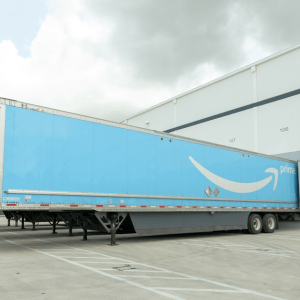
A Connecticut man will spend two years in federal prison after defrauding Amazon through its trucking network. Ameer Nasir, 25, registered or caused the registration of 23 trucking businesses with Amazon Logistics. Federal prosecutors linked those accounts to more than 1,000 trailer movements that never occurred. The scheme ultimately cost Amazon more than $3.5 million. U.S. District Judge Kari A. Dooley sentenced the Trumbull resident Wednesday in Bridgeport, Connecticut. Nasir received 24 months behind bars, followed by three years of supervised release. The court also ordered $3,547,090.93 in restitution. He must report to prison Nov. 12. Amazon Logistics contracts with interstate motor carriers through Amazon Relay to move loaded equipment and empty trailers. Relay connects trucking companies with transportation assignments across the company’s distribution network. Nasir entered that system through multiple business registrations, according to federal court records. One account operated under his company, Pak Express Transport LLC. Trucking identities opened additional accounts Other accounts used identifying information belonging to unrelated trucking or transportation companies. The indictment identifies names, addresses and U.S. Department of Transportation numbers among the information Nasir misappropriated. Prosecutors did not specify how many of the 23 accounts involved those companies. Court records also do not explain how Nasir obtained their identifying information. window.googletag = window.googletag || {cmd: []}; googletag.cmd.push(function() { var gptSlot = googletag.defineSlot('/21776187881/FW-Responsive-Main_Content-Slot1', [[300, 100], [320, 50], [728, 90], [468, 60]], 'div-gpt-ad-1709668545404-0').defineSizeMapping(gptSizeMaps.banner1).addService(googletag.pubads()); googletag.pubads().enableSingleRequest(); googletag.pubads().collapseEmptyDivs(); googletag.enableServices(); setInterval(function() { if (!document.hidden) { googletag.pubads().refresh([gptSlot]); } }, 30000); }); googletag.cmd.push(function() { googletag.display('div-gpt-ad-1709668545404-0'); }); The fraud ran from December 2019 through February 2021, making the underlying activity more than five years old. Nasir used Amazon Relay to obtain transportation assignments and virtually check trailers out and back in. The platform typically used GPS geofencing to determine a device and trailer location. Prosecutors charged that Nasir evaded that safeguard by misusing Relay’s manual override. One May 16, 2020, assignment showed Pak Express moving a trailer from Kent, Washington, to Lakeland, Florida. Amazon Logistics paid $4,566.41 for the trip, according to the indictment. Prosecutors charged that the trailer movement never occurred. Nasir ultimately represented more than 1,000 nonexistent movements as completed. Using 1,000 assignments as a baseline, the $3.5 million loss equals roughly $3,500 per assignment. FBI investigation leads to guilty plea A federal grand jury indicted Nasir on 13 wire fraud counts in May 2025. Authorities arrested him May 8 following an FBI investigation assisted by Amazon. Nasir pleaded guilty to one wire fraud count on March 6, 2026. Assistant U.S. Attorney Elena L. Coronado prosecuted the case. Wire fraud carries a maximum federal prison term of 20 years. Nasir remained free on a $300,000 bond following his guilty plea. Sentencing originally had been scheduled for May 29 before the proceeding moved to October. Judge Dooley ultimately imposed the two-year prison term Wednesday. The scheme ended in February 2021, leaving an important question for today’s transportation industry. Amazon has since introduced additional fraud controls within Relay, including identity and driver verification measures, according to previous FreightWaves reporting. The indictment shows how Nasir exploited the platform more than five years ago. Whether the same scheme could succeed today remains unclear. Why it matters One compromised trucking identity can create access far beyond a single load. Nasir’s scheme reached more than 1,000 assignments before costing Amazon $3.5 million. CFCO CFCO treats verification as a repeatable process, not an onboarding checkbox. Each transaction provides another opportunity to confirm the company, person and activity still align. Consistent verification can expose changes before the next transaction moves forward. window.googletag = window.googletag || {cmd: []}; googletag.cmd.push(function() { var gptSlot = googletag.defineSlot('/21776187881/fw-responsive-main_content-slot3', [[728, 90], [468, 60], [320, 50], [300, 100]], 'div-gpt-ad-1665767553440-0').defineSizeMapping(gptSizeMaps.banner1).addService(googletag.pubads()); googletag.pubads().enableSingleRequest(); googletag.pubads().collapseEmptyDivs(); googletag.enableServices(); setInterval(function() { if (!document.hidden) { googletag.pubads().refresh([gptSlot]); } }, 30000); }); googletag.cmd.push(function() { googletag.display('div-gpt-ad-1665767553440-0'); }); Click here for more articles on cargo theft and freight fraud by Phil Brink. LAPD uncovers $1M in stolen BNSF and Union Pacific rail cargo at Los Angeles–area shoe retailer – FreightWaves CBP finds $6M in cocaine hidden under floor of empty semi-trailer bound for Canada – FreightWaves Thieves clone $60K shipment, redirect 41,000 pounds of glycerin in Illinois – FreightWaves window.googletag = window.googletag || {cmd: []}; googletag.cmd.push(function() { var gptSlot = googletag.defineSlot('/21776187881/fw-responsive-main_content-slot4', [[300, 100], [320, 50], [728, 90], [468, 60]], 'div-gpt-ad-1709668086344-0').defineSizeMapping(gptSizeMaps.banner1).addService(googletag.pubads()); googletag.pubads().enableSingleRequest(); googletag.pubads().collapseEmptyDivs(); googletag.enableServices(); setInterval(function() { if (!document.hidden) { googletag.pubads().refresh([gptSlot]); } }, 30000); }); googletag.cmd.push(function() { googletag.display('div-gpt-ad-1709668086344-0'); }); The post Man gets 2 years for $3.5M Amazon fraud using 23 trucking accounts appeared first on FreightWaves.
UKRAINE: A roadmap for gradually opening the rail freight and passenger markets to competition has been approved, setting out the next steps in the long-running reform of national railway Ukrzaliznytsia and the wider railway sector. Ukraine’s cabinet approved the new railway reform roadmap on September 23, putting dates on changes that have been discussed for years. Under the Cabinet-approved roadmap and action plan, state railway company Ukrzaliznytsia is to separate infrastructure management from train operations organisationally and in its accounts by the end of 2027, before implementing a new corporate model by 2029. The EU-linked programme includes organisational separation within UZ and the eventual introduction of competition, although the government says Ukraine’s main 1 520 mm gauge network will not be opened up before martial law ends. Ukraine’s emerging 1 435 mm gauge network is due to open to competition in 2031, while the much larger broad gauge network would be liberalised only after transition periods agreed during EU accession negotiations. The September decision replaces the previous railway reform action plan adopted in 2019, which the Cabinet formally declared void. It also fulfils a commitment under the Ukraine Plan, which underpins financing through the EU’s Ukraine Facility, making rail liberalisation part of the country’s wider accession-linked reform programme ahead of negotiations under Chapter 14 on Transport Policy. Deputy Infrastructure Minister Volodymyr Shemaiev, who joined the ministry in September after previously heading Ukrzaliznytsia’s International Projects Office, wrote on LinkedIn that Ukraine’s railway reform now had ‘a timeline, not just a direction’. However, he stressed that ‘throughout the reform, the railway must keep running reliably under wartime conditions’. The roadmap itself acknowledges that balance. It says Ukraine’s vertically integrated railway model ‘ensures the continuity of the sector’s operations’, but also ‘creates constraints’ on competition, non-discriminatory infrastructure access and transparent tariff-setting. It therefore envisages a ‘controlled transition to a competitive model’ while preserving the stability and manageability of the railway under military conflict conditions. UZ separation starts before market opening The 2027 deadline does not necessarily mean Ukrzaliznytsia will be broken up into completely independent companies. The roadmap requires the organisational and accounting separation of infrastructure management from train operations within UZ, while a target corporate model is to be approved by the end of 2027 and implemented two years later. UZ has already begun much of that restructuring internally. CEO Oleksandr Pertsovskyi told Ukrainian press in July that the company had ‘practically completed’ the separation of its main business verticals and was in the final stages of creating infrastructure operator UZ Infra, which would combine infrastructure activities currently spread across its six regional railways. Passenger, suburban and locomotive operations already have separate internal balance sheets. Pertsovskyi also stressed that unbundling did not necessarily require the different businesses to leave the same corporate group, pointing to Germany’s Deutsche Bahn as an example. He has also argued that Ukraine would need to retain strong operational coordination during the war, when railway capacity may have to be prioritised for evacuation and other critical movements. The institutional changes will continue through to the end of the decade, according to the Cabinet-approved plan. A framework Law on the Rail Services Market is due by the end of 2028, followed by the creation of an independent National Transport Regulatory Commission in 2029. Infrastructure charging and capacity-allocation procedures are also to be established before the market opens. Freight cross-subsidies to go Another major element of the reform is the planned dismantling of Ukrzaliznytsia’s longstanding system of cross-subsidy, under which freight revenues have been used to cover losses from passenger services. According to the roadmap and its accompanying action plan, socially important passenger trains are to move towards the EU’s Public Service Obligation model, with the state commissioning and compensating services through contracts. The first PSO contract is targeted for December 2027, subject to the necessary legislation being adopted, while longer contracts of up to 15 years would become possible once the relevant rail market has opened. The war remains an immediate obstacle to bringing private operators onto the network. Government officials have cited security risks and the difficulty of securing long-term financing under wartime conditions as major barriers to market entry, including on the standard gauge routes. However, the roadmap still sets out a step-by-step timetable for opening the market. Pressure for reform has also come from businesses operating in Ukraine. In the European Business Association’s latest Infrastructure Index, 59% of respondents identified opening the rail market to private operations as a priority, while 56% backed ending passenger cross-subsidy and 53% identified UZ unbundling and infrastructure rationalisation as priorities. However, the approach to liberalisation is not uncontested. There are currently insufficient votes in parliament for full market opening, while concerns have also been raised over how far liberalisation should proceed during the war. During a parliamentary debate over summer, Maksym Zaremskyi, an MP in President Volodymyr Zelenskyy’s Servant of the People parliamentary faction, argued that railway traction provision should remain in state ownership on national security grounds, describing potential de-nationalisation under current conditions as ‘premature’. A version of this article first appeared in Railway Gazette International’s sister publication RailFreight.com. Ukrzaliznytsia CEO warns rail leaders to ‘invest in resilience’
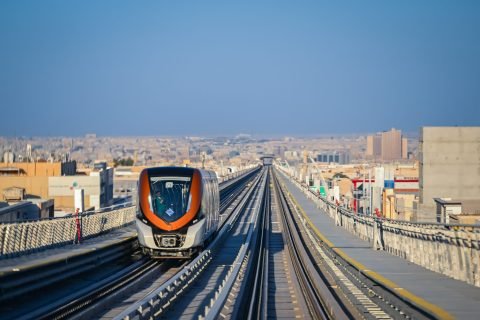
SAUDI ARABIA: The Royal Commission for Riyadh City has awarded Alstom a €460m contract to supply additional Metropolis driverless metro trainsets for used on lines 3 (Orange), 4 (Yellow) and 6 (Purple). Alstom said the expansion of the fleet would increase capacity, enhance operational flexibility and enable the provision of more frequent services as passenger demand continues to grow. The order for an undisclosed number of trainsets builds on the 116 already supplied by Alstom for the three lines. The additional sets will be maintained by the manufacturer as part of the existing operation and maintenance contract for this tranche of the network. ‘We are proud to continue supporting the Royal Commission for Riyadh City in expanding one of the world’s most advanced metro networks’, said Mohamed Khalil, Alstom’s MENA RHQ Managing Director, on September 28. ‘The additional vehicles will help the network respond to growing demand while continuing to provide a high-quality passenger experience.’