Start CDL Inc. is challenging its emergency removal from the Federal Motor Carrier Safety Administration’s training registry. The Cinnaminson, New Jersey-based truck driving school said the FMCSA improperly used drivers’ later English-proficiency violations to justify shutting down its federally regulated training operations, according to a complaint filed Oct. 2. But the 236-page complaint and exhibit packet presents questions beyond that legal dispute: A six-driver spreadsheet names another training provider, the attached roadside reports concern 10 different drivers, and a scanned removal notice makes substantive findings against a third school. The school’s own account also contains unresolved date discrepancies, including an English-assessment certificate dated after the roadside inspection it allegedly preceded. Start CDL filed the suit Oct. 2 in the U.S. District Court for the District of New Jersey against the U.S. Department of Transportation, FMCSA and Administrator Derek D. Barrs, seeking reinstatement and relief from the agency’s action. FMCSA’s Aug. 31 notice immediately removed Start CDL from its training provider registry, along with more than 100 other schools. The notice to shutdown arrived as federal regulators crack down on hundreds of commercial driver training providers and attempt to create stricter enforcement of CDL training. The FMCSA notice prohibited Start CDL from conducting entry-level driver training, enrolling new trainees, certifying completion or uploading training certifications. FMCSA cites safety risks The agency said six trainees certified by Start CDL subsequently received English-language-proficiency violations during roadside inspections. FMCSA inferred that the drivers lacked the required proficiency when the school submitted their certifications, concluding that the provider had material deficiencies and demonstrated willful disregard of applicable requirements. The notice invoked both an immediate public safety rationale and willful disregard as grounds for emergency removal. English proficiency is a longstanding federal driver-qualification requirement. Enforcement guidance included in the exhibits describes restoration of out-of-service treatment for English-proficiency violations in June 2025. Several attached inspection reports in the Oct. 2 complaint document specific communication problems or incorrect highway-sign responses. An Arkansas report describes difficulty answering questions about cargo, documents and air pressure. A Missouri report records four incorrect sign responses. Those accounts provide factual support for officers’ findings at the roadside. They do not, by themselves, establish when the drivers completed training or their proficiency when certifications were uploaded — the connection at the center of the school’s challenge. Driver records do not line up The spreadsheet attached to the removal materials lists six drivers under Star CDL Training LLC. Its provider identifiers differ from Start CDL’s registry identifier. None of those six names appears among the 10 unique drivers in the attached inspection reports. The report numbers also differ. Start CDL’s exhibits include training agreements connecting the school to three of the inspection subjects, but do not provide a reconciled six-driver roster with completion dates and certification upload records. The notice describes the inspection reports as a representative sample, yet the packet does not explain how they correspond to the six drivers in the spreadsheet. A scanned version of the notice also names Punjabi School of CDL Inc. in findings addressing deficiencies, immediate safety necessity and willful disregard. Another version is called Start CDL. The discrepancies raise questions about how the FMCSA may have assembled and matched its evidence. The filing does not establish whether they reflect attachment errors, underlying data errors or another explanation. School’s timeline also needs clarification Start CDL argues in the complaint that later roadside violations do not establish deficient instruction or proficiency at the time of training. It also disputes FMCSA’s interpretation of a training provider’s responsibilities under federal entry-level driver training requirements. However, the complaint and administrative petition describe cited inspections occurring between May and August 2026. The attached roadside reports instead span July 2025 through May 2026. The complaint says driver Viacheslav Iroltuev passed the school’s English assessment with an 84% score in February 2026, before a May 13 roadside inspection. Both attached certificate copies show a date of July 2, 2026. The packet does not establish whether that is an issuance date documenting an earlier assessment. School owner Vasyl Kushnir also says a July 23 DOT inspection prompted process corrections but identified no English-proficiency deficiencies. The exhibits contain no completed inspection report verifying that account. Start CDL says it submitted an administrative-review petition and emergency-stay request Sept. 10. According to the complaint, those requests remained undecided when the lawsuit was filed Oct. 2. The latest docket supplied for review lists no subsequent government response or judicial ruling. The administrative stay request included in the exhibits is directed to FMCSA; it is not a separately filed federal injunction motion. FMCSA and Start CDL attorney Anton Kaminsky did not respond to requests for comment by publication time. Why it matters: Removal prevents Start CDL school from providing federally required entry-level driver training, while the case raises questions about how FMCSA connects roadside safety violations to training providers. More FreightWaves articles by Noi Mahoney: Mexico remains top US trading partner as August commerce hits $94.3B TA Services acquires 2 Texas cross-border carriers, adds 133 trucks DP World plots US port comeback with Corpus Christi container terminal The post New Jersey CDL school lawsuit questions evidence behind FMCSA shutdown appeared first on FreightWaves.
The Federal Motor Carrier Safety Administration (FMCSA) is moving closer to launching a pilot program that could results in amending split sleeper berth requirements, with an eye on allowing more flexibility in how a driver spends the required daily minimum of 10 hours off-duty. In a Federal Register notice released Wednesday, FMCSA opened the “information collection activities” that would provide it with data on whether a change in the 10 hours split, which now allows only 10 consecutive hours, or an 8-2 split or a 7-3 split, would meet safety goals if it was 5-5 or 6-4. Those new splits would become possible if the minimum length of the required sleeper berth period drops to five hours from seven. The program needs as many as 256 volunteers to participate. It can be a team of drivers. Drivers will receive $1,600 for their participation, according to a press release published by the Department of Transportation in late August. As FMCSA said in a September 2025 Federal Register notice that first called for comments on the proposal, the current law says the 10 hours of off duty time “may either be accumulated consecutively, or alternatively, split into 1 consecutive period of at least 7 hours in the sleeper berth and a second period of at least 2 consecutive hours of time in the sleeper berth, off duty time, or any combination thereof, provided that the total of the periods is at least 10 hours. In practice, this allows drivers to utilize any split of sleeper berth time including and between a 7/3 split and an 8/2 split.” The September 2025 notice was more detailed on the issue, and was described as a “notification of proposed pilot program; request for comments.” The notice Wednesday was just described as a “notice and request for comments.” Following up on the April 2025 EO The April 2025 executive order on trucking from the Trump administration that was notable mostly for its English language proficiency requirements and restrictions on non-domiciled CDLs also had in it a general goal for the Secretary of Transportation Sean Duffy to “identify and begin carrying out additional administrative, regulatory, or enforcement actions to improve the working conditions of America’s truck drivers.” In the Federal Register recap of the steps that have led to the pilot program, FMCSA said the experiment would be part of that call to action. The pilot program involves taking those 256 commercial motor vehicle drivers and giving them flexibility over 16 weeks to spend their 10 off duty hours in the sleeper berth as they choose. Participants in the study are volunteers. Chris Eckhart, a partner with the trucking-focused Scopelitis law firm, said the Federal Register notice this week is the follow to the September 2025 notice which sought comment on the split sleeper berth proposal with the goal of seeking flexibility for drivers. “The notice published Wednesday requests comments on the information collection the FMCSA will seek through the pilot,” Eckhart said in an email to FreightWaves. “I don’t think it breaks any new ground on the FMCSA’s plans for the pilot or other potential changes to the split-sleeper berth rule.” The comment period is open until December 7. Not a quick process Even though the actual testing of drivers and their daily submissions on their activities is scheduled to go on for 16 weeks, the September 2025 announcement of the program said the entire pilot program would take 34 to 36 months. The Federal Register notice recaps the long tortuous road to the launch of the study. It cites a joint submission by the American Trucking Associations and the Minnesota Trucking Association to FMCSA in 2013 for what the two groups called a “flexible sleeper berth pilot program.” That came after three FMCSA listening sessions on the issue in 2010. When the Hours of Service rule was implemented in 2011, according to the Federal Register notice, the split sleeper berth beyond 7-3 was not included. “FMCSA determined that the issue should be explored in greater depth to determine whether additional flexibility would achieve an equivalent or improved level of safety relative to compliance with the current regulations,” the Federal Register notice this week said. In the September 2025 Federal Register notice, FMCSA said a review of the issue conducted in 2015 “suggested that sleep split into multiple segments is restorative, and when implemented strategically, does not negatively impact performance. Further, split sleep does not negatively affect daytime ‘‘neurobehavioral performance’’ when compared to a consolidated sleep period of the same total duration.” OOIDA checks in Lewie Pugh, executive vice president of the Owner Operator Independent Drivers Association (OOIDA), said his group is “always in favor of more hours of service flexibility for the driver.” Pugh discussed the length of time that the issue of a split sleeper berth HOS flexibility has been discussed. He said OOIDA “was pushing for the three hours back in 2018,” he said. But a key feature needs to be that the use of those hours are at the driver’s discretion. What OOIDA doesn’t want, he said, is “either the carrier or the shipper saying, hey, you got an extra three hours? Just go off near whatever, and use that extra three hours while we jack you around to load you.” Pugh’s discussion of control and driver discretion is one that his organization has been sounding since soon after the September 2025 Federal Register notice. Eligibility to participate as a driver in the study will not be available to drivers with a list of several disqualifying marks, including having an “unsatisfactory” rating from FMCSA, having an Out of Service (OOS) rate more than the national average. Eligible drivers also can not have had any FMCSA enforcement actions in the last three years. More articles by John Kingston FMCSA’s Elison: ‘weeks’ away from fixing Motus user experience Wall Street analysts positive on C.H. Robinson deal; S&P more cautious Red dye diesel break is being greeted with a big yawn The post FMCSA split sleeper berth pilot program moves closer to launch appeared first on FreightWaves.
The Federal Motor Carrier Safety Administration granted a five-year exemption on Wednesday that lets carriers running Level 4 autonomous trucks use cab-mounted warning beacons in place of reflective triangles. The exemption runs through Oct. 7, 2031, and covers Aurora Operations plus any other Level 4 carrier that notifies the agency first, under a notice signed by Administrator Derek Barrs. It replaces four three-month waivers Aurora has operated under since October 2025. Kodiak AI, Waabi and Stack AV opted in along the way. “Going from a temporary waiver to a five-year exemption gives the industry a lot of confidence,” said Jeff Farrah, CEO of the Autonomous Vehicle Industry Association, in an interview with FreightWaves. “As these companies scale, raise money in the capital markets and set up business partnerships, there are often questions about what they are going to do about the warning-triangle issue. Now there is a firm answer.” Bart Teeter, director of fleet and operational safety at Bot Auto, said in a statement that the exemption “will give the autonomous freight industry a key piece of regulatory certainty that will allow us to continue to scale safely.” Federal rules require the driver of a truck stopped on a road or shoulder to turn on hazard flashers and place warning devices in front of and behind the truck within 10 minutes. The required devices are three bidirectional reflective triangles or at least six fusees. “Now, with autonomous vehicles, we need to evolve some of these requirements, since with an autonomous truck there is not going to be somebody who can get out and put warning triangles behind the vehicle,” Farrah said. Beacon specifications and operating limits The beacons must be amber, meet the Class 1 photometric requirements of SAE J595 and sit at least 100 inches off the ground, at or above the top of the side mirrors. Each truck needs at least one rearward-facing light on each side of the cab and one forward-facing light on the front, with redundant power to prevent a single-point failure. They must activate within five minutes of a stop and keep flashing, alongside the standard hazard flashers, until the truck moves again or is recovered. FMCSA called the five-minute limit “a clear, verifiable safety improvement” over the 10 minutes drivers get to place triangles. Trucks may run only on roads inside their validated operational design domain. Carriers cannot haul hazardous materials or passengers, or run any operation that would require an H, X, P or S endorsement if a human were driving. Doubles are limited to two 28-foot trailers, and triples are barred. Tankers are permitted. Every carrier other than Aurora must email FMCSA before starting, certifying under penalty of perjury that it has the beacons and will follow the terms. Carriers must report any crash while the beacons are on, or should have been on, within five calendar days. Annual reports on beacon malfunctions and power issues are due by Nov. 1. States may not enforce conflicting rules on interstate operations covered by the exemption. “Aurora filed the exemption, and Aurora was part of the first waiver process, but this allows any similarly situated company to use it,” Farrah said. “It is not just Aurora. It is any other autonomous vehicle company doing these operations.” From 2024 denial to five-year exemption FMCSA denied Aurora and Waymo’s 2023 request for the same relief in December 2024. Exempting “a class of unspecified carriers using unspecified equipment on unspecified vehicles only further undermines the claimed likely equivalent level of safety,” the agency wrote at the time. The new exemption names the equipment and the vehicles, and it makes every carrier identify itself. After the denial, FMCSA issued Aurora a narrow waiver. From Oct. 10, 2025, through Jan. 9, 2026, Aurora ran the beacons on 34 trucks that traveled more than 500,000 miles, the company reported in its application. The beacons were active for nearly 10 hours, and Aurora reported no faults, malfunctions or power issues. FMCSA said the trucks were not involved in any collisions while stopped with the beacons on. Aurora filed its new five-year request in April with limits similar to the waiver’s. Two studies filed with both applications got a second look. In 2024, the agency flagged that Aurora’s October 2022 “Naturalistic Study of Warning Device Equivalency” showed a slightly lower share of drivers responding to beacons than to triangles in five of eight scenarios. This time it pointed to response distance from the same study: motorists began evasive moves an average of 135.71 meters from the beacons and 133.24 meters from the triangles. A Virginia Tech Transportation Institute study prepared for Waymo in August 2022 found beacons drew earlier braking at night. Opponents cite trailers, power and weather Aurora’s application drew 402 comments. Opponents included the Owner-Operator Independent Drivers Association (OOIDA), the Truck Safety Coalition, Advocates for Highway and Auto Safety, REAL Women in Trucking and many individual truck drivers. Supporters included the American Trucking Associations, Waymo, Kodiak AI, Volvo Group North America, Amazon and the National Fraternal Order of Police. Critics argued a jackknifed or angled trailer could block cab-mounted lights and that a single electrical failure could knock the beacons out. Others said the studies did not cover the range of weather, road and lighting conditions trucks face. Advocates said nearly 10 hours of beacon use during planned stops was not a sufficient basis for a five-year exemption. The Small Business in Transportation Coalition said granting the exemption “would open a can of worms” by holding driverless trucks to more lenient standards than trucks driven by humans. OOIDA urged FMCSA to wait for its own study of warning devices for stopped trucks. FMCSA answered that the terms confine trucks to their validated operational design domains. It said it lacks data showing triangles significantly improve driver reaction time, and that whether such devices improve traffic safety at all is a historically unresolved question. The Autonomous Vehicle Industry Association and Volvo urged FMCSA to allow beacons on traditional trucks. The agency wrote that updating warning device requirements for all commercial vehicles “may be ripe for future regulatory action.” “High-visibility, cab-mounted warning beacons are a critical, 21st-century solution that enhances roadside safety by immediately alerting other road users without ever needing to put a person in harm’s way,” said Gerardo Interiano, senior vice president of government relations and public affairs at Aurora, in a statement. The industry has coalesced around cab-mounted beacons, an idea Waymo and Aurora first conceived, Farrah said. “This is a critical step, because this is one of the issues that has been really problematic for the deployment of autonomous trucks,” he said. “Now we have a pathway to deploying in the U.S.” The post AV truck fleets win 5-Year exemption on warning beacons appeared first on FreightWaves.
Global container shipping volumes reached a record 17.46 million twenty-foot equivalent units in August, while freight pricing climbed to its highest level in more than two years, according to Container Trades Statistics. August liftings surpassed the previous record set in July and increased 3.7% from August 2025. Through the first eight months of 2026, global volumes were up 4.7% year over year, CTS said in its Oct. 8 report. The figures show continued growth in container trade despite elevated fuel prices, disruption in the Arabian Gulf, Panama Canal constraints and changing tariff conditions. August volumes were 7.2% higher than in the same month of 2024 and 12.9% above August 2023 levels. Freight pricing rises alongside volumes CTS’ Global Price Index rose two points from July to 117 in August, its highest reading since July 2024, when Red Sea shipping disruption was putting pressure on rates. The index was approximately 50% above its January level and 44% higher than in August 2025. CTS said the increase reflected pricing pressures that had developed since late February, as disruptions to key shipping routes affect available capacity and operating costs as vessels are rerouted. North American imports recover North American container imports were up 2% through August compared with the same period last year, extending a gradual recovery that began in May after negative year-to-date growth earlier in 2026. Increased cargo flows from Asia supported the recovery, with trans-Pacific trade up 5% year-to-date. CTS described that performance as a notable improvement from the trade’s earlier weakness amid tariff uncertainty and severe typhoon-related congestion at originating ports. Sub-Saharan Africa posted the strongest percentage growth in imports, with volumes up 13% through August. Growth came from across its major origin markets, with the Indian Sub-Continent and Middle East the notable exceptions. The combined Indian Sub-Continent and Middle East region was the only region to record declining imports, down 5% year to date. It also was the only region with lower exports, which fell 10%, representing just under 1 million fewer TEUs than in the first eight months of 2025. Far East drives export growth Asia exports increased 8% year to date, adding approximately 6.3 million TEUs compared with the same period of 2025. Every destination region recorded growth in cargo originating in the Far East, with Sub-Saharan Africa and South and Central America leading in percentage terms. European exports, meanwhile, returned to roughly flat year-to-date growth after declines earlier in the year. CTS attributed the improvement to stable or increasing cargo flows across most destination regions. Despite the new volume record, CTS cautioned slowing month-to-month growth could signal a moderation in demand, making growth and elevated rates a key issue heading into the final quarter of 2026. Read more articles by Stuart Chirls here. Read more: Samsung seeks $186M from CMA CGM in container charges dispute Zim lifts profit forecast 72% on strong demand New submarine plant planned at Baltimore multimodal hub Xeneta: US-bound container rates peak, but sharp collapse unlikely DP World plots US port comeback with Corpus Christi container terminal The post Global container volumes hit record 17.46 million TEUs appeared first on FreightWaves.
Amazon’s Fall Prime Day Sale event is over, but that doesn’t mean the savings are slowing down, and we’re keeping all the ongoing deals in our updated Fall Prime Day Green Deals hub here for the rest of the week. Leading today’s edition of Green Deals is the latest and final EcoFlow Prime Day flash sale running for 72 hours, with offers like the 2x 1,024Wh DELTA 3 Classic power station bundle down at $889, alongside some other notable units from $599. Right behind that we have collected all the ongoing Segway Fall Deals Deals Day Sale savings on e-scooters, with continuing options like the ZT3 Pro Off-Road Electric Scooter down at $800. We also have Anker’s SOLIX Prime Deals Encore Sale offering the 2,048Wh C2000 Gen 2 Portable Power Station with a 400W solar panel at an exclusive $1,330, among others, as well as the Segway Navimow i2 Series Robot Mowers at their lowest prices, a continuing low price on EGO’s 56V 12-inch Electric Snow Shovel, and more options hanging onto savings for a while longer. Head below for other New Green Deals we’ve found today and, of course, Electrek’s best EV buying and leasing deals. Also, check out the new Electrek Tesla Shop for the best deals on Tesla accessories. more…
Unfilled orders at U.S. factories rose 0.6% to $1,609.6 billion in August, and shipments stalled, the Census Bureau said in its Oct. 2 report on manufacturers’ shipments, inventories and orders. Backlogs have increased in 25 of the last 26 months. Transportation equipment accounted for $1,009.9 billion of the total and led the August increase. Shipments were virtually unchanged at $658.6 billion, the first stall after eight monthly gains. New orders rose 0.1% to $663.5 billion. The ratio of unfilled orders to shipments rose to 6.87 from 6.81. Census does not adjust the figures for inflation. Orders for motor vehicle bodies, parts and trailers rose 0.8%. Machinery orders rose 1.1%. Nondefense capital goods orders excluding aircraft rose 1.6%. Durable goods orders fell 0.1%, with transportation equipment down 0.7% and nondefense aircraft and parts down 4.3%. A fabricated metal products respondent told the Institute for Supply Management the company has orders through year-end above forecast levels. “Our biggest challenge continues to be a severe shortage of workers, limiting our production output to meet demand. The second challenge is general availability of steel; the market is getting worse, and more production delays are expected as we gap out of needed material.” Freight, diesel and steel cost more ISM’s manufacturing index registered 54.5 in September, a tenth of a point below August, the group said in its Oct. 1 report. ISM said it was the ninth straight month of expansion after a 10-month contraction. The prices index climbed 6.8 points to 77.9, the largest move in the report. ISM said 58.6% of respondents reported paying higher prices, up from 46.2% in August. Freight was on ISM’s list of commodities up in price for a seventh month. Diesel fuel was on it for a second. No commodity was reported down in price. The Energy Information Administration’s weekly benchmark diesel price, the figure most fuel surcharges use, set a record of $6.529 a gallon on Sept. 21, FreightWaves’ John Kingston reported. “The Prices Index reading is still being driven by (1) increases in steel and aluminum prices that impact the entire value chain, (2) tariffs applied to many imported goods and (3) increases in petroleum-based products as a result of the Middle East conflict,” said Susan Spence, chair of ISM’s Manufacturing Business Survey Committee. A food, beverage and tobacco products respondent told ISM that “fuel costs are still affecting transportation costs and the overall cost of goods.” A machinery respondent said higher interest rates are slowing new construction and that “we also have to face up to the higher cost of components from overseas due to tariffs and freight rates.” ISM’s inventories index fell 2 points to 48.6 in September, back in contraction. The customers’ inventories index slipped to 41.6, a 24th month in “too low” territory. “A ‘too low’ status for the Customers’ Inventories Index is usually considered positive for future production,” Spence said. Canada tariffs and the August import jump The August trade figures predate Canada’s retaliation. The U.S. goods deficit with Canada widened $4.1 billion to $7.1 billion as imports from Canada rose $4.6 billion to $37.1 billion, the Census Bureau and Bureau of Economic Analysis said. Ottawa put retaliatory tariffs of 15% to 50% on about C$27.6 billion in U.S. goods on Sept. 8, FreightWaves’ Noi Mahoney reported, matching U.S. duties after talks broke down in August. “Canada tariffs have impacted cross-border costs and left our supply chain team scrambling — those supply chains took years to develop and nurture — hurting the very lead times government buyers are concerned about,” a machinery respondent said. That respondent said orders and delivery times had both doubled in semiconductors, electronics and government work. Goods imports rose $17.2 billion to $342.2 billion in August, and the goods deficit widened $12.8 billion to $136.6 billion. Industrial supplies accounted for $9.1 billion of the import increase. Crude oil was up $3.3 billion and nonmonetary gold $3.1 billion. Capital goods imports rose $6.2 billion, including $2.4 billion in semiconductors and $1.3 billion in other industrial machinery. Real goods imports, in 2017 dollars, rose 4.1% to $267.7 billion, against a 5.4% nominal increase. Year to date, the goods and services deficit is down 19.9% from the same period in 2025, and total imports are up 4.4%. “This month, it is the trade war with Canada, which every day is getting worse — causing prices to go up and uncertainty that creates massive disruption,” a transportation equipment respondent said. “Buying continues to get pushed out indefinitely as customers don’t want to spend on capital expenditures until there is more certainty of costs and demand.” The post Factory backlogs build as freight and steel costs climb appeared first on FreightWaves.
VinFast wants to put electric buses on US streets, and its pitch goes beyond the vehicles: charging, maintenance, and operations bundled into one package. Deliveries of buses approved for US use are expected to begin in Q1 2028. more…
Tesla is preparing a dedicated Tesla Semi service center in Las Vegas, according to a new building permit filed with Clark County, Nevada. It’s one of the first concrete signs of the service network Tesla needs to support its electric Class 8 truck, which only entered volume production two weeks ago. more…
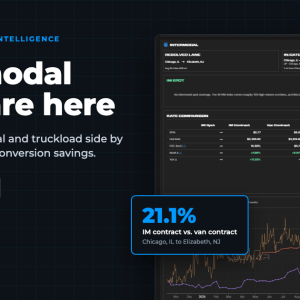
SONAR, the freight market intelligence platform, has added intermodal rates to Rate Intelligence, giving shippers, freight brokers and carriers a new way to evaluate truckload-to-intermodal conversion potential on any lane. Users can now view intermodal contract and spot rates, compare them side by side with van pricing, and estimate the savings per load from converting truckload freight to intermodal. On the Chicago-to-Elizabeth, New Jersey lane, for example, intermodal contract pricing runs 21.1% below van contract, about $593 per load. At a glance What: Intermodal rates, ramps, trends and Conversion Savings inside SONAR Rate Intelligence Who it’s for: Shippers, freight brokers, 3PLs and carriers evaluating mode shifts Data included: Intermodal contract rates, intermodal spot rates on covered corridors, rate and volume trends How to access: Select intermodal as an equipment type, or drill into it from any van lane Available: October 2026, for Rate Intelligence users What can you do with intermodal in SONAR Rate Intelligence? See intermodal pricing. View intermodal contract rates, plus intermodal spot rates where coverage is available. Know the resolved lane. See the resolved intermodal lane, including suggested in-gate and out-gate ramps and their distance from origin and destination. Compare modes side by side. Line up intermodal and van pricing across rate per mile (RPM), flat rate, fuel surcharge, and month-over-month and year-over-year change. Track trends. Review intermodal rate and volume trends over the last 12 months, in absolute or relative view. Size the opportunity. Evaluate Conversion Savings, including estimated savings per load, total lane savings, intermodal volume and conversion potential. Enter your own rate and annual volume to personalize the math. Work your way. Select intermodal directly as an equipment type, or drill into the intermodal view while researching a van lane. Example: Chicago to Elizabeth, New Jersey intermodal vs. truckload On the Chicago-to-Elizabeth lane, intermodal contract pricing runs about 21% below van contract, worth roughly $593 per load. Rail miles: 808 average intermodal miles In-gate ramp: Chicago 14th Street (Global I), Union Pacific, 1 mile from Chicago Out-gate ramp: Norfolk Southern ramp in Elizabeth, New Jersey, 3 miles from Elizabeth How the modes compare What the conversion view shows Savings: Intermodal contract is 21.1% below van contract, or $592.96 per load. Confidence: The intermodal contract rate of $2,220 sits within a $2,075 to $2,435 range, built on 46 observations over a 41-day lookback. Volume: 283 domestic intermodal containers support the lane, and conversion potential is rated High. Trend: Intermodal contract rates are up 11.55% year over year. Figures reflect SONAR data at the time of publication. Why does intermodal in Rate Intelligence matter? Mode decisions no longer need a separate data source or a side spreadsheet. Faster answers: Compare intermodal and truckload on the same lane, in the same workflow. Clearer opportunities: Flag lanes where intermodal offers a real cost-saving alternative to truckload. Stronger conversations: Bring conversion math, not guesses, to customer, carrier and procurement discussions. Frequently asked questions What is truckload-to-intermodal conversion? Truckload-to-intermodal conversion means moving freight that travels by over-the-road truck onto rail in containers, with truck drayage at each end. Shippers typically convert longer-haul lanes to lower cost per load when transit time allows. What intermodal data does SONAR Rate Intelligence include? Rate Intelligence includes intermodal contract rates, intermodal spot rates on covered corridors, the resolved intermodal lane with in-gate and out-gate ramps, rate and volume trends, and Conversion Savings estimates. How does SONAR calculate Conversion Savings? Conversion Savings compares the van flat rate to the intermodal contract flat rate on the same lane. Savings per load is the difference between the two, and total lane savings applies that figure to the annual volume you enter. Does every lane have intermodal spot rates? No. SONAR’s intermodal spot index covers roughly 100 high-volume corridors. Lanes outside that set show intermodal contract rates for comparison. How do I find intermodal rates in SONAR? Select intermodal as the equipment type in Rate Intelligence, or open the intermodal view while researching a van lane. Saved intermodal lanes are labeled with an “I.” Who should use intermodal rates in Rate Intelligence? Shippers, freight brokers, 3PLs and carriers use it to test mode shifts, price lanes, support procurement and bid decisions, and identify lanes where intermodal can lower transportation costs. See it for yourself Intermodal is live in Rate Intelligence now. Learn more at gosonar.com Request a demo The post SONAR Rate Intelligence Adds Intermodal Rates and Truckload-to-Intermodal Conversion Savings appeared first on FreightWaves.
The artificial intelligence infrastructure boom is creating significant new trade flows and opportunities for third-party logistics providers and carriers. Freight transportation companies are rapidly scaling up capabilities, especially to support semiconductor supply chains in Asia, the epicenter for production and distribution of advanced chips used to power AI applications, data centers, connected devices and next-generation vehicles. Two reports issued on Wednesday show how AI-related goods such as semiconductors and data-transmission equipment have become a major driver of international trade growth, spawning increasingly complex regional and global supply chains that depend on speed, visibility, cross-border expertise and resilience. Unlike traditional consumer electronics, AI infrastructure requires the coordinated movement, including customs clearance and storage, of oversized, high-value and highly sensitive equipment from manufacturers across Asia to hyperscale data centers under construction around the world. Semiconductors, data transmission equipment and data center hardware accounted for 42% of all goods trade growth in 2025, and that share rose to about 76% during the first quarter, according to an annual report on globalization trends by the New York University Stern School of Business, and commissioned by DHL Group. Trade in critical minerals, batteries, and electric vehicles also expanded rapidly during the first quarter, it said, relying on research by the World Trade Organization and the Organization for Economic Co-operation and Development. The large-scale AI buildout in the U.S. has fueled import growth, while imports of other goods have declined. The Federal Reserve Bank of Minneapolis estimates that without the AI investment boom, U.S. imports would have declined 10% in 2025 rather than increasing modestly. The second-largest trade bump was in East Asia & Pacific, supported by that region’s leading role in producing AI-enabling hardware, the DHL report added. “The biggest story in global trade right now is AI – not tariffs,” said John Pearson, CEO of DHL Express, in a news release promoting the report. “Every AI query ultimately depends on logistics. Chips, networking equipment and the many other goods behind this technology must be in the right place at the right time.” A report this week from Frost & Sullivan underscored how AI is influencing trade patterns. Production and investment in semiconductors and related digital infrastructure is accelerating in the Asia-Pacific region, which now accounts for about 58% of global semiconductor industry revenue, amid insatiable demand for artificial intelligence, high-performance computing, electric vehicles and advanced communications, it said. The research, sponsored by FedEx, identifies AI and high-performance computing as the fastest-growing drivers of semiconductor demand. More than 2,000 new data centers are expected to be built globally between 2026 and 2035, according to IEEE Spectrum. FedEx (NYSE: FDX) conservatively estimates the addressable transportation market focused on data centers and IT service equipment is $7 billion, Chief Commercial Officer Brie Carere said at the company’s Investor Day event in February. DHL Global Forwarding put the market size for data center logistics market in 2025 at about $23 billion and estimates that figure to rise to at least $35 billion by 2030, said Amanda Rasmussen, chief commercial officer and data center executive lead, in a company article. Last month, global logistics powerhouse Kuehne+Nagel was named the primary logistics provider for Amazon Web Services, supporting data center installation and operations around the world. Cloud computing giants could spend up to $525 billion on data center construction in 2026 alone, by some estimates. The infrastructure investment supercycle is expected to reach $3 trillion by 2030, says commercial real estate services firm JLL. In an article last month, consulting firm PwC projected global data center capital expenditure could reach $31.6 trillion through 2050, with a plausible upside of nearly $50 trillion if AI adoption accelerates. The Worldwide Semiconductor Trade Statistics forecasts the global semiconductor market to reach about $975 billion by the end of the year. Data center investment is expected to keep rising because servers, GPUs, and other information and communication technology equipment require refreshes every four to six years. Server values have surged. Several years ago, servers cost around $100,000 to $250,000. Today, it is common for servers to cost $1 million and $3 million — and the value is expected to continue rising as AI workloads demand increased power. Modern AI servers pack exponentially more processing power, custom silicon, and advanced cooling requirements into every unit — making them both more valuable and more complex to handle safely, logistics experts say. Beyond semiconductors, AI is generating huge demand for high-density server racks, networking equipment, liquid cooling systems, fiber optics, and large-scale power-generation hardware. The technologies often are transported between multiple manufacturing, assembly and testing facilities before being delivered to data centers. “These shipments are bulky, they are very high value and they require the specialized expertise that we have had for decades. A large amount of these components are produced in Asia and shipped into North America. We are the market leader on the trans-Pacific lane, so we are poised to outpace market growth,” Carere said, adding that FedEx has established a new specialized data center sales team. The freight transportation giant is seeing double digit revenue growth in the AI sector as it captures business from across the value chain, including power generation manufacturers, the marketing chief said on FedEx’s June 23 earnings call. She described how FedEx responded to an urgent request from a global technology company to move multiple pallets of equipment to the United States, adding that successful execution on ad hoc engagements is leading to repeatable revenue streams. Kuehne+Nagel experienced strong demand from hyperscalers during the second quarter, especially on the trans-Pacific lane from China to the United States, CEO Stefan Paul said on the company’s July 23 earnings call. Why It Matters: The massive sums spent on AI projects and the huge demand for digital services means hyperscalers need to quickly deploy server farms so they can start generating revenue. Tech companies are willing to pay for premium transportation — namely air freight — because speed is a priority, which makes the sector attractive for logistics providers. Companies operating major infrastructure projects often expect pricing responses within two to four hours for air freight and within 24 hours for ocean freight. In standard freight markets, equivalent quotes typically take 24 to 72 hours — making responsiveness an operational differentiator for logistics companies, DHL’s Rasmussen said. “That gives you a sense of how fast-paced and competitive this market is. The industry increasingly demands both speed and agility, which means decisions have to move quickly alongside the freight itself,” she explained. In the past year, C.H. Robinson saw semiconductor and AI-related air freight volumes from Asia to the United States grow nearly 60%, and expects them to remain the engine of trans-Pacific air demand over the next 12 months, said Vincent Wong, director of product development, in an article posted to the freight forwarder’s website. Ocean shipping and hybrid sea-air solutions are options for construction materials, server racks and replacement parts, he added. “The ongoing heavy demand from AI hyperscalers shows no sign of slowing down, and we have seen increased demand for freighter space, as some hyperscalers are requiring upper-deck access for their servers,” said David Wall, the CEO of Expeditors, said in the Seattle-based company’s earnings report. AI-related shipments continue to underpin trans-Pacific air cargo growth, making up for the fall in e-commerce traffic — the main source of growth over the past two to three years. “The scale of AI’s impact is easy to underestimate because it sits inside a small slice of total air cargo volume — below 10% of what flies,” said Niall van de Wouw, chief airfreight officer for Xeneta in a recent research note. The growth in semiconductor sales this year “has made the trans-Pacific this year’s strongest air freight corridor, even as China-U.S. volumes weakened under tariffs.” Airlines are also cashing in on the AI boom. The International Air Transport Association estimates that AI-related goods accounted for 53.5% of the total value of goods transported by air, while representing just 7% of its volume—highlighting the segment’s high value density and strategic importance for the industry. Moreover, the value of air cargo trade in AI-type goods grew by 20% compared with 2024. In Asia, Korean Air saw cargo revenue increase 46% in the second quarter, primarily due to AI demand. All Nippon Airways said second-quarter cargo revenue increased 38% year over year behind strong semiconductor traffic. And Taiwan-based EVA Air said AI-related items now contribute up to half its cargo revenue. On Saturday, Japan Airlines and Nippon Express launched a weekly freight service between the United States and Asia utilizing a Boeing 747 freighter aircraft chartered by JAL to meet growing demand for AI and semiconductor-related shipping. The round-trip service originates in Los Angeles with stops at Tokyo Narita Airport; Taipei, Taiwan; Singapore; and Narita, according to a JAL news release. An area of concern for the AI industry — and shippers writ large — is that solid demand globally, and from Asia to North America, has outpaced capacity growth all year. Regional ecosystem EVs, which require significantly more chips than traditional vehicles, together with the continued rollout of 5G cellular network technology, connected devices, consumer electronics, medical devices and industrial automation are further expanding semiconductor demand across industries, experts say. APAC is home to four of the world’s top 15 semiconductor companies and is a major auto manufacturing region and local chip supply is critical. Tier 2 and Tier 3 suppliers provide essential support to the larger semiconductor industry, supplying specialized chemicals, precision components, and testing services. The markets widely expected to see the greatest increase in semiconductor demand over the next three years are Taiwan, Southeast Asia, Greater China, and Japan, according to a survey conducted by FedEx at a major trade show in Taiwan. Rather than being concentrated in a single market, semiconductor manufacturing and related activities are distributed across highly specialized hubs throughout the region. Taiwan dominates advanced semiconductor manufacturing, accounting for about 60% of worldwide foundry output. China is a major material supplier, consumer market and growing fabrication hub. South Korea is a leader in memory chip production. Japan plays a critical role in semiconductor equipment, materials and specialty manufacturing inputs, while Southeast Asia has emerged as a key center for semiconductor assembly, packaging and testing operations. Industry sentiment reflects the regionalization trend and a focus on geographic diversification. In the survey, 35% of respondents said they expect their companies to expand manufacturing into additional APAC markets over the next three years. A further 25% plan to increase or diversify sourcing either within APAC or globally. Asia-Pacific’s focus on production has shifted the industry to fragmented interdependence, with more small, customized shipments replacing bulk deliveries. Since a single semiconductor often requires design, fabrication, and packaging in different hubs, there is increased cross-border movement of prototypes, test wafers, and high-value spares, Frost & Sullivan said. Just-in-case supply chain model Supply chain resilience is becoming a strategic priority for hyperscalers, as well as smaller suppliers as geopolitical uncertainty, regulatory complexity, tariff changes and other external disruptions make them vulnerable to disruptions. Traditionally, companies pursued lean efficiency to minimize costs, but in an era when components travel over 25,000 miles and cross more than 70 borders before completion, even minor shipment delays can halt production. As a result, technology companies are supplementing just-in-time operating models with inventory buffers and larger supplier pools. As semiconductor and data center supply chains become more complex and globally interconnected, the FedEx survey suggests that speed and visibility will be central to future logistics strategies, with 44% of respondents identifying faster international shipping as the most important capability when selecting logistics and supply chain partners over the next three years. To support growing high-tech demand in Asia, FedEx last year introduced daily direct flights between Taiwan and South Korea, extending cutoff times by more than three hours and providing greater flexibility for high-tech customers. South Korea has become one of Taiwan’s major trading partners, with semiconductors and electronic components leading the way on export flows. FedEx and UPS this year upgraded their logistics facilities located near Taiwan’s main airport. The expanded FedEx transshipment center doubled the footprint of the previous site and features an advanced automated system that can process up to 9,000 packages per hour, significantly increasing productivity. UPS opened an 872,000-square foot automated distribution center, more than doubling its warehouse footprint in Taiwan. The facility features a fleet of autonomous mobile robots for freight handling. DHL Supply Chain in March announced a significant expansion of its North America data center logistics footprint with 10 dedicated warehouse sites totaling more than seven million square feet of capacity set to go live this year. Designed for hyperscale and colocation data center operators rushing to deploy new capacity, the facilities offer white‑glove handling, rack configuration services, and specialized warehouse‑to‑site transportation. Click here for more FreightWaves/American Shipper stories by Eric Kulisch. Write to Eric Kulisch at ekulisch@freightwaves.com. RELATED STORIES: New UPS distribution center in Taiwan doubles capacity, productivity FedEx boosts revenue behind premium parcel, freight volumes The post AI gold rush transforms trans-Pacific trade and logistics appeared first on FreightWaves.