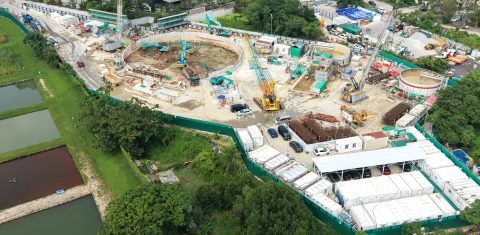
CHINA: Hong Kong’s government has authorised the Northern Link Spur Line project under the Railways Ordinance. This will become the third direct cross-boundary railway, linking the metro networks of Hong Kong and Shenzhen to deepen cross-boundary connections with the mainland. The project which was authorised by the Transport & Logistics Bureau on September 18 involves the construction of a 6.2 km underground line from San Tin station on the NOL Main Line, through stations provisionally named Chau Tau and The Loop to the Huanggang border point in Shenzhen, where there will be co-located border facilities and access to the Shenzhen metro. The Part 1 Project Agreement for the NOL project was signed by MTR Corp and the government in 2025. This enabled the start of major advanced works for the main line, which will connect the existing East Rail Line at Kwu Tung with the Tuen Ma Line at Kam Sheung Road to form a loop connecting the New Territories and the Kowloon urban area. Excavation works are underway for the first tunnel boring machine launching shaft, and the structure of the electrical substation for the tunneling works has also been completed. The NOL Main Line and Spur Line projects are being developed together to maximise synergies, and both expected to open no later than 2034. See also Lion dance launches Hong Kong Northern Link metro expansion project
Tesla has finally re-unveiled its next-generation Roadster, originally unveiled in quite different form back in 2017. So since I did a technical breakdown of how it would work last time, I thought I’d give a quick update with what we know about the new version. (Update: Now that various media videos are out showing a tour of the car, we’re updating this article with answers to some of the questions that were not answered in the product demo). more…
This week’s global railway supply chain news from Railway Gazette International. Robel presented itself with a unified brand identity at InnoTrans 2026, bringing together Robel Rail Automation and Robel Metrics (formerly Vogel & Plötscher) under a single international Robel master brand. Plasser Robel Services will remain part of the Robel Group. ’Customers expect outstanding expertise in railway construction machinery, services, automation and measurement systems. With us, they get everything from a single source under one strong Robel umbrella’, said Managing Director Wolfgang Fally. Bulgarian private freight operator Bulmarket Group has spent €60m restoring the former locomotive and wagon workshop at Ruse as a centre for wagon manufacturing and rolling stock maintenance. The historic workshop closed in 2013, Bulmarket acquired the site in December 2020 and began its phased reconstruction in 2023. It aims eventually to create around 600 jobs at the site. Masabi has launched Masabi AI Labs, an AI Incubator focused on developing tools that deliver ‘meaningful, practical value’ for public transport agencies and their customers. Greater Dayton Regional Transit Authority is testing an AI-powered natural language data tool developed through Masabi AI Labs to enable technical and non-technical users to ask questions about ridership and fare-validation data and receive comprehensive analytics and insights. Masabi AI Labs has worked with a large transport authority in the USA and a machine-learning partner to analyse ticket purchase and validation data to examine distinct sources of revenue loss and assess whether machine learning could reveal additional patterns. Leasing company Alpha Trains has achieved the maximum score of 100 points in the 2026 GRESB Infrastructure Assessment, an ESG benchmark for real assets and infrastructure, and secured a 5-Star Rating for the 10th consecutive year. TÜV Thüringen independently verified both Alpha Trains’ carbon footprint and its Sustainability Report. AtkinsRéalis has appointed Julian Hill as Head of Rail for Asia, Middle East & Australia and Global Rail Development Director to lead the company’s rail business and growth strategy across the broader region. He joins from NEOM, where he served as Executive Director, Regional Infrastructure, and before that was Chief Operating Officer at Etihad Rail. He previously spent more than a decade with AtkinsRéalis, where he led the rail business in the Middle East and Africa. Dirk Rodermann will become Director of Operations at Rail Force One Germany on November 1. He was previously responsible for human resources, fleet management, training and services at Hector Rail. Alstom has launched its first US Innovation Station, located in Pittsburgh alongside the company’s global development centre for signalling and train control. It is headed by Karina Ricks, most recently a partner at the urban strategy consulting firm Cityfi, and will focus on improving accessibility, sustainability, resilience and the passenger experience. Alstom’s Innovation Stations in Paris, Stockholm, Singapore and Montréal are dedicated spaces for collaboration by transport agencies, city authorities, universities, technology centres, start-ups and industry partners. They seek to identify promising local ideas and partnerships, accelerate development and provide a platform to test and incubate new concepts with potential for impact around the world.
Tesla has unveiled a new version of its next-generation Roadster. As expected, it received Tesla’s latest design “cyberfication” and cold-gas thrusters to allow it to jump and flip through the air. The livestream featured impressive stunts but offered few details. Tesla released more information on X after the event, but there’s still no price and no production date. more…
Elon Musk promised a flying car. And the Tesla Roadster did exactly that. Tesla demonstrated its next-generation Roadster at an event in Waco, Texas, where the electric supercar drove upside down, briefly flew, and accelerated to 60mph in under a second. It was an impressive demonstration of a car that likely will come with some heavy caveats and restrictions if it ever goes into production. The event was less than 30 minutes and felt more like a stunt show than a product reveal. Indeed, there was no mention of price, release date, or other such mundane details. Musk promised the hypercar would go into production in 2028, but after near … Read the full story at The Verge.
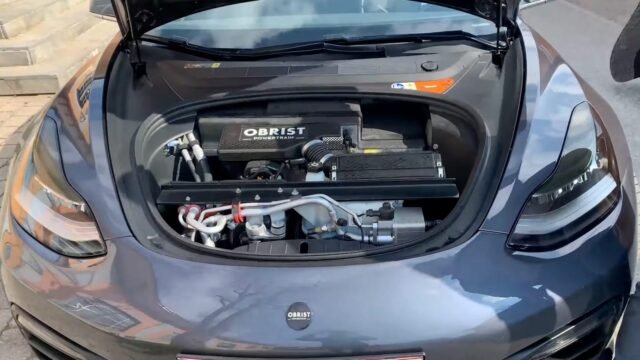
Obrist, the Austrian engineering firm famous for ripping battery cells out of a Tesla Model 3 and bolting a gas engine into the frunk, is bankrupt. Three companies in the Obrist Group are insolvent with combined debts of about €31.8 million, or roughly $37 million. The company spent over a decade pitching its “HyperHybrid” range extender as the smarter alternative to battery-electric cars. It never got a single production vehicle out of it. more…
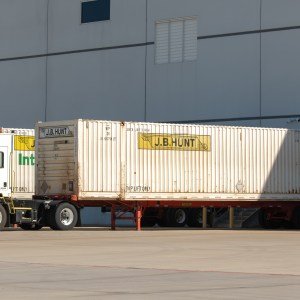
J.B. Hunt Transport Services’ third quarter slightly surpassed analysts’ lowered expectations following the company’s earnings warning issued in September. J.B. Hunt (NASDAQ: JBHT) reported third-quarter revenue of $3.68 billion Thursday after the market closed. The result was ahead of a $3.59 billion consensus estimate. Earnings per share of $1.82 were 1 cent higher than analysts’ revised expectations. (A higher tax rate was a 4-cent EPS headwind in the quarter, partially offset by a 2-cent decline in net interest expense.) The result was slightly better than its September update, calling for a 5% to 10% sequential decline in EPS, implying $1.77 at the midpoint of the range. At the time, the company flagged near-term cost pressures—a sharp runup in diesel prices ($10 million), driver-related costs ($25 million) and elevated cargo claims ($10 million)—as headwinds. The actual impact in the quarter was over $50 million. The third quarter marked a fifth straight quarter of year-over-year improvement to operating income and EPS. The company’s earnings turnaround started in the 2025 third quarter, well ahead of peers. window.googletag = window.googletag || {cmd: []}; googletag.cmd.push(function() { var gptSlot = googletag.defineSlot('/21776187881/FW-Responsive-Main_Content-Slot1', [[300, 100], [320, 50], [728, 90], [468, 60]], 'div-gpt-ad-1709668545404-0').defineSizeMapping(gptSizeMaps.banner1).addService(googletag.pubads()); googletag.pubads().enableSingleRequest(); googletag.pubads().collapseEmptyDivs(); googletag.enableServices(); setInterval(function() { if (!document.hidden) { googletag.pubads().refresh([gptSlot]); } }, 60000); }); googletag.cmd.push(function() { googletag.display('div-gpt-ad-1709668545404-0'); }); Intermodal revenue increased 20% y/y to $1.83 billion as loads were up 8% and revenue per load increased 11%. Higher fuel prices pushed revenue higher in the period. Excluding fuel, revenue per load was up 2% y/y. Volumes increased 18% y/y in the East and 1% on transcontinental lanes. A 3% decline in length of haul, due to a mix shift to the East, was a modest headwind to revenue per load. The unit booked a 91.9% operating ratio (inverse of operating margin), which was 15 basis points worse y/y. Higher costs (driver personnel, equipment and employee benefits) were a drag in the quarter. The dedicated OR deteriorated 360 bps y/y to 91.5%. Revenue was up 11% y/y, almost entirely due to higher revenue per truck per week (inclusive of fuel). Revenue per truck was up just 3% excluding fuel. Average trailers in service increased 11% even though load counts grew just 3%. Higher driver costs, group medical claims, insurance premiums and new account startup costs were among the culprits. The brokerage unit booked a second straight operating profit after 13 quarters in the red. The company’s asset-light truckload unit swung to a $7-million operating profit after a modest second-quarter loss. Shares of JBHT were down 2.4% in after-hours trading on Thursday. The stock fell 14% from its mid-September earnings update to the Thursday close. J.B. Hunt will host a call at 5 p.m. EDT on Thursday to discuss third-quarter results. window.googletag = window.googletag || {cmd: []}; googletag.cmd.push(function() { var gptSlot = googletag.defineSlot('/21776187881/fw-responsive-main_content-slot3', [[728, 90], [468, 60], [320, 50], [300, 100]], 'div-gpt-ad-1665767553440-0').defineSizeMapping(gptSizeMaps.banner1).addService(googletag.pubads()); googletag.pubads().enableSingleRequest(); googletag.pubads().collapseEmptyDivs(); googletag.enableServices(); setInterval(function() { if (!document.hidden) { googletag.pubads().refresh([gptSlot]); } }, 60000); }); googletag.cmd.push(function() { googletag.display('div-gpt-ad-1665767553440-0'); }); Why it matters? J.B. Hunt’s quarterly results serve as a bellwether for the intermodal, trucking and logistics industries. The company’s third quarter was a modest slowdown after four quarters of strong recovery. However, some of the incremental costs that plagued the period were likely transitory in nature. More FreightWaves articles by Todd Maiden: LTL rates hit new high in Q3, moving higher in Q4 Cass: TL linehaul rates up 10% in September, shipment counts remain positive Yellow Corp., Teamsters settle on WARN Act claims The post First look: J.B. Hunt’s Q3 earnings appeared first on FreightWaves.
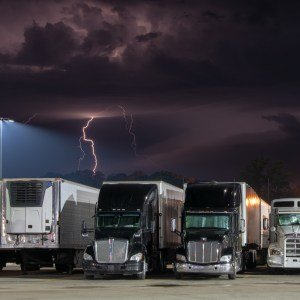
There will be a little more than 2,400 new truck parking spaces built over the next few years as a result of funding provided to various projects under the Nationally Significant Multimodal Freight & Highway Projects (INFRA) program. “A targeted objective of this funding opportunity is to directly address the national shortage of commercial motor vehicle parking,” the Department of Transportation said in announcing the grants Wednesday. “By funding projects that expand safe, accessible public parking for commercial drivers, the Department aims to reduce fatigue-related accidents, improve supply chain fluidity, and provide essential infrastructure along the nation’s most critical freight corridors. To support these national freight and mobility goals, the Department intends to invest in projects that enhance or maintain the operational efficiency of the national transportation network.” According to an FAQ document on INFRA, the funds for parking can only be provided to some sort of public entity or a public-private partnership. The list of acceptable entities to apply included potential applicants as big as a state or a group of them, down to an individual local government or a group of them. But it also provides that any of the public applicants could have applied with a “private entity to fund development, capacity expansion, or operations and maintenance.” There were 14 new parking projects approved by INFRA and announced by the Department of Transportation Wednesday. The precise total of new spots is 2,403. Biggest project in the Volunteer State The largest is a 500 spot project in Tennessee. That project is actually two separate projects, one near Nashville and the other near Knoxville. The recipients of the grant of just under $24 million are three counties, joined together under the banner of the Greater Nashville Regional Council. The new parking spots will be built at five separate Pilot Travel Center locations, according to the fact sheet released by the DOT. They will be built along interstate 40 and interstate 24. Border crossing parking The dropoff to the next largest project is significant: 305 spots to be built in Los Indios, Texas, near the Brownsville border crossing with Mexico. In that project, according to the DOT, work will need to be done to reconstruct about 0.35 miles of a local road that will provide access to a new parking area near the Los Indios Port of Entry. Cameron County was the entity granted the $9.2 million award. The other projects from largest to smallest, along with their sponsors, are as follows: Port of Savannah, 275 spots, sponsored by the Georgia Ports Authority, near the port of Savannah, less than two miles from gate 4 of the port, $24.5 million. Enfield, Connecticut, 260 spots at a new parking facility, sponsored by the state’s Department of Transportation, on interstate 91 north of Hartford, $13.5 million. Rest Iowa sponsored by the state’s Department of Transportation, described as “rural,” 150 spots spread out over six existing rest areas on interstate 80, $24.5 million, sponsored by the state’s Department of Transportation. Port of Wilmington, North Carolina, 140 spots, $6 million, at the port, serving interstate 40, sponsored by the North Carolina State Ports Authority. Interstate 49 rest area, new project on the future interstate 49 in Crawford County, Arkansas, 137 spots, $23 million, Arkansas Department of Transportation is the sponsor. Nebraska interstate 80 rest stop, sponsored by the state’s Department of Transportation, 120 spots for $7.5 million, building a new facility between mile markers 247 and 254 in Dawson County. Monroe County, Georgia, 109 spots, $13.5 million, adding spots at existing sites at two Georgia-owned parking facilities, one a weigh station and one a rest area, sponsored by the state’s Department of Transportation. Wisconsin project on interstate 41 near Dodge County, sponsored by the state’s Department of Transportation, 106 spots for $15 million, adding to two existing areas. Fort Worth Alliance project at a Pilot Travel Center, 100 spots, $5 million, state highway 170 & interstate 35 west, sponsored by the city of Fort Worth. Needles truck parking area, 100 spots at a new 15-acre site, near the interstate 40 and California 95 interchange, $6.4 million, sponsored by the city of Needles. Fergus Falls rest area in Minnesota, 63 spots, $27.7 million, sponsored by the state’s Department of Transportation, located on interstate 94. Southern Illinois project, sponsored by the state’s Department of Transportation, 38 parking spots, reconstructing the southbound Green Creek and Post Oak rest areas on interstate 57. More articles by John Kingston English language rule’s comments bring criticism from Sikh organization Wall Street analysts positive on C.H. Robinson deal; S&P more cautious FMCSA split sleeper berth pilot program moves closer to launch The post Federal DOT grants will fund more than 2,400 parking spots appeared first on FreightWaves.
freight visibility meant knowing where a given truck was, but the industry has only gotten more complex as it has digitized. On a recent episode of FreightWaves’ What the Truck?!?, host Malcolm Harris pressed Andrew Wimer, Associate General Manager, Transportation Management at Descartes, on how visibility metrics have evolved as shippers, carriers, and brokers demand a fuller picture of what’s happening with a load. Wimer, who oversees the Descartes MacroPoint visibility platform, said the fundamentals haven’t gone away. “It’s always been ‘Where’s my truck?’ or ‘Where’s the load? Where’s the freight?’” Wimer said of visibility’s original mandate. “That’s still essential. Don’t get me wrong. You need to know where your freight is or where your truck is.” But Wimer argued the industry’s reliance on electronic logging devices has created blind spots that go beyond simple location pings, and that closing those gaps means rethinking who gets a voice in the tracking process. For years, Wimer said, the industry treated ELDs as the definitive answer to tracking, fraud prevention, and driver accountability. That approach, according to Wimer, sidelined the drivers themselves. “There’s a massive network of millions of drivers who are very good drivers, who are reliable drivers, and who are safe drivers, and when they’re removed from visibility, they don’t have the ability to help validate shipment status,” Wimer said. Validation covers everything from confirming a delivery to speeding up paperwork. Drivers who stay engaged with a tracking app can flag when they’ve arrived at a dock, upload proof-of-delivery documents on the spot, or send updates that would otherwise require a phone call to dispatch. Removing them from the workflow, according to Wimer, meant losing that layer of real-time confirmation just as the industry leaned harder on ELDs as “the silver bullet” for tracking. The fix, however, is not to abandon ELDs. According to Wimer, “We need to bring the drivers back into the equation. We need to leverage ELDs along with the app within the driver community so that we can have the most robust dataset possible and improve our time to cash.” That philosophy is the foundation of Descartes MacroPoint ELD+: to run ELD and mobile app tracking on the same shipment simultaneously, rather than forcing brokers to choose one data source over another. “We’re combining the two data sources together,” Wimer said. “We’re tracking the ELD, the truck, and the driver so that you can have continuity over the tracking session.” The redundancy is the point. If a driver’s phone loses signal, or an ELD provider’s API goes down, the other data source keeps the shipment visible instead of leaving a broker or shipper with a blind spot in the timeline. “If there’s a gap in connectivity or signal or for whatever reason there’s an issue with one of the devices, the other one’s still picking up data and fulfilling any gaps in visibility so you can provide your shippers with good customer service and meet your compliance metrics and scorecards,” Wimer said. Under the hood, Descartes MacroPoint no longer picks a single best identifier to track on a shipment. It tracks all of them at once, on one session, and feeds it all back to the transportation management system. “We’re tracking them all on a single session,” Wimer said. “We’re sending it all back to the TMS.” Beyond redundancy, Wimer said the dual data streams give brokers and carriers a new tool for spotting trouble. When a truck’s ELD and a driver’s phone stop telling the same story, that divergence itself is a signal. “Truck and driver should be telling the same story, moving down the highway together,” Wimer said. “If they go separate ways or signals go different directions, that should set off an alert and an operational workflow to call and investigate.” A mismatch doesn’t always mean fraud, but it’s worth a phone call. “If something odd is going on, get after it before it’s too late,” Wimer said. He pointed to a broader pattern the industry has had to reckon with over the past year: bad actors spoofing location data on both ELDs and driver-facing apps. “There’s spoofing of both ELDs and of the mobile app across any platform,” Wimer said. “Having multiple signals to help validate fraud and give you more data to then go out and talk to carriers is very important.” There’s one specific scam that brokers run into often: a carrier selling a team-driver service (with two drivers alternating behind the wheel to keep a truck moving around the clock) while actually running solo, a bait-and-switch that can show up as a single phone number covering a load that should have two. Wimer, who spent time on the brokerage side of the business before joining Descartes, said he’s seen it firsthand. Tracking multiple sources of data, he said, is an excellent way to catch issues like that as they occur. Rolling out the new ELD+ feature, Wimer said, required no new lift from Descartes’ TMS partners or the brokers using them. Using Descartes Tai TMS as an example, Wimer explained that a broker’s existing driver information (including phone number, truck number, and trailer number) flows automatically into Descartes MacroPoint to kick off tracking, and the solution handles the rest internally. “ELD plus just starts off the bat,” Wimer said. “There’s nothing extra a customer needs to do.” That’s a deliberate design choice rooted in how Descartes manages its relationships with the TMS providers that feed MacroPoint driver data. “We don’t want to add complexity to what a TMS has to send to MacroPoint to take advantage of additional features,” Wimer said. “We want to handle that within the application ourselves, so that customers don’t need the TMS to do anything additional to reap the value from it.” The scale behind that promise, Wimer said, comes from roughly two decades of building out the MacroPoint driver network. “We’ve been building a driver network for roughly two decades,” Wimer said. “We’re talking millions of unique drivers on the network, with their cell phones. They’re ready to track.” On the ELD side, MacroPoint has spent nine years building out telematics integrations and now connects with more than 500 ELD and telematics providers globally. Wimer said that Descartes has worked to maintain the network carefully so tracking doesn’t break down over vendor disputes. Asked what shippers, carriers, and brokers should do first if they suspect their visibility still has gaps, Wimer pointed to the data brokers put into their own systems at the moment of dispatch. “The first thing would be ensuring that you are working with your brokers on the floor to get full driver information. That’s the biggest gap we see,” Wimer said. Wimer said he recognized the temptation to cut corners on driver data firsthand, from his own time working as a broker under deadline pressure. That habit, multiplied across an industry, is what still undermines visibility tools no matter how many data sources feed them, Wimer said. “Getting accurate and good driver information in your TMS is still the biggest hurdle that I see our customers have,” Wimer said. “It starts with a good phone number. It starts with a good truck number or trailer number in the TMS so that then we have something accurate to track against.” Click here to learn more about Descartes. The post Freight Visibility Gets a Second Set of Eyes appeared first on FreightWaves.
#fwtv_UrUAI8EKn0 .fwtv-panel{border:1px solid #d0d0d0;padding:18px;border-radius:6px;line-height:1.6}#fwtv_UrUAI8EKn0 .fwtv-panel p{margin:0 0 12px}#fwtv_UrUAI8EKn0 .fwtv-note{font-style:italic;color:#666;margin-top:16px;padding-top:12px;border-top:1px solid #e0e0e0}Samsara’s new Agent Studio is changing the game for physical operations, making powerful AI agents accessible through a no-code builder. Discover how voice and chat agents are helping logistics companies proactively manage everything from HOS compliance to driver coaching, improving safety by up to 30% and reducing manual review time by 85%. Learn why operators find this hands-free approach essential for real-time problem-solving and how you can build your own custom AI workflows.Samsara has made Agent Studio, its no-code builder for chat and voice AI agents, available to all customers at no added cost, the company announced this week. Usage of AI agents on the platform has grown sevenfold since June, underscoring accelerating demand from fleet operators looking to automate coaching, compliance monitoring, and driver communications without dedicated IT resources. Agent Studio allows operators to build, test, launch, and set permissions on an agent in minutes using plain-language instructions rather than custom code. Agents can trigger automatically — for example, delivering yard entry instructions to a driver when a truck crosses a geofence — or respond on demand to queries about fuel efficiency, safety scores, or hours-of-service status. Brendan O’Driscoll, VP of Platform AI at Samsara, said voice has emerged as the dominant format for physical operations, outpacing chat agents because drivers and site workers need hands-free access to information. He pointed to Jordan Carriers, a fleet of roughly 1,000 drivers, as an early example of the technology’s impact: the carrier deployed a voice agent to automate safety coaching that previously required manual outreach to as many as 140 to 150 drivers at any given time. “The fleet is running about 30% safer — it’s 30% less crashes they’ve seen in that cohort of drivers,” O’Driscoll said. “That’s a perfect example of being able to meet the driver where they are in the moment.” On the compliance side, O’Driscoll highlighted Aspertrum Foods as a customer using an agent to predict hours-of-service violations up to three hours before they occur, tracking remaining stops, drive time, and total shift time in real time. The proactive approach has cut manual review time by roughly 80% to 85%, allowing managers to authorize extensions or reroute drivers before a violation is logged rather than auditing incidents after the fact. The no-code design is central to the product’s pitch to operators. O’Driscoll said tasks that once required a data analyst or a multi-week IT project — such as pulling a fuel-inefficiency report or scheduling outbound calls to drivers with low safety scores — can now be initiated by speaking a plain-language request. “If you can think it, if you can ask it, you know, it will do it,” he said, “and there’s no middle person needed.” Samsara said 30% to 40% of customers who set up one agent go on to run two or more within a short period. The company said its near-term focus is on helping operators identify a first use case — often a start-of-shift briefing — before expanding to fuel efficiency, safety scoring, and other workflows as customer familiarity grows.Samsara’s Agent Studio no-code AI builder is now free for all customers, with platform agent usage up sevenfold since June.Jordan Carriers, a 1,000-driver fleet, reported 30% fewer crashes after deploying Samsara voice agents for automated safety coaching.Aspertrum Foods cut manual HOS compliance review time by 80–85% using an agent that flags potential violations up to three hours in advance.This Summary is generated thanks to a transcription of the interview, for the full interview please enjoy the video above. The post How AI Agents Boost Fleet Safety & Efficiency by 30% appeared first on FreightWaves.