Closing out this week’s Green Deals is Lectric’s freshly launched Spooky Sale with up to $762 e-bike bundle savings (that include two FREE mystery gifts) starting from $999. Right behind that group of treats is the Worx 40V 20-inch Cordless Electric Snow Thrower with 2x 6.0Ah batteries down at $395, as well as the Jackery HomePower 1000 V2 1,024Wh Portable Power Station for $549 that is part of the brand’s Power Outage Ready Sale lineup. We also rounded up a bunch of Greenworks chainsaw deals, like the 24V 6-inch Cordless Electric Mini Chainsaw at $95, and spotted the first Amazon deal on BougeRV’s Lightweight Foldable Electric Wagon with a 360-pound payload capacity. All these and more wait for you below, including the hangover deals from this week at the bottom of the page, like the yesterday’s $550 FREE extra battery Velotric Nomad 2 e-bike bundle, the kids-friendly Hiboy electric dirt bike deals, and more. Head below for other New Green Deals we’ve found today and, of course, Electrek’s best EV buying and leasing deals. Also, check out the new Electrek Tesla Shop for the best deals on Tesla accessories. more…
More than 40 kilograms of cocaine traveled from California to Florida aboard a commercial truck without the carrier’s knowledge. Investigators intercepted the shipment as suspects began unpacking a pallet containing the drugs. Florida Attorney General James Uthmeier announced October 13 that Operation Icebreaker uncovered a trafficking network spanning three South Florida counties. Authorities charged 25 individuals in connection with the operation. Investigators seized approximately 45.5 kilograms of cocaine during the operation. Uthmeier announced the takedown following enforcement operations across Palm Beach, Broward and St. Lucie counties. Officers also recovered fentanyl, methamphetamine, prescription pills and firearms. How cocaine moved through commercial freight According to the Attorney General’s announcement, traffickers concealed multi-kilogram quantities of cocaine aboard commercial trucks. The organization relied on legitimate carriers that authorities described as unaware of the illegal cargo. Investigators identified Ariel Fernandez-Alonso as a major supplier who reportedly claimed receiving 50 to 60 kilograms every 15 days. Detectives intercepted one delivery as Fernandez-Alonso and associates began unloading the shipment. Authorities have not confirmed whether the intercepted pallet traveled through a truckload or less-than-truckload network. Investigators have not identified the shipper, consignee, freight broker or carrier. Specific pickup and delivery locations also remain undisclosed. Court records provide no additional details about the shipment arrangements. Previous FreightWaves reporting has documented other drug trafficking operations involving commercial transportation. One investigation uncovered a $139 million trafficking operation involving broker-style arrangements with knowing drivers. Another case involved $6 million in cocaine concealed beneath a semi-trailer’s floor near the Canadian border. Palm Beach County Sheriff’s Office narcotics detectives began investigating suspicious social media activity in March 2026. A 162-page arrest warrant affidavit details undercover purchases, court-authorized wiretaps and surveillance of suspected distributors. Detectives identified Kenny Charles as a primary supplier to Richard Paterniti during the operation. The filing does not explain how investigators first identified the intercepted California shipment. Investigators identify trafficking network across three counties Authorities executed more than 20 search warrants during coordinated enforcement operations. Prosecutors charged 25 individuals, including Fernandez-Alonso, Paterniti, Charles, Craig Benard, Jerri Kitzelman and Jerry Salerno. Charges include drug trafficking, racketeering conspiracy and unlawful use of communication devices. All defendants are presumed innocent unless proven guilty. Why it matters Legitimate trucking companies can unknowingly transport illegal cargo when traffickers exploit commercial freight networks. The case highlights the importance of shipper verification, accurate cargo documentation and maintaining control throughout the transportation process. Click here for more articles on cargo theft and freight fraud by Phil Brink. Nebraska deputies recover $250K stolen copper load 50 miles past Iowa destination – FreightWaves Freight Fraud Awareness Day returns as strategic cargo theft reshapes trucking – FreightWaves Man gets 2 years for $3.5M Amazon fraud using 23 trucking accounts – FreightWaves The post 25 charged after drug ring used unsuspecting truckers to haul cocaine from California to Florida appeared first on FreightWaves.
Two California Highway Patrol officers are recovering from serious injuries after a Tesla drove into their patrol car at a crash scene on Interstate 80 in Fairfield. The 22-year-old driver told investigators he was asleep with Tesla’s “Full Self-Driving” engaged. CHP released dashcam video of the impact on Thursday. It’s the latest Tesla to plow into an emergency scene, a failure federal regulators started investigating five years ago. more…
The American Trucking Associations wrapped up a busy week Friday as it prepares for its annual conference beginning Sunday, with the American Transportation Research Institute, ATA’s not-for-profit research organization, naming a new head the day after ATA announced a new chief of the entire organization. Page Siplon will head up ATRI, according to a Friday announcement. He will hold the positions of president and chief operating officer. According to ATRI, Siplon was most recently the CEO of TeamOne Logistics, a firm that partners with companies to provide drivers and other employees to carriers. “His leadership focused extensively on the trucking workforce, driver recruitment and retention, safety, and the operational challenges facing motor carriers,” ATRI said in its announcement of Siplon’s hiring. The news of Siplon’s appointment comes a day after the ATA said it had hired Mark Colson, current head of the Alabama Trucking Association, to head the national organization. Georgia background TeamOne is based in Georgia, and Siplon’s career in logistics prior to that was focused on the Peach State. Previously, Siplon had been executive director of the Georgia Center of Innovation for Logistics. He also founded the Georgia Logistics Summit, which ATRI described as “one of the nation’s largest logistics conferences.” Siplon also has been vice chairman of the U.S. Department of Commerce’s Advisory Committee on Supply Chain Competitiveness. Siplon will join the ATRI staff next month. He will work alongside current ATRI president Rebecca Brewster, who is retiring in February 2027. He will then assume his duties at the top of the organization. Siplon’s announcement comes right before the ATA MCE meeting next week which also is when ATRI announces the results of its Top 10 survey. The input from that research into the top 10 issues separates the results out by totals and separate subcategories drawn from driver and management input, the latter of which often reveal a significantly different perspective between the two. ATRI regularly conducts such surveys throughout the year. Earlier this week it announced two new surveys, one aimed at carriers and the other at drivers, on the issue of driver health. Looking at driver health The survey, according to ATRI, will take different approaches in its methodology. ATRI said it would ask drivers to share anonymously several inputs, “as well as their experience with maintaining health and wellness while on the road.” Carriers would be asked by ATRI for information on their fleets’ medical card durations, insurance costs and other key performance indicators. “Motor carriers are also strongly encouraged to share the driver survey with their driver workforce,” ATI said. A medical card is more formally referred to as a Medical Examiner’s Certificate. It certifies a driver’s fitness to be on the road and is required by federal law. In the prepared statement kicking off the health study, ATRI quoted Project 61 Founder & CEO Jeremy Reymer. ““We already know driver health can affect safety,” he said. “The next question is how much it may also be affecting operational risk and cost.” More articles by John Kingston English language rule’s comments bring criticism from Sikh organization FMCSA split sleeper berth pilot program moves closer to launch Federal DOT grants will fund more than 2,400 parking spots The post ATRI gets a new head: TeamOne’s Siplon appeared first on FreightWaves.
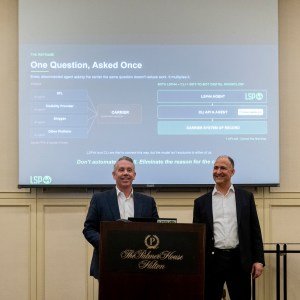
Carrier Logistics and LSP44 have partnered to develop an AI-powered API that can identify less-than-truckload shipments when a shipper or third-party logistics provider does not have the correct tracking number, targeting a source of manual work for carrier customer service teams. The collaboration combines Carrier Logistics freight management software for LTL carriers with LSP44’s AI agent and API infrastructure for logistics service providers. The jointly developed technology allows shippers and 3PLs to submit other shipment details, including company names, delivery locations, shipment descriptions and approximate dates to search for freight through an automated connection. “We’ve opened up the API to accept not just a pro number, but description of the shipment, an approximate date, where it’s getting delivered, and the names of the parties,” Carrier Logistics President Ben Wiesen said. The companies announced the collaboration at Carrier Logistics’ user group conference in Chicago on Friday, Oct. 9. The partnership is now live, according to Carrier Logistics. Traditional tracking APIs rely on a valid PRO number, the identifier used to track less-than-truckload shipments. When a shipper or broker doesn’t have the correct number, the carrier’s system may be unable to find the shipment, forcing the customer to call or email the carrier so an employee can locate the freight manually. As more logistics companies automate communications, failed tracking requests can add to the volume of calls carriers must handle. LSP44 cited RXO‘s report that its AI agents automated more than 500,000 phone calls in the first quarter of 2026, illustrating the growing scale of AI-driven communications in logistics. Also, at Carrier Logistics’ user conference on Friday, Oct. 9, Jeremy Estep, head of sales at LSP44 cited estimates that responding to bot communications can cost motor carriers upward of $10 per shipment. “The industry has treated manual tracking requests as the cost of doing business for decades. Every carrier running LTL has a customer service team absorbing that cost today,” said Nick Ruggiero, LSP44’s head of product. Wiesen described the problem from a carrier perspective. “If both parties don’t know what the tracking number is, then that electronic communication fails,” Wiesen said. The API searches recent shipment records and ranks potential matches using details such as origin and destination, ZIP codes, company names and other shipment characteristics. Shippers and 3PLs can compare the results with their own records to identify the correct shipment and resume electronic tracking. The API first identifies potential shipment matches using defined search criteria. Carrier Logistics said AI then ranks those candidates by accounting for discrepancies in the available information. For example, it might recognize a shipment number with two incorrectly transcribed digits as a potential match, or rank a shipment higher when its ZIP code matches even if its listed weight differs from the search information. Wiesen said the system searches around a week’s worth of shipment records. The approach is intended to replicate the work a customer service representative would perform when trying to identify freight from incomplete information. The API is password-protected and uses account-specific credentials. Carrier Logistics said it considers only shipments associated with validated accounts as potential matches, limiting the records available through a search. Testing whether the API reduces manual inquiries The collaboration targets a specific failure point in freight automation: tracking requests that cannot be resolved because the requesting system lacks a valid shipment identifier. Rather than deploying additional AI agents to respond to calls and emails generated by failed tracking requests, Carrier Logistics and LSP44 are attempting to resolve the identification problem at the API level. “We could put voice bots on our side to answer voice bots on your side, and email-responding AI to email it. But why? Why can’t we just solve the bottleneck and the fundamental problem?” Wiesen said. The system’s effectiveness will depend on whether it can identify the correct shipment from incomplete information and whether the requesting company’s software can use the results to resolve the inquiry without additional manual work. The companies did not disclose how many carriers or customers would participate in the rollout. “We can’t be sure it’s going to stop all the phone calls until we implement and deploy it,” Wiesen said. LTL industry works toward standardized visibility The partnership comes as the LTL industry develops common standards for exchanging shipment information across transportation systems. The National Motor Freight Traffic Association’s Digital Standards Development Council has published an In-Transit Visibility API standard covering shipment status, delays and delivery estimates. The standard defines common milestones, including pickup, in transit, out for delivery and delivered, so shippers and logistics providers can interpret status updates consistently across carriers. The council’s framework also provides for authenticated access to detailed shipment information and public access to certain status information. Its stated goal is to reduce reliance on phone calls and inconsistent tracking portals. Carrier Logistics and LSP44 are addressing a related but distinct problem. Standardized data formats help systems communicate, but the new collaboration is designed to identify the shipment itself when the tracking number supplied in a request is missing or inaccurate. That distinction matters for companies managing freight across multiple carriers and technology platforms. A system can successfully send an API request yet fail to retrieve the intended shipment if it cannot match the available information. The API’s impact will depend on how accurately it identifies shipments from incomplete information and whether those matches reduce manual tracking inquiries. The companies have not yet established how many carriers or customers will participate in the rollout or how much manual work the system can eliminate. Why this matters As logistics companies automate more communications, missing or incorrect shipment identifiers can prevent tracking systems from finding freight and push inquiries back to carrier customer service teams. Carrier Logistics and LSP44 are trying to address that problem at the API level, rather than adding more automation to handle calls and emails. Whether the technology can reduce manual work will depend on its ability to match shipments accurately and its adoption by carriers and logistics providers. The post Carrier Logistics, LSP44 announce partnership to automate LTL shipment identification appeared first on FreightWaves.
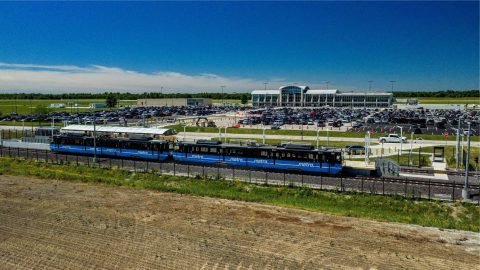
USA: Construction has finished on a $192m extension of the MetroLink light rail system to MidAmerica St Louis Airport in Illinois. The 8.4 km line from Shiloh-Scott Transit Center marks the St Louis network’s first full expansion in two decades. Officials held a ribbon-cutting ceremony at the new airport station on October 5, after which attendees boarded an inaugural train along the newly completed tracks. Revenue passenger service will begin in the coming months once testing is completed. Multimodal corridor The overall scheme comprises three distinct elements. These include the $154m railway extension, $32m in roadway works and a $6m bicycle trail. The 7.2 km MetroBikeLink Trail extension enhances access for cyclists to the wider transport network. Additionally, new road access connects Interstate 64 to the airport terminal and Scott Air Force Base. Funding was provided jointly by the State of Illinois and the St Clair County Transit District. The state contributed $127m through the Rebuild Illinois Capital Programme, and the local transit district supplied $65m. The partners delivered the project on time without federal funding or debt to taxpayers. Direct link between regional airports The new facility represents the 39th station on the MetroLink network. It sits directly opposite the airport terminal and parking facilities. The stop features ‘Taking Flight’, a large sculpture depicting five 3.6 m tall gulls by artist Dale Rogers. Once the new section is operational, the 69 route-km light rail network will offer direct services between MidAmerica Airport and St Louis Lambert International Airport, which, like central St Louis, lies across the Mississippi river in the state of Missouri. St Clair County Chairman Mark Kern praised the regional partnership behind the infrastructure works. ‘This project is much more than a transit expansion. It is an investment in our communities, workforce and future. By connecting MidAmerica St Louis Airport, Scott Air Force Base, employers and neighbourhoods to the region’s transit network, we are creating new opportunities for residents while positioning St Clair County for continued economic growth.’ Bi-State Development President & CEO Taulby Roach highlighted the broader network benefits. ‘When the new MidAmerica Airport Station comes online, the bi-state region will have the unique position of 50 miles of rail connecting dozens of communities to two international airports’, he said. ‘For our riders, this means connecting to more jobs, finding more places to travel, and having even more reasons to choose Metro Transit.’ Local delivery Five separate construction packages were used to design and build the corridor. Project partners coordinated with American Indian tribes to protect culturally and historically significant archaeological sites. Furthermore, the majority of construction contracts were awarded to local firms, union labour and disadvantaged business enterprises. ‘This project shows what can happen when state, local and regional partners come together around a shared vision’, said local county chairman Kern. ‘It would not have been possible without the skilled labour trades and construction professionals whose expertise, dedication and hard work made this project a reality.’ St Louis begins roll-out of Masabi account-based ticketing See also: Metro beats monorail as best choice for the Sepulveda Transit Corridor
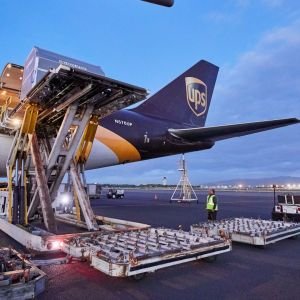
United Parcel Service’s new air hub at Clark International Airport in the Philippines is 15 times larger than its predecessor, enabling the express carrier to provide up to two days faster delivery for customers within Asia and improve connectivity across its global network. UPS (NYSE: UPS) spent $80 million on the expansion project, which includes specialized handling areas for healthcare, high-tech and manufacturing customers with time-sensitive and temperature-sensitive shipments. Parcel handling capacity increased to an average daily volume of 46,000, with maximum processing capacity of 15,000 pieces per hour, according to a news release on Thursday. The announcement marks the first time UPS has disclosed the size of the capital expenditure to expand its Clark hub, which now covers 323,000 square feet. UPS now operates 170 flight segments into and out of Clark every week, connecting businesses across Asia Pacific, India, Europe and the United States in as little as one business day. The new hub has also created nearly 600 jobs, the company said. In August, the U.S. Department of Transportation approved the transfer of six UPS flying rights between Hong Kong and Warsaw, Poland, and Hanoi, Vietnam, to Clark Airport to support growing trade flows between the Philippines and Hong Kong. UPS began operations at Clark, a former U.S. Air Force base, in 2002 and announced plans to build a new facility in March 2024. Why It Matters: Service enhancements enabled by the new Clark hub include up to two days faster delivery to and from eastern China and other major Asia Pacific markets, and similar transit improvements between several Southeast Asian markets and India, UPS said. Faster service also enables UPS to extend shipment pickup windows at customer locations and make faster deliveries to cities in the region. “Asia Pacific has been the heartbeat of global trade for years. There are still plenty of growth opportunities for the region’s businesses and a lot of untapped potential. Clark is the latest in a series of recent major investments UPS has made in its Asia Pacific network and there’s more to come as we continue to speed up connectivity, unlock trade growth opportunities, improve service reliability and strengthen supply chains for our customers,” said Bernard Jiang, president UPS Asia Pacific, in the news release. The new hub houses three refrigeration and freezer units, ranging from -20 to 25 Celsius, dedicated re-icing capability and UPS RFID technology to provide priority handling and enhanced visibility for critical and temperature-sensitive healthcare shipments. It also features an automated sorting system, which uses smart technology to process up to 9,000 small packages per hour. Ramp operations use a fleet of electric ground servicing equipment, including cargo tractors, belt and cargo loaders, ground processing units and forklifts. Clark is the latest in a series of investments to expand capabilities in UPS’s Asia-Pacific network. In March, the express carrier broke ground on a new hub at Hong Kong International Airport and in April it completed an expansion of its hub at Incheon Airport in Seoul, South Korea, quadrupling the size of the previous facility. During the same period, UPS also opened its largest logistics center in the region, in Taiwan. Click here for more FreightWaves/American Shipper stories by Eric Kulisch. Write to Eric Kulisch at ekulisch@freightwaves.com. RELATED STORIES: UPS projects to boost capacity at 3 Asia air hubs The post Larger UPS air hub in Philippines boosts Asia service levels appeared first on FreightWaves.
Container shipping is facing an escalating threat in the Strait of Hormuz, which can impact shippers far from the region. The attacks this week included the Singapore-flagged GFS Pride, which caught fire and sank with containers still aboard. Maritime authorities reported at least 10 vessels attacked in or near the chokepoint since Sunday, with six incidents on Sunday alone, the highest one-day total since the U.S.-Iran war began in February. The 2,824-TEU feeder vessel GFS Pride was hit by an unknown projectile on Tuesday while transiting the strait, sustaining damage and a fire before sinking off Oman. Singapore’s Maritime and Port Authority said all 21 crew members were evacuated safely and no injuries were reported. window.googletag = window.googletag || {cmd: []}; googletag.cmd.push(function() { var gptSlot = googletag.defineSlot('/21776187881/FW-Responsive-Main_Content-Slot1', [[300, 100], [320, 50], [728, 90], [468, 60]], 'div-gpt-ad-1709668545404-0').defineSizeMapping(gptSizeMaps.banner1).addService(googletag.pubads()); googletag.pubads().enableSingleRequest(); googletag.pubads().collapseEmptyDivs(); googletag.enableServices(); setInterval(function() { if (!document.hidden) { googletag.pubads().refresh([gptSlot]); } }, 60000); }); googletag.cmd.push(function() { googletag.display('div-gpt-ad-1709668545404-0'); }); Iran’s Islamic Revolutionary Guard Corps said the vessel struck a naval mine on an “unauthorized” route and was carrying contraband. Singaporean authorities and maritime analysts disputed that account, with the MPA saying the ship was struck by projectiles; CNN reported that experts assessed a drone strike as the more likely cause. A second Singapore-flagged container ship, the GFS Giselle, was also struck by projectiles and suffered hull damage, but reached safe anchorage under its own power; its 22 crew members were reported safe. Two other feeder vessels were also hit, including the 2,500-TEU DP World Kaveri operated by a unit of Dubai’s DP World. The downstream effect can resonate far beyond attacks in the region. Other carriers may have bought feeder slots on the vessels, suggested analyst Lars Jensen. He noted Maersk (OTC: AMKBY), Ocean Network Express, PIL and OOCL showed active schedules for some of the ships. Analysts point out that for shippers, war insurance can be cancelled on short notice if cargo moves on a vessel not owned by the carrier listed on the bill of lading. British security monitor UKMTO data showed 12 vessels reported attacks between Oct. 5 and Oct. 11, the largest weekly total since the war began, following 10 attacks the prior week. Six vessels were struck on Sunday, including five tankers and one container ship. window.googletag = window.googletag || {cmd: []}; googletag.cmd.push(function() { var gptSlot = googletag.defineSlot('/21776187881/fw-responsive-main_content-slot3', [[728, 90], [468, 60], [320, 50], [300, 100]], 'div-gpt-ad-1665767553440-0').defineSizeMapping(gptSizeMaps.banner1).addService(googletag.pubads()); googletag.pubads().enableSingleRequest(); googletag.pubads().collapseEmptyDivs(); googletag.enableServices(); setInterval(function() { if (!document.hidden) { googletag.pubads().refresh([gptSlot]); } }, 60000); }); googletag.cmd.push(function() { googletag.display('div-gpt-ad-1665767553440-0'); }); The GFS Pride and the Antigua and Barbuda-flagged bulk carrier Cape Dao, which sank after being struck on Sept. 23, are the second and third vessels to sink since the conflict began, according to IMO casualty data. Iran has linked the intensified campaign to the U.S. blockade of its ports and tougher sanctions, while U.S. Central Command said commercial traffic continues through the strait with coordinated protection from American forces and regional partners. The violence is beginning to constrain traffic. Analyst Kpler counted 131 crossings through the strait in the week ended Oct. 14, down from 176 the previous week, though the firm cautioned that the decline was not solely attributable to the latest attacks. Kpler estimated 12.6 million barrels of crude oil per day moved through the strait on Oct. 13, below the roughly 15 million barrels per day reported at the end of September. window.googletag = window.googletag || {cmd: []}; googletag.cmd.push(function() { var gptSlot = googletag.defineSlot('/21776187881/fw-responsive-main_content-slot4', [[300, 100], [320, 50], [728, 90], [468, 60]], 'div-gpt-ad-1709668086344-0').defineSizeMapping(gptSizeMaps.banner1).addService(googletag.pubads()); googletag.pubads().enableSingleRequest(); googletag.pubads().collapseEmptyDivs(); googletag.enableServices(); setInterval(function() { if (!document.hidden) { googletag.pubads().refresh([gptSlot]); } }, 60000); }); googletag.cmd.push(function() { googletag.display('div-gpt-ad-1709668086344-0'); }); Read more articles by Stuart Chirls here. Read more: New Long Beach record as volume nears 1M containers Houthi attacks add new geopolitical risk to softening container rates New chief for DP World Americas window.googletag = window.googletag || {cmd: []}; googletag.cmd.push(function() { var gptSlot = googletag.defineSlot('/21776187881/fw-responsive-main_content-slot5', [[728, 90], [468, 60], [320, 50], [300, 100]], 'div-gpt-ad-1665767778941-0').defineSizeMapping(gptSizeMaps.banner1).addService(googletag.pubads()); googletag.pubads().enableSingleRequest(); googletag.pubads().collapseEmptyDivs(); googletag.enableServices(); setInterval(function() { if (!document.hidden) { googletag.pubads().refresh([gptSlot]); } }, 60000); }); googletag.cmd.push(function() { googletag.display('div-gpt-ad-1665767778941-0'); }); Philadelphia ports sets $837 million expansion, first new berth in 50 years Despite new record, Port of LA chief warns of tariff-driven planning risk The post Container ship attacks escalate in Strait of Hormuz appeared first on FreightWaves.
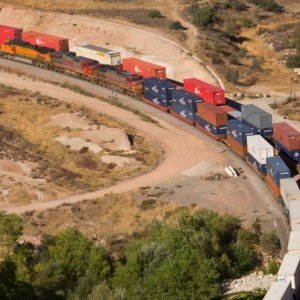
Weekly traffic on U.S.railroads was 534,256 carloads and intermodal units for the week ending Oct. 10, up 7.2 percent compared with the same week a year ago. Carload commodities totaled 232,004 carloads, up 3.4 percent, according to Association of American Railroads data, while intermodal volume was 302,252 containers and trailers, up 10.4% y/y. Eight of 10 carload commodity groups posted an increase from the same week in 2025. They were topped by metallic ores and metals typically used in steelmaking, 19.7%; forest products, 9.6%, and motor vehicles and parts, 9.4%. Declines were seen in coal, 2%, and farm products excluding grain and food, 5.6%. For the first 40 weeks of this year, U.S. railroads reported cumulative volume of 9,142,597 carloads, up 2.7%, and 11,379,949 intermodal units, up 4.4% from a year ago. Total combined traffic was 20,522,546 carloads and intermodal units, an increase of 3.6%. The gains came as high diesel prices and regulatory enforcement have tightened the trucking market. North American rail volume for the week on nine reporting U.S., Canadian and Mexican railroads totaled 338,457 carloads, up 2.6%, and 386,946 intermodal units, up 9.1% y/y. Total combined traffic was 725,403 carloads and intermodal units, up 5.9%. Volume year-to-date was 28,096,978 carloads and intermodal units, up 3.1% from 2025. Subscribe to FreightWaves’ Rail e-newsletter and get the latest insights on rail freight right in your inbox. Read more articles by Stuart Chirls here. Read more:CSX operations chief to retireState loan to aid Louisiana port’s new rail connection Climbing intermodal rail volumes more than treble commodities traffic gains Union Pacific CEO ‘99.99%’ confident rail merger will win approval Major chemical producer backs UP-NS merger The post Intermodal rail better by 10% in latest count appeared first on FreightWaves.
Last night, Elon Musk gave the people what they want: a car driving vertically up a multi-story ramp, launching off the edge, executing a mid-air "kickflip" over a lineup of Teslas, and landing via cold-gas thrusters. That's what the people want, right? "We were promised flying cars," sure, but isn't the operative word in that statement "we"? Because as far as I can tell, everything we saw last night - while extremely cool and incredibly impressive - won't result in a real, production-ready car you can park, or, I guess, land in your driveway. Tesla's late-night demonstration in Waco, Texas, certainly gave some corners of the internet wh … Read the full story at The Verge.