Breaking
Advertisement

Transportation

Category Added in a WPeMatico Campaign

Transportation

Box truck carrier’s pivots show new fleets must know costs

Telly Arnold founded TLA Group LLC, a Houston-based carrier that has run non-CDL box trucks for about three years. In that time the company has rented a truck, co-owned one, financed its own, hauled final-mile appliance deliveries and moved over the road. Her advice to new owners, drawn from each of those stops, comes down to two habits: know every line item behind your cost per mile, and change course quickly when a business model stops paying. She came to trucking with a bachelor’s degree in accounting, a master’s degree in business and more than 20 years in corporate America. She is also a small business trainer at the University of Houston Small Business Development Center. She runs StraightConnect, a platform aimed at new box truck owners, and co-hosts a podcast, “The Box Truck Hustle,” with Sharif Brooks. Arnold started TLA Group to create opportunities for her son, and she planned to run it alongside a full-time job. Her business partner, Sharif Brooks, who has more than 20 years in trucking and a CDL, would drive. “I thought it was something easy I could do while I work full-time and that you can make a lot of money,” Arnold said in an interview with FreightWaves. “I kind of just watched what he did and I saw his work ethic and I was like, I got a driver. I got the business sense. Let’s start a trucking business.” Three tries at a truck and the bills that followed Getting a truck on the road took three tries, and the first was a rental. “We heard that you can rent a truck and then you don’t really have the commitment, but you do not know about how much it costs to rent a truck,” Arnold said. A 50-50 ownership split on a truck with another party came next. “That was a disaster,” she said. The third try was a financed truck of its own, and a truck note came with it. The biggest surprise was the expenses, and they started the day the company’s motor carrier authority went active. The first insurance deposit ran $4,000 to $5,000 against a monthly premium of about $2500. “That was alarming,” Arnold said. “Was not expecting that whatsoever.” Then came renewal. “Also, finding out that even though you renew your insurance, that big deposit does not go away,” she said. “I didn’t realize that every time you renew your commercial policy, you’re having to pay a deposit every single time.” The largest bill she named was a repair. The company’s first major mechanical breakdown cost about $10,000. Of everything on her list, including the deposit and the truck note, the repair bills are the ones she singles out. “The mechanical bills — not maintenance, the mechanical bills,” she said. “When your truck breaks down, how expensive that is.” Final-mile lessons Finding freight came next, and the load board turned out to be the easy part. “People say when your MC becomes active, you can immediately start booking loads on the load board. That is very true. However, there’s not a lot of brokers that like to work with new authority,” Arnold said. TLA Group sat for a month before it went looking for white-glove work, the appliance and furniture deliveries that new box truck owners are told pay $5,000 to $6,000 a week. “That’s not true,” she said. The company landed local carrier work first, then moved into appliance delivery after Hurricane Beryl made landfall in Texas in July 2024. That is where it learned what claims cost. “People tell you about the claims, but they don’t really go into deep details about the claims and how do you survive the claims and what can you do to prevent the claims so your check is not being pinched away,” Arnold said. Her rule for anyone doing that work is documentation at every handoff: a photo of every side of the box at the warehouse, another once it is on the truck and another at the customer’s house, because damage can be concealed inside the packaging. TLA Group learned that on its first day. “We were new. We didn’t know. We didn’t take pictures,” she said. “And so if you don’t have the pictures to support that this refrigerator, as an example, was damaged before we even did anything, you’re going to get hit with a claim. There’s no ifs or buts about it.” Customer surveys carried their own risk. On one install, a stove scratched the inside of a customer’s door. Because the crew worked as contractors, TLA Group was responsible for the damage, and Arnold moved fast to keep a claim off the company’s insurance. “I called a contractor within 24 hours to go out there, repair it, exact paint. I called him, I followed up, I did all the steps, great customer service, and he did a horrible survey on us,” she said. “And because he did a horrible survey on us, I didn’t get a route the next day.” Over the road, from a phone TLA Group left appliance delivery for over-the-road freight in February 2025. “We learned that we have to pivot really fast because when you sit in something too long and you’re seeing that is not a good business model for you, it’s best to make those changes quick instead of just drowning,” Arnold said. Over the road works much the same for a box truck as for a semi, she said. The carrier searches a load board and decides how far out it will run, 500 miles or 1,000. Out of Houston, TLA Group prefers freight headed to the Midwest, where the truck bounces between loads. A load booked on Friday may deliver on Monday. “We’re booking loads off the load boards like Truckstop, DAT. We have to have a pallet jack, straps. Sometimes we got to have PPE. It just really depends what’s on the load board at that time,” she said. Her partner drove the first truck, and he drives the only truck TLA Group runs today. In between, when the company added a second truck, it hired drivers and kept one truck local. “Hiring drivers was another obstacle that I did not see, which is hiring drivers who are qualified to drive non-CDL because the box truck you don’t need a CDL, but you need that CDL knowledge, hours of service, post-trip, pre-trip, making sure you strap down the freight so we don’t get any type of claims,” Arnold said. The company dispatches its own loads, and Arnold is moving into AI dispatch tools to shorten the search. She uses two: Truckstop’s AVA, a voice assistant the load board launched in July, and FleetWorks, which builds AI dispatch agents. “Like on Truckstop, they have a tool called AVA where you could talk to AVA and tell her what you’re looking for,” she said. “And then there’s another company called FleetWorks that they’ll email us and say, ‘Hey, where are you looking? Where’s your truck at?’ And then we’ll tell them how much we can hold, what region we like to go.” “What I like now is everything I do is on my phone,” Arnold said. “Book a load, factor it, everything is on my phone. I generally rarely have to go to my computer.” Knowing the numbers Arnold recently sat down with someone to go through every expense TLA Group carries. She already knew her cost per mile. Now she is learning what each line item inside it pays for. “So when you’re negotiating, you’re knowing that if your rate per mile is $2 a mile, this is covering everything that is helping your truck to stay operational,” she said. Fuel is the line that swings. “If the fuel fluctuates, it is going to hit you, but you still need to know your numbers,” Arnold said. TLA Group splits its fueling between two cards because one drafts its account on Friday and the other on Tuesday, and both carry discounts. “All I can say is we’ve been used to struggling already, so we just come up with a game plan,” she said. Cost-per-mile math also decides when to add a truck. Arnold would not put a second truck on a very young authority unless overhead stopped at insurance, fuel, driver pay and a dispatcher. Before an owner scales, she wants a bookkeeper keeping clean books and reports the owner can read. “Before you jump into that second truck, know your numbers. It’s very important for you to know your numbers,” she said. Drivers shape the insurance bill too. Safety violations affect it, she said, and turnover can make a small carrier look risky. “When I went from one truck to two trucks, drivers in and out, in and out, in and out, you look kind of high risk,” Arnold said. After a year of stability with her partner driving, the company’s latest renewal came in “a lot better,” though Arnold is not sure the stability was why. “Maybe we’ll see next year,” she said. “It may go up three times the amount.” A second truck is on the plan for 2027 or 2028. “I think we’re ready to scale. Our MC is aged. We built a good reputation,” Arnold said. The numbers are where Arnold parts ways with the advice new owners find online. “There are a lot of social media gurus who are out here selling people pipe dreams,” she said. “They concentrate on revenue but you can make six figures in revenue and you need to look at your bottom line.” She built StraightConnect in response. The platform features verified industry voices, and her podcast brings on dispatchers, box truck carriers and factoring companies to explain what to expect. Being in the industry taught her that trucking “is more than just moving freight,” she said. “People are really out here struggling for information and you don’t know who’s really trying to just sell you a course or if they’re really just trying to help you,” Arnold said. “This is why I created my podcast and also why I created the platform StraightConnect because I looked for it and never could find it.” The post Box truck carrier’s pivots show new fleets must know costs appeared first on FreightWaves.

Transportation

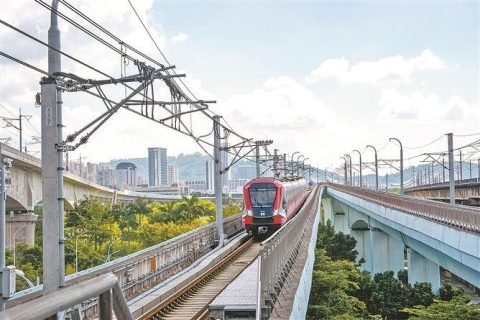
Xiamen adds an inter-urban and an express metro route

CHINA: Limited passenger carrying operations have started with free travel on two newly-opened metro lines in Xiamen, adding a total of 57.4 km or 37% more coverage to the network. With the openings on September 16, the five-line network reached 155.8 km from the previous 98.4 km. Both lines operate with long headways and limited service hours as part of an informal running-in period, where passengers are carried free of charge. Xiamen city map Click to explore Both fully automated metro lines are operated by four-car B-type trainsets using 1.5 kV DC overhead electrification. Express metro to new airport The initial 31.3 km section of metro Line 4 has opened between Jimei Software Park North to Qianwu. Extensions are being built at both ends. At the eastern end, it will serve the Xiang’an International Airport, which is also under construction, while the Xiyan infill station will also be added. A five-station branch is also to follow in the medium term, running southwest from Xiamen North main line station to Huizuo / Maluan Bay South. Line 4 has a maximum operating speed of 120 km/h and relatively long gaps between stations, reflecting the line’s function of linking major transport hubs. It forms part of China’s growing family of express metros, which have been on the rise throughout the country in recent urban rail openings. Inter-urban metro opens The 26.1 km Line 6 opened as Xiamen’s first inter-urban metro line. It links Huaqiao University in Xiamen to Jiaojiang Road in the suburbs of neighbouring Zhangzhou. A two-station extension in Zhangzhou is currently under construction as well as an infill station at Chenjing in Xiamen. The line was developed and is being operated jointly by the two municipalities, but it runs as a through service. China: Express metros serve growing conurbations Xiamen – city map Recent and upcoming openings to extend Changchun metro network by a third

Transportation

The Maeving RM2 is high-style electric riding with a few compromises

There's a fast-growing category of two-wheeled electric vehicles splitting the difference between high-end scooters and entry-level motorcycles, fresh bikes with avant-garde style but approachable performance. I'm talking about offerings like the Infinite Machine P1 and BMW CE 02, similar concepts but with wildly different attitudes. Among this class, the Maeving RM2 stands out. It has a distinctly retrofuturistic flair, bringing together the vibe of classic British motorcycles like the Triumph Bonneville or Royal Enfield Continental GT, just without the literal vibes caused by internal combustion. Quite the contrary, in fact. The RM2 is o … Read the full story at The Verge.

Advertisement
Transportation

R8.9bn enhancement package to boost capacity on South Africa’s heavy haul rail corridor

SOUTH AFRICA: Transnet Rail Infrastructure Manager is undertaking a R8.9bn modernisation programme running to 2030 on the Sishen – Saldanha heavy haul railway, which carries export commodities including iron ore and manganese. The programme aims to improve infrastructure reliability and capacity on the 861 km line, which opened in 1976 to connect mines near Sishen with a port at Saldanha Bay. The investment comes as South Africa seeks to increase rail freight volumes and open its state-owned network to private train operating companies, with the government having set a target of rail carrying 250 mtpa of rail freight by 2029. This corridor alone carried 52.8 million tonnes of iron ore in the 2025–26 financial year, up from 50.6 mtpa the previous year. Its current licensed capacity is 60 mpta and operator Transnet is seeking approval to increase this to 67 mtpa. TRIM plans to invest approximately R2.2 bn in the corridor during the current financial year, including R1.5bn funded from the government’s Budget Facility for Infrastructure which has allocated R3.4bn for the programme. Transnet National Ports Authority is undertaking a separate R750m electrical upgrade at the port of Saldanha to provide power for Transnet Port Terminals to operate a third tippler to support higher throughput. Rolling stock maintenance is being funded separately. Transnet has allocated R1.47bn for the maintenance of locomotives and wagons this year, and a similar sum for next year. The programme includes the overhaul of Class 15E electric locos and Class 43 diesel locos. Transport Minister Barbara Creecy outlined the plans for the corridor during a visit to the line at Upington on October 12. This coincided with the annual maintenance shutdown, when work is undertaken which would be difficult while the trains are running. The shutdown was held from October 6 to 16 this year, enabling rail and sleeper replacement, ballast screening, turnout renewals, formation rehabilitation, culvert installation and electrical and signalling maintenance. The ministry said the shutdown created about 1 300 fixed-term jobs, with a further 600 indirect employment opportunities.

Transportation

ZSSK signs €266m long-distance EMU order

SLOVAKIA: National passenger operator ZSSK has signed a €266m contract with a consortium of Škoda Group and ŽOS Trnava for eight seven-car electric multiple units. Signed at InnoTrans 2026 in Berlin, the agreement includes an option for seven additional trainsets. The first EMUs are expected to be delivered in 2032-33. ZSSK intends to use the trains primarily on the Bratislava – Žilina – Košice corridor, introducing an hourly service. The carrier also plans future international operations with possible extensions to Austria. The basic contract value is €266.2 m excluding VAT. Tri-voltage capability across borders ‘The EMU550 is the first three-system variant of our new-generation electric multiple-unit platform designed for international long-distance services at speeds of up to 200 km/h’, said Tomáš Ignačák, Vice-Chairman of Škoda Group. The 200km/h trains will be 190 m long and will have 566 seats, including 75 in first class. A 32-seat bistro section is also included. To manage busy services, two EMUs will be able to run in multiple. The EMU550 will be equipped for operation under Slovakia’s 3 kV DC and 25 kV 50 Hz systems, as well as Austria’s 15 kV 16.7 Hz. Installed traction power would be 3.8 MW. Initial approvals cover Slovakia, with Austrian certification planned within 12 months of delivery. If the option is exercised, certification will extend to the Czech Republic and Hungary. The specified signalling equipment includes Mirel VZ, PZB90, LZB80 and ETCS. Onboard amenities Passenger facilities will include Wi-Fi, a modern passenger information system, power and USB outlets, adjustable seats and a first-class quiet zone. Dedicated onboard areas will cater for families and cyclists. The trains will provide capacity for two wheelchair users, seven prams and 16 bicycles. The contract includes a 10-year maintenance and service agreement, tendered at €3.27 per train-km. This procurement supports the operator’s shift from locomotive-hauled trains to high-capacity multiple-units. Crucially, the operator expects the new trains to release modernised conventional coaches for deployment on other routes, including Bratislava – Banská Bystrica. Ivana Piňosová, Chairwoman and CEO of ZSSK, said ‘the new EMUs will provide passengers with greater comfort, while also allowing us to redeploy higher-quality carriages from the mainline to other routes and gradually improve the quality of rail travel in other regions’. European co-financing ZSSK launched the tender in March 2025, postponing deadlines following manufacturer inquiries. Ultimately, only one bid was submitted, by the Škoda and ŽOS Trnava consortium, which was selected in March 2026. The consortium has already supplied ZSSK with Panter EMUs and battery-electric trainsets. The trains will be based on Škoda’s 26Ev platform, derived from trains previously developed for Arriva in the Czech Republic. Financing remains a condition for the contract to take effect. ZSSK plans to utilise future EU funding for the base order, while the option covers seven extra trainsets.

Transportation

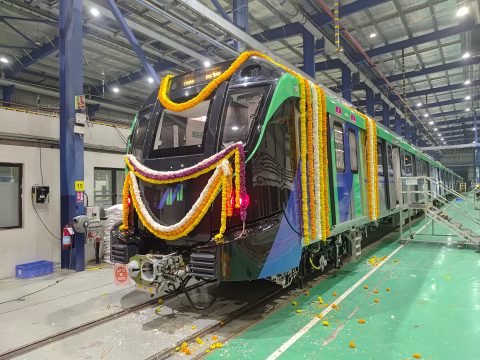
Mumbai Metro Line 4 & 4A train rolled out in ‘record time’

INDIA: Alstom has rolled out the first of 39 Metropolis six-car driverless metro trainsets for the future Mumbai lines 4 and 4A, saying the train was engineered and built in a record time of 14 months. The manufacturer said the trainset unveiled on October 14 draws on its global expertise adapted to Indian conditions. The trains were designed in Bengaluru and are being manufactured at Alstom’s Sri City factory, with propulsion systems supplied from Coimbatore and bogies from Savli. ‘Progress, trust and environmental responsibility’ The 1 435 mm gauge trains have a design speed of 90 km/h and an operating speed of 80 km/h. Features include airflow-based cooling, wheelchair access and, for the first time on an Alstom metro train in India, bicycle racks to support sustainable last-mile connectivity. Development used Alstom’s Eco-design approach, with materials selected with fire safety requirements and environmental considerations in mind. Alstom said the green-and-blue livery ‘reflects progress, trust and environmental responsibility’. Line 4 & 4A project The elevated metro Line 4 will run 32.3 km from Wadala near Mumbai Harbour to Kasarvadavali, with 30 stations. It is expected to reduce journey times by between 50% and 75% depending on road conditions. Line 4A will be a 2.7 km extension from Kasarvadavali to Gaimukh, with two elevated stations. Mumbai Metropolitan Regional Development Authority awarded Larsen & Toubro the Integrated Systems contract for the Line 4 & 4A project. Alstom is supplying the trainsets, signalling systems and depot equipment and will provide five years of maintenance. ‘By bringing together L&T’s expertise in large-scale EPC execution and systems integration with Alstom’s leadership in rolling stock, we are proud to contribute to the government of Maharashtra’s and MMRDA’s vision of a safe, efficient and sustainable urban mobility network for Greater Mumbai’, said S Ramkumar, SVP & Head of Transportation Infrastructure at L&T, when the first trainset was unveiled. ‘With L&T also executing the Power Supply and Track Systems packages for metro Line 4 & 4A, we are well positioned to seamlessly integrate multiple systems in close co-ordination with Alstom and other stakeholders.’

Advertisement
Transportation

The Shift From Owning Trucks To Subscribing To Them, And What It Means For Fleet Finance

The trucking industry has fallen in love with two phrases that get tossed around in conference rooms and press releases without anyone stopping to explain them, and if you have heard the terms truck as a service and driver as a service and nodded along while quietly wondering what they actually mean for the money coming out of your account every month, you are not alone, because at a recent candid session with Daimler Truck and Daimler Truck Financial Services leadership, these concepts got pulled apart in a way that finally makes them concrete for a working carrier. Both ideas come down to the same underlying shift. For as long as most of us have been in this business, buying a truck meant buying a truck, then arranging financing as a separate step, then paying for maintenance, insurance, and everything else out of your own pocket as those bills came due. The model now being pushed by the manufacturers flips that. Instead of a truck plus a stack of separate costs, you get a service, a single arrangement that folds many of those costs into one predictable payment. Understanding how that works, and where the catch is, matters whether you run one truck or a hundred. What Truck As A Service Actually Is Strip away the buzzword and truck as a service is bundling. It is the manufacturer taking the pieces you used to buy and manage separately, financing or leasing, scheduled maintenance, repair contracts, insurance, telematics, extended warranty, and the eventual resale or residual value of the equipment, and wrapping them together into one monthly rate. Stephan Unger, who chairs Daimler Truck Financial Services, framed the company’s own evolution exactly this way, describing a shift from being a pure financing company into an integrated solutions company. The logic he laid out is that customers increasingly want ease of doing business. The fewer separate vendors, invoices, and decisions a carrier has to juggle, the more time it can spend actually moving freight, and bringing all of those services together into a single rate is the advantage the manufacturer is selling. The most complete version of this is full-service leasing and rental, where you are not really buying the truck at all, you are paying to have a working truck available. Unger pointed to a Daimler unit in Europe called Charterway that runs more than 6,000 trucks for customers on short-term and long-term rental, with the pitch being that the customer concentrates on moving goods while the provider takes care of the machine and everything around it. The selling point that lands hardest is uptime. In that model, if a truck goes down, the provider hands you a replacement from the rental fleet so you can keep your commitments to your own customers. In North America, Daimler delivers that kind of full-service leasing through partnerships with Penske and Ryder rather than running the fleet itself, while the rest of the bundle comes through the manufacturer side. Daimler is not a small player making a small bet here. The financial services arm operates in 21 countries with more than 30 billion euros in assets under management and leans on an A credit rating, so when the manufacturer talks about bundling the whole lifecycle of a truck, it has the balance sheet to back the offer. What Driver As A Service Means Driver as a service is the newer and stranger of the two, and it exists because of autonomous trucks. When the driver is no longer a person in the seat but a software system guiding the truck, the question becomes how you pay for that software, and the answer taking shape is a subscription. Daimler described a model where the revenue streams are deliberately separated. You buy or finance the truck and the chassis the way you always have, and then the virtual driver, the autonomous system that actually does the driving, comes as a per-mile software-as-a-service charge layered on top. In other words, the truck is a capital purchase and the driving is a running subscription billed by the mile. The company’s autonomous program centers on a redundant Freightliner Cascadia paired with a virtual driver from its subsidiary Torc Robotics, and leadership said it expects to get the driver out on a first route by the end of this year, building toward commercialization at scale around 2028. For financing, Daimler said it is prepared to structure around whatever shape that autonomous model ultimately takes. The point for carriers is that driver as a service is not a far-off abstraction. It is a payment model being designed right now, and it splits the cost of a truck into owning the metal and renting the capability. The Ownership Question Nobody Wants To Answer Here is where it gets philosophical, and where a reporter in the room cut straight to the heart of it by asking, if all these services are bundled into the financial contract, what does a customer actually own, and do they even have an interest in owning? The honest answer from Daimler’s leaders was that it depends on what you choose, and that flexibility is the whole point. Unger described a menu of states, from straightforward financing where you own the truck, to leasing, to arrangements more common in Europe, with service elements added into the contract according to what the customer prefers. Kevin Bangston, who leads the financial services arm in North America as president and CEO of Daimler Truck Financial Services USA LLC, was clear that a fleet can still decide what suits it best. You can own the equipment and make monthly installments over three years, then sell and remarket it yourself. You can take an operating lease with its own financial advantages and run it for a period. Or you can layer the full ecosystem on top in whatever combination serves your cash flow and flexibility. Importantly, Bangston said North America has not seen a fundamental shift out of ownership and into leasing, no dramatic change in the mix at this moment, just more interest in the bundling concept. So the picture is not that ownership is dying. It is that the options around it are widening, and the manufacturer is increasingly happy to sell you access to a working truck rather than only the truck itself. One force quietly pushing carriers toward these models is residual-value uncertainty, especially with battery-electric trucks. Nobody is fully sure what a used electric truck will be worth in a few years because the battery is the big unknown. Unger noted that Daimler is willing to take on that residual risk because its battery management systems and the data it collects give it a read on the health of the truck and its battery that an individual owner does not have. When the resale value is murky, letting the manufacturer carry that risk through a lease or bundle starts to look more attractive, which is exactly why these as-a-service models tend to grow fastest around new and uncertain technology. The Real Trade-Off For A Small Carrier None of this is free, and the trade is straightforward once you see it. Bundling buys predictability. One monthly rate that covers the truck, the maintenance, the insurance, and the warranty means fewer surprises, and when cash flow is tight, an unexpected major repair that would otherwise sink a month becomes someone else’s problem to absorb. For an operation running thin, that certainty has real value. What you give up is the upside of ownership. When you own the truck outright and maintain it well, you capture the resale value yourself, you build equity, and a paid-off truck becomes a margin machine. Hand the lifecycle to a provider and you trade that equity and that upside for convenience and predictability. Neither choice is automatically right. The answer depends on your breakeven, your cash position, and how much you value a steady number over a shot at the upside. The one mistake is signing into a bundle because it sounds modern without running it against what owning would actually cost and return over the same years. Why It Matters The move from owning trucks to subscribing to them is not a marketing trend, it is a restructuring of how capital, risk, and cost sit on a fleet’s books, shifting maintenance, insurance, warranty, and residual exposure off the operator and into a single recurring rate the manufacturer controls. For any leader responsible for fleet economics, the decision is no longer just which truck to buy but how much of the lifecycle to own versus rent, and getting that balance right against total cost of ownership and residual risk, especially as electric and autonomous equipment make resale values harder to predict, is becoming one of the more consequential financial calls a fleet makes. This article is based on a panel discussion with Daimler Truck and Daimler Truck Financial Services leadership at the DTFS North American headquarters in Charlotte, North Carolina, featuring Eva Scherer, CFO of Daimler Truck Holding AG, Stephan Unger, chairman of Daimler Truck Financial Services, and Kevin Bangston, president and CEO of Daimler Truck Financial Services USA LLC. Figures and forward-looking statements are as presented by the executives. The post The Shift From Owning Trucks To Subscribing To Them, And What It Means For Fleet Finance appeared first on FreightWaves.
Transportation

California trucking owner pleads guilty in $2.1M identity theft scheme

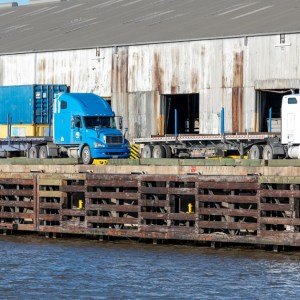
A California trucking company owner pleaded guilty to a $2.1 million fraud scheme involving nearly 100 stolen identities. Hasan Korkmaz, 45, of Las Vegas, operated San Diego Logistics Group Inc. in Santee, California. Federal prosecutors detailed how he processed fraudulent credit card transactions through several businesses, including his trucking operation. Individual charges reached $18,500, ultimately causing more than $2,103,000 in losses across two banks. Korkmaz admitted to all 18 counts involving bank fraud, money laundering and aggravated identity theft on October 15. The operation ran during 2022 and 2023, using personal information belonging to real individuals. Prosecutors traced proceeds into financial accounts he controlled in Turkey. Korkmaz remained overseas for approximately 18 months before returning to the United States, where authorities arrested him in June 2025. How the credit card scheme worked Korkmaz obtained names, birth dates, Social Security numbers and other identifying information to open numerous fraudulent credit card accounts. Prosecutors described the operation as a credit card “bust-out” scheme. The method involves establishing accounts under stolen identities and exhausting available credit without intending to repay the balances. He also submitted checks from nonexistent accounts or those lacking sufficient funds, temporarily restoring credit limits for additional purchases. San Diego Logistics Group was among the businesses that processed the fraudulent credit card charges. Some individual transactions reached $18,500. Prosecutors did not identify the services associated with those payments. Court filings cited in the DOJ announcement do not establish whether the transactions involved actual freight shipments. window.googletag = window.googletag || {cmd: []}; googletag.cmd.push(function() { var gptSlot = googletag.defineSlot('/21776187881/FW-Responsive-Main_Content-Slot1', [[300, 100], [320, 50], [728, 90], [468, 60]], 'div-gpt-ad-1709668545404-0').defineSizeMapping(gptSizeMaps.banner1).addService(googletag.pubads()); googletag.pubads().enableSingleRequest(); googletag.pubads().collapseEmptyDivs(); googletag.enableServices(); setInterval(function() { if (!document.hidden) { googletag.pubads().refresh([gptSlot]); } }, 60000); }); googletag.cmd.push(function() { googletag.display('div-gpt-ad-1709668545404-0'); }); Federal records reveal trucking company’s operating history Federal Motor Carrier Safety Administration records identify San Diego Logistics Group Inc. under USDOT 3210732 and MC 1002578. The company reported three trucks, five CDL drivers and 2,948,000 miles traveled in 2022. Its registered cargo categories included general freight, refrigerated food, fresh produce, meat and U.S. mail. The figures came from the carrier’s November 2023 MCS-150 filing. Divided among three trucks, the reported mileage equals approximately 983,000 miles per truck in one year. The American Transportation Research Institute reported an industry average of 78,863 miles per truck in 2022. That makes San Diego Logistics Group’s reported mileage more than 12 times the industry average. An inaccurate mileage filing or a larger fleet operating during 2022 could explain the discrepancy. Neither explanation has been confirmed, and the mileage figures come from the carrier’s own filings. Its registered cargo categories also do not independently establish completed freight deliveries. For brokers, discrepancies like this highlight why carrier verification must go beyond checking operating authority. Federal records do not establish whether the mileage discrepancy had any connection to Korkmaz’s criminal conduct. FMCSA granted the company’s common carrier authority on December 6, 2021. The agency initiated six involuntary revocation proceedings during 2022 and 2023, subsequently discontinuing each one. FMCSA commonly starts these proceedings when required insurance coverage lapses and may discontinue them after carriers restore compliance. Available records do not establish what triggered each action against San Diego Logistics Group. Regulators ultimately revoked the company’s common carrier authority on January 2, 2024. Its current registration profile lists both common and broker authority as inactive. Insurance records show previous cancellations and no active primary liability coverage. Federal filings do not establish any connection between those regulatory issues and Korkmaz’s criminal conduct. Sentencing scheduled for January The indictment included 12 bank fraud counts, two money laundering charges and four aggravated identity theft offenses. Bank fraud carries a maximum sentence of 30 years per count. Money laundering carries up to 10 years per count under 18 U.S.C. Section 1957. Aggravated identity theft requires a mandatory consecutive two-year prison term. These statutory penalties do not establish the sentence Korkmaz will ultimately receive. U.S. District Judge James E. Simmons Jr. scheduled sentencing for January 8, 2027, at 9 a.m. Assistant U.S. Attorney Kevin Mokhtari and Special Assistant U.S. Attorney Katherine Rookard are prosecuting case 25-cr-1405-JES. The Justice Department has not identified the banks or explained how Korkmaz obtained the victims’ information. window.googletag = window.googletag || {cmd: []}; googletag.cmd.push(function() { var gptSlot = googletag.defineSlot('/21776187881/fw-responsive-main_content-slot3', [[728, 90], [468, 60], [320, 50], [300, 100]], 'div-gpt-ad-1665767553440-0').defineSizeMapping(gptSizeMaps.banner1).addService(googletag.pubads()); googletag.pubads().enableSingleRequest(); googletag.pubads().collapseEmptyDivs(); googletag.enableServices(); setInterval(function() { if (!document.hidden) { googletag.pubads().refresh([gptSlot]); } }, 60000); }); googletag.cmd.push(function() { googletag.display('div-gpt-ad-1665767553440-0'); }); Why It Matters A registered trucking company became part of a financial fraud operation that caused more than $2.1 million in losses. The case highlights the importance of examining company ownership, operating authority and financial activity when evaluating transportation businesses. window.googletag = window.googletag || {cmd: []}; googletag.cmd.push(function() { var gptSlot = googletag.defineSlot('/21776187881/fw-responsive-main_content-slot4', [[300, 100], [320, 50], [728, 90], [468, 60]], 'div-gpt-ad-1709668086344-0').defineSizeMapping(gptSizeMaps.banner1).addService(googletag.pubads()); googletag.pubads().enableSingleRequest(); googletag.pubads().collapseEmptyDivs(); googletag.enableServices(); setInterval(function() { if (!document.hidden) { googletag.pubads().refresh([gptSlot]); } }, 60000); }); googletag.cmd.push(function() { googletag.display('div-gpt-ad-1709668086344-0'); }); Click here for more articles on cargo theft and freight fraud by Phil Brink. 25 charged after drug ring used unsuspecting truckers to haul cocaine from California to Florida – FreightWaves Nebraska deputies recover $250K stolen copper load 50 miles past Iowa destination – FreightWaves Freight Fraud Awareness Day returns as strategic cargo theft reshapes trucking – FreightWaves window.googletag = window.googletag || {cmd: []}; googletag.cmd.push(function() { var gptSlot = googletag.defineSlot('/21776187881/fw-responsive-main_content-slot5', [[728, 90], [468, 60], [320, 50], [300, 100]], 'div-gpt-ad-1665767778941-0').defineSizeMapping(gptSizeMaps.banner1).addService(googletag.pubads()); googletag.pubads().enableSingleRequest(); googletag.pubads().collapseEmptyDivs(); googletag.enableServices(); setInterval(function() { if (!document.hidden) { googletag.pubads().refresh([gptSlot]); } }, 60000); }); googletag.cmd.push(function() { googletag.display('div-gpt-ad-1665767778941-0'); }); The post California trucking owner pleads guilty in $2.1M identity theft scheme appeared first on FreightWaves.
Advertisement