Are the recent outages in the airline booking systems, banking platforms, and productivity platforms really a coincidence? There's actually likely something deeper going on, cybersecurity experts say.
In the wake of the Make America Healthy Again movement's midterm wipeout, a top leader suggested the heavy losses came down to being outspent by wealthier, more powerful rivals. But a Stat report on MAHA's own spending in the run-up to the election raises questions about whether the group's priority was ever winning elections in the first place. The dive into the financial documents reveals that the MAHA PAC, led by Tony Lyons, spent more on allies, boosters, meals, luxuries, and its affiliated nonprofit than it did on political candidates. The findings are in stark contrast to an announcement from Lyons in the spring that he was heading a $100 million fundraiser to boost MAHA's clout in the midterms. In reality, MAHA PAC took in $3.2 million. During the election cycle, the PAC spent more than $10.5 million, with over $7 million coming from money it had collected previously.Read full article Comments
A Russian national has been indicted on suspicions he was a Russian spy who stalked and surveilled employees of a Silicon Valley company that was assisting Ukraine in its ongoing war with its western neighbor. Igor D’iu, 25, allegedly photographed the employees and their computer screens as they worked at a coffee shop located near the company’s Palo Alto office, federal prosecutors said Wednesday. He also kept a list of home addresses of employees and a senior executive. At one point, prosecutors said, D’iu trailed an employee as she traveled home from Palo Alto to San Francisco. An affidavit filed in the case referred to the employee as FEMP1, short for female employee, and said the event left her “in a state of emotional distress.” Evasive and irregular turns “FEMP1 made evasive and irregular turns, took back roads, and turned into a grocery store parking lot where D’IU continued aggressively following her vehicle,” an FBI special agent wrote. “D’IU followed FEMP1 through U-turns, illegal left turns, and ran a red light to stay with FEMP1 for nearly thirty miles. FEMP1 called 911 while driving and was instructed to drive directly to San Francisco Police Department (“SFPD”) Mission Station. Near SFPD Mission Station, FEMP1 flagged an SFPD patrol vehicle and reported the incident. D’IU left once FEMP1 made contact with the patrol vehicle.”Read full article Comments
In October 2025, four Black high school students were sharing Cool Ranch Doritos after football practice, winding down, and waiting for their rides home to arrive. It was then, in the lull of a moment any teen with after-school activities knows well, that the school’s AI gun detection system suddenly flagged one teen holding a bag of chips as a potential gunman. Within two minutes, Baltimore County Public Schools officials who reviewed security camera footage linked to the alert determined there was no actual threat. They recognized the Doritos bag and cancelled the alert, which notified not only other school officials on the chain, but also the Baltimore County Police Department, that no response was needed. The false alert could have ended there—before a traumatizing campus clash with police—but it didn’t.Read full article Comments
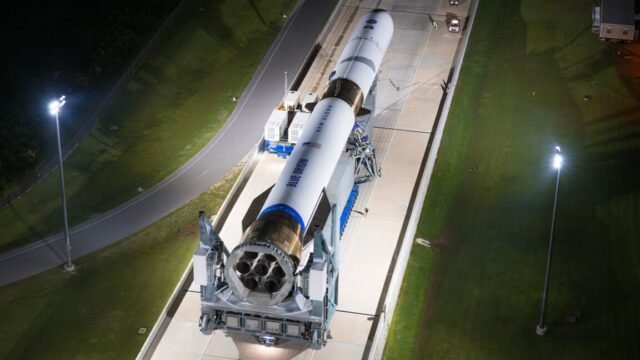
Blue Origin announced Thursday that its New Glenn rocket will launch data center satellites for Google in 2029 as part of that company's Project Suncatcher program. Google disclosed it was working on scalable orbiting data centers about a year ago and characterized the project as one of its research "moonshots." The mission on New Glenn is designed to deploy satellites, each with computing capacity at roughly the scale of a data center rack, into Sun-synchronous orbit where they can receive nearly continuous solar energy. "Project Suncatcher is a long-term moonshot to scale AI infrastructure in space by tapping into the abundant solar power in orbit," said Travis Beals, senior director of Project Suncatcher at Google, in the news release. "This dedicated launch with Blue Origin represents a crucial milestone on our roadmap as we expand the boundaries of what's possible for the future of compute."Read full article Comments
Many studies over the years have examined how people encounter climate science information. Some focused on the top results that Google surfaced (back when Google was still in the business of serving links), while others examined social media content or newspaper and TV news coverage. With large language models (LLMs) now forming a share of the public information diet, it's worth looking at how they handle climate change. But there’s no direct way for researchers to look at the information people have seen. It is served ephemerally to individual users, confined to their chat session. A study led by researchers from University College London and the United Nations Educational, Scientific, and Cultural Organization (UNESCO) tried to tackle this question from multiple angles, testing LLMs with different prompts and evaluating their output. They started with benchmarks of simple factual questions (benchmarks that might even be in models’ training data at this point) but also analyzed more complex interactions—including when users think they’re right to push back on an answer. CO2 Q&A LLM research often faces (no-true-Scotsman-tinged) criticism for focusing on a particular model rather than some other frontier model that may have been released after the experiment concluded. In this case, the study used 33 models, including multiple versions of the major frontier and open-weight models. The flagship frontier models used were Claude Fable 5, Claude Opus 5, Gemini 3.1 Pro Preview, Gemini 3.6 Flash, and GPT-5.6 Sol. (You can find the full list in the report.)Read full article Comments
Google announced Android developer verification last year, and despite numerous objections from developers and users, the company is forging ahead. It began blocking the installation of unregistered apps in some countries this fall, and the system is expanding globally soon. Google says it will start rolling out the requirement in all regions in January 2027, and it urges devs who still haven't registered their apps to do so soon. The apps you download from the Play Store all come from verified developers, and Google's new requirement expands that requirement to apps from third-party sources. Once developer verification is live in your region, you won't be able to sideload apps unless the developer has registered with Google, which is framed as a security measure. Verification requires providing government identification and paying a $25 fee, which will allegedly make it harder for nefarious actors to distribute malware and scammy apps. In September, Google launched verification in Brazil, Indonesia, Singapore, and Thailand. Apparently, nothing exploded, so the company is now ready to expand. It previously said verification would go global in 2027, and it's not wasting any time with the January start. It says that verification will reach all devices within "several months."Read full article Comments
In some of these instances, employees said Muse surfaced messages about childcare requests they never made, career advice they never asked for, product orders they never placed, and bank account balances that didn't belong to them.
Anthropic faces enormous compute commitments as it goes public, but its biggest infrastructure partners, including Amazon and Google, could continue profiting from AI even if Anthropic loses its lead.
There's something about watching violent events that broadly appeals to us, whether it's the latest John Wick movie, a video game, or a live UFC bout. Scientists have debated whether watching violent things could make us more aggressive, but it could also be an adaptive survival strategy. Male mice, for instance, who watched other mice fighting learned enough about how to fight to better protect themselves (compared to mice who didn't watch fights) when pitted against stronger, more aggressive opponents, according to a paper published in the journal Nature. The team randomly assigned male mice to three groups—fighters, spectators, or novices—and then subjected each group to eight days of training with three 10-minute sessions per day. The novices played with stuffed mice in isolation, while the spectators watched various pairs of fighter mice battle from a raised platform behind a transparent barrier—a set-up chosen to let them smell and listen to the fights as well as observe them. The ninth day was "fight night," when all the mice had to face a daunting opponent in three 4-minute rounds. Each fight was filmed from above so that the mouse behavior could be analyzed. To monitor corresponding changes in brain activity, the team engineered the rodents' excitatory brain cells to glow green whenever they were activated, while inhibitory brain cells glowed red. They also implanted tiny optical fibers into 12 interconnected brain regions so they could track changing activity in every brain region simultaneously.Read full article Comments