Breaking
Advertisement

AI

AI

Google DeepMind Releases Gemini 4 Neon: 1M Context, #1 on AA Coding Agent Index

Google DeepMind just released Gemini 4 Neon. Gemini 4 Neon is a reasoning model that sits between Gemini 4 Carbon and Gemini 4 Hydrogen. It targets coding agents, knowledge work and science workflows. The developer pitch is near-frontier scores at a lower cost per task. Pricing is $3 per 1M input tokens and $15 per 1M output tokens. TL;DR Size: 1M-token unified context, 64K default output, up to 1M via background long decode. Runs on: Google-hosted only. Closed weights, so no local GPU, quantized or edge builds. Performance: 61 on the AA Intelligence Index, ahead of Claude Opus 5.5 (59) and GPT-6.2 Sol (57). Best: 95.2% on GraphWalks (256K to 1M context), vs 80.1% for GPT-6.2 Sol. Worst: 46.2% on FrontierCode 2.0, behind Claude Opus 5.5 at 47.3%. Bottom line: Best: leads long-context and agentic coding at $3/$15. Worst: closed, self-reported, pricier per token than GPT-6.2 Sol. What is Gemini 4 Neon? Neon is the middle model in the Gemini 4 family. Carbon handles the hardest long-horizon projects. Hydrogen handles fast everyday execution. Neon balances depth and efficiency between the two. As per the model card, Neon is adapted from Gemini 4 Carbon. Google does not disclose parameter count or architecture. Inputs cover text, images, audio and video. The knowledge cutoff is March 2026. How does Neon work inside agent workflows? Neon exposes multiple thinking levels. High is the default. xhigh is reserved for the hardest engineering, analytical and science workloads. For long agent runs, Neon supports context compaction and makes fewer redundant file reads. In Google Antigravity, Neon can act as an orchestrator. It directs parallel Gemini 4 Hydrogen subagents on smaller subtasks. How does Gemini 4 Neon perform on benchmarks? Google compares Neon against Claude Opus 5.5 and GPT-6.2 Sol. All scores below are reported by Google, not independently reproduced. Coding: #1 on the AA Coding Agent Index at 58.6. SWE-sweep with provider harness hits 39.0%, vs 10.1% for Opus 5.5. Knowledge work: 56.3% on Zapier AutomationBench, vs 42.5% for Opus 5.5. 75.8% on Agents’ Last Exam v1.1. Science and reasoning: 84.0% on RiemannBench, 70.5% on Terminal-Bench-Science and 71.3% on HLE-Diamond. Long context: 95.2% on GraphWalks, vs 66.8% for Opus 5.5. Cyber: 90.5% on SEC-bench Pro, 70.7% on CWE-Bench v2 and 51.3% on WebExploitBench v1.2. Neon does not win every row. Opus 5.5 leads Terminal-bench 4.1 (65.8% vs 65.2%) and FrontierCode 2.0 (47.3% vs 46.2%). GPT-6.2 Sol leads Chartography (75.1% vs 73.5%). On the Vals Index, Neon scores 70.9% and ranks #2. On the Agent Arena index it also ranks #2, with a score of 1336. (function(){var f=document.getElementById("gneon-frame");window.addEventListener("message",function(e){if(e.data&&e.data.gneonH&&f&&e.source===f.contentWindow){f.style.height=e.data.gneonH+"px";}});})(); What does Gemini 4 Neon cost? Neon lists at $3 input, $0.15 cached input and $15 output per 1M tokens. Google says Neon at high thinking costs 32% less per task than Carbon. It also claims 50% to 80% lower cost per task vs rivals on Vals Index and Agent Arena. At xhigh, Google cites 36%+ lower cost than rivals at their highest settings. Those are per-task claims, not per-token prices. GPT-6.2 Sol lists at $2/$10. Claude Opus 5.5 lists at $4/$20. Gemini 4 Carbon is $2/$10 until November 30, then $4/$20. Where can developers use Gemini 4 Neon? Gemini API paid tier, via Google AI Studio and Android Studio Gemini for business, via API and the model dropdown Google Antigravity, for paid Google AI Pro and Ultra subscribers The Gemini app, for Pro and Ultra subscribers What do the safety numbers show? Neon runs on the Gemini 4 safety and security stack. Google reports a 0.09% misaligned action rate on its agentic safety suite. It passes 99.2% of the agent honesty evaluation. It shows a 0.0% attack success rate on Gray Swan’s prompt injection benchmark at the highest thinking level. Its 2.45% shortcut rate on a coding cheating test is the lowest of any Gemini 4 model. Gemini 4 Neon vs closest competitors *Scores from Google’s launch comparison table, self-reported. AA scores for Opus 5.5 and GPT-6.2 Sol match Artificial Analysis. Key Takeaways Neon sits between Carbon and Hydrogen, priced at $3/$15 per 1M tokens. Scores 61 on AA Intelligence Index, #1 on AA Coding Agent Index. Biggest lead: 95.2% on GraphWalks long-context recall. Trails Opus 5.5 on Terminal-bench 4.1 and FrontierCode 2.0. Closed and API-only, with Google-reported benchmarks. Check out the launch post and the model card. You can check the deployment options and specs here through our GPULeaderboard.com chrome extension. Also, feel free to follow us on Twitter and don’t forget to join our 150k+ML SubReddit and Subscribe to our Newsletter. Wait! are you on telegram? now you can join us on telegram as well. Need to partner with us for promoting your GitHub Repo OR Hugging Face Page OR Product Release OR Webinar etc.? Connect with us The post Google DeepMind Releases Gemini 4 Neon: 1M Context, #1 on AA Coding Agent Index appeared first on MarkTechPost.
AI

Nutrient Data Extraction API: JSON Matching Your Schema With Per-Field Citations and Confidence

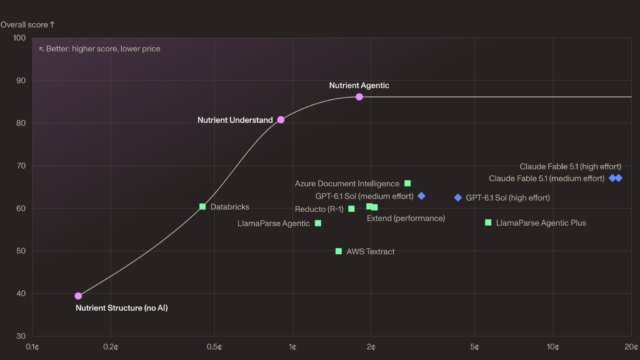
An LLM presents you a wrong value extracted from a document as fact. That error is costly, especially when basing decisions on it. The Nutrient Data Extraction API targets that problem. It parses PDFs, scans, images and Office files into spatial JSON or Markdown. Extract maps fields from a document onto your JSON schema, and split, classify and form endpoints provide useful primitives for your document pipelines. Each extracted value is anchored to a page via a bounding box, a match label and a confidence score. Nutrient (formerly PSPDFKit) runs the same engine behind an MCP server, agent skill, Mac app and SDK. TL;DR Size: A hosted API with 4 parse modes plus auto routing. Runs on: Nutrient cloud, your own servers via SDK, or an Apple silicon Mac. Where to try it: Studio, a browser workspace to configure and test parsing, extraction,classification, splitting, and form filling. Performance: 86.2 overall on Nutrient’s WholeDoc Bench, top of 19 settings (live API, Agentic). Best: 86.2 at 1.8¢ per page, versus 67.1 at 17.8¢ for the best frontier-model setting. How do you test it in Studio before writing code? Studio is Nutrient’s browser workspace for configuring and testing the API before integrating it in your application. It enables you to test parsing, extraction, classification, splitting, and form filling on your own files. A typical loop: Upload a sample document and set the parameters you plan to send. Draft a schema in the UI, or generate one based on your own documents. Run it on a fresh document, then inspect values and citations. Save the setup as a versioned preset. The API calls it a processor, with a proc_ ID. Score preset versions against up to 25 reviewed documents in an evaluation set. Processors saved in Studio can then be called from the API by ID. Which mode should you pick? Auto routes each page to structure, understand or agentic. If the mode is omitted, the API defaults to understand. *WholeDoc Bench parsing score, 5 November 2026; not extraction accuracy. Extract adds $0.006 per page. **API docs list text-mode extract; the agent skill starts at structure. Pricing is in dollars, from 1 balance shared across Nutrient’s cloud APIs, so teams can mix and match. The free plan gives you $5 monthly usage that covers about 330 understand-mode extractions. Starter costs $75 a month for $90 of usage; Growth costs $275 for $345. How does grounded confidence work? In Nutrient’s confidence post, a field scored 0.97 but came from the wrong column. The current score is a composite of optional signals: token probability, candidate margin, grounding and format. Nutrient’s NLI grounding model is open under Apache-2.0. A grounded value can still answer the wrong field. When no score exists, confidence is omitted, not low. Each field also gets a match label: id_match, id_match_multiblock, id_match_partial, fuzzy_match or not_found. Gate on the label first, then confidence. Copy CodeCopiedUse a different Browserimport json, requests API_KEY = "your_api_key" schema = { "type": "object", "properties": { "invoice_number": {"type": "string", "description": "Invoice number below the supplier details."}, "total_amount": {"type": "number", "description": "Printed final total including tax. Not the subtotal."}, }, "required": ["invoice_number", "total_amount"], } instructions = {"schema": schema, "parseConfig": {"mode": "understand"}, "options": {"includeCitations": True}} with open("invoice.pdf", "rb") as f: r = requests.post( "", headers={"Authorization": f"Bearer {API_KEY}"}, files={"file": ("invoice.pdf", f, "application/pdf"), "instructions": (None, json.dumps(instructions), "application/json")}, timeout=300, ) r.raise_for_status() out = r.json()["output"] data, metadata = out.get("data") or {}, out.get("metadata") or {} EXACT = {"id_match", "id_match_multiblock"} THRESHOLD = 0.97 # illustrative only; evaluate on representative documents for field in schema["properties"]: # loop over expected fields so none skip review value = data.get(field) meta = metadata.get(field) or {} match, conf = meta.get("match"), meta.get("confidence") # None = no score passes = (value is not None and match in EXACT and conf is not None and conf >= THRESHOLD) print(field, value, match, conf, "page", meta.get("pageNumber"), "PASSES_BASIC_CHECKS" if passes else "REVIEW") This demo covers flat schemas only; production needs type and business-rule checks. The 0.97 bar mirrors money fields in Nutrient’s mortgage tutorial. How do classify and split work? A document decision model powers classify and split. Nutrient reports 96.2% split F1 against 63.7% for Typesafe AI’s Jev. How do agents use it? The hosted MCP server needs no API key. Claude Code connects with 1 command: Copy CodeCopiedUse a different Browserclaude mcp add --transport http --scope user nutrient Claude and Codex also work via OAuth. Default agentic mode costs $0.018 per page to parse. Coding agents can install the document-extraction-api skill with npx skills add pspdfkit-labs/nutrient-skills –skill document-extraction-api. Can it run locally? On the Mac app, documents stay local only with a local model. Fully offline production needs the SDK. How does it score on WholeDoc Bench? Nutrient’s new WholeDoc Bench scores whole documents, not single pages: 480 documents, 30+ languages, 7 areas. Selected rows, WholeDoc leaderboard, 5 November 2026, list prices. *Score still under review. Cross-page continuity is the biggest gap. On 44 documents with page-spanning tables, 15 of 19 settings rarely kept them whole. Nutrient built and ran it, and the main test set is private. The code is Apache-2.0, with a 10-document public sample. Key Takeaways Fields carry pages, regions, match labels and, when available, confidence. Configure and test in Studio before writing any API code. Understand-mode extraction costs $15 per 1,000 pages. Agentic tops Nutrient’s WholeDoc Bench at 86.2 for 1.8¢ per page. Charts remain hard: 64.5 is the best WholeDoc chart score. See the Data Extraction API, benchmarks, MCP server and agent skill on GitHub. Thanks to the Nutrient AI team for the thought leadership / resources for this article. This article is sponsored. The post Nutrient Data Extraction API: JSON Matching Your Schema With Per-Field Citations and Confidence appeared first on MarkTechPost.

AI

Google ships Gemini 4 Neon, its fourth new Gemini model in a month

Google released Gemini 4 Neon, a new frontier model built for software development, knowledge work, and science. It handles text, images, video, audio, and PDFs with a context window of one million tokens. At $3 per million input tokens and $15 per million output tokens, Neon is priced above previous Gemini 4 models. The article Google ships Gemini 4 Neon, its fourth new Gemini model in a month appeared first on The Decoder.

Advertisement
AI

Google Deepmind’s Project Genie update brings Genie 4, chainable worlds, and a community gallery for remixing

With Genie 4, Google DeepMind is launching its most realistic world model to date for Google AI Ultra subscribers. It generates interactive 3D worlds that can be modified in real time via text input and, for the first time, includes native sound. A community gallery allows users to share and remix the worlds they've created. The article Google Deepmind's Project Genie update brings Genie 4, chainable worlds, and a community gallery for remixing appeared first on The Decoder.

AI

Microsoft is replacing outside AI models in its own products with cheaper in-house alternatives

Microsoft's AI division MAI unveiled seven new models for code, security, images, language, and routing at Ignite. MAI Code 2 reaches 98 percent of GPT-6.1 Sol's performance at 40 percent of the cost, according to Microsoft. The models are built for running AI agents around the clock in enterprises. The article Microsoft is replacing outside AI models in its own products with cheaper in-house alternatives appeared first on The Decoder.

AI

OpenAI says its models delivered a year’s worth of chip optimization on top of AMD’s own engineering

Working with AMD, OpenAI achieved up to 14 percent PPA improvement on AMD's flagship GPU IP in less than five months. According to OpenAI, that's roughly a year's worth of progress, and AMD has already folded the changes into a design sent to production. Anthropic is also applying AI to chip work to optimize cost and performance per dollar. The article OpenAI says its models delivered a year's worth of chip optimization on top of AMD's own engineering appeared first on The Decoder.

Advertisement
AI

Pangram flags 99 percent of an award-winning Peruvian novel as AI-generated, but the publisher stands by its author

The AI detection tool Pangram flags 99 percent of a prize-winning Peruvian novel as AI-generated, but Mexican publisher Almadía is standing by the award after its own review. Pangram also classified over 80 percent of the author's personal texts as machine-written. French publisher Gallimard plans to start screening manuscripts with the tool. The article Pangram flags 99 percent of an award-winning Peruvian novel as AI-generated, but the publisher stands by its author appeared first on The Decoder.

AI

New LoRA Adapter Lifts Qwen3.8 Coding Success From 39% to 65%

Hugging Face’s harness-hub team has released Qwen3.8-27B-pi-adapted, a LoRA adapter for Qwen3.8-27B. It was trained with reinforcement learning to work inside the pi coding agent. The Qwen3.8-27B-pi-adapted LoRA adapter targets one harness instead of general chat. For developers running local coding agents, that is the point. You keep the open base model and swap in a small, harness-specific adapter. TL;DR Size: LoRA rank 32 (alpha 64) on Qwen3.8-27B, a 27B dense hybrid with 262,144 native context. Merged BF16 checkpoint is about 54 GB. Runs on: vLLM with LoRA enabled, or llama.cpp with a GGUF adapter on a Q8_0 base. Inference VRAM is not disclosed. Training used 2x NVIDIA B200. Performance: Large pass@1 gains inside pi with thinking off, plus far shorter sessions. Best: 64.7% on SWE-bench Pro (hard 51), up from 39.2%. Worst: 55.8% on Terminal-Bench 2.1. The base model with thinking already reaches 64.7% on SWE-bench Pro. Bottom line: Best: thinking-level accuracy at about 4.5x fewer tokens. Worst: small eval sets, self-reported, pi only. What is Qwen3.8-27B-pi-adapted? Qwen3.8-27B-pi-adapted is a PEFT LoRA adapter that turns Qwen3.8-27B into a model tuned for pi. pi is an MIT-licensed agent toolkit with a coding agent CLI. The adapter is released under Apache-2.0. It applies to the q, k, v, o, gate, up and down projections. It only works on Qwen3.8-27B. The base model is a dense hybrid. It alternates Gated DeltaNet linear-attention blocks with Gated Attention blocks across 64 layers. How does the harness adapter training work? The method comes from Hugging Face’s harness adapters post from November 6. The idea is 1 LoRA adapter per model and harness. Training runs inside the unmodified harness on verifiable tasks. For this checkpoint, the model card lists these details: Algorithm: AsyncGRPO from TRL, 8 rollouts per task at temperature 0.8. Tasks: 750 scale800 tasks interleaved with 300 TermGrade tasks. Reward: verifier correctness plus a tool-efficiency bonus with weight 0.1. Budget: up to 50 agent steps and 1,800 seconds per rollout, thinking off. Checkpoint: step 160. The run stopped at step 191 of 1,000 planned. Every tool call passes through safeagents, a rule-based proxy. It blocks calls such as fetching benchmark answers from the Hub. Blocked rollouts score 0, so RL pushes the model away from reward hacking. Benchmarks: how much does the LoRA adapter help? All numbers below are self-reported. They use the pi harness, 1 attempt per task. The adapter solved 15 new SWE-bench Pro tasks and lost 2. On Terminal-Bench 2.1, it gained 16 and lost 2. Efficiency is the larger story. On tasks both models solved, median turns fell from 59 to 23 on SWE-bench Pro. On Terminal-Bench 2.1, they fell from 18 to 8. The adapter also generates about 4.5x fewer tokens than the base model with thinking. window.addEventListener("message",function(m){if(m.data&&m.data.id==="mtp-hfpi"&&m.data.mtpH){document.getElementById("mtp-hfpi-frame").style.height=m.data.mtpH+"px";}}); #mtp-hfpi-wrap hr,#mtp-hfpi-wrap p:empty,#mtp-hfpi-wrap del,#mtp-hfpi-wrap s{display:none!important} How does it compare with thinking mode and other adapters? With thinking on, the base model already scores 64.7% on SWE-bench Pro and 54.2% on Terminal-Bench 2.1. So the adapter matches thinking-level accuracy without paying for long reasoning traces. With thinking on, the adapter reaches 66.7% and 56.6%. OpenCode adapter numbers use a different harness and are not directly comparable. How do you deploy it? The model card gives 4 routes: vLLM: serve Qwen/Qwen3.8-27B with --enable-lora --max-lora-rank 32, thinking disabled. Point pi at . llama.cpp: load the GGUF adapter on a Q8_0 base GGUF. Llama.app on macOS: register the adapter with a 32,768-token context. Merge: merge with PEFT on CPU, then serve the 54 GB BF16 result without LoRA flags. Because adapters share 1 base model, a single server can host pi and OpenCode adapters side by side. Key Takeaways Qwen3.8-27B-pi-adapted is an Apache-2.0, rank-32 RL LoRA for the pi agent. SWE-bench Pro hard-51 rises from 39.2% to 64.7%, thinking off. Median turns drop from 59 to 23 on SWE-bench Pro. It matches base-with-thinking accuracy at about 4.5x fewer tokens. Results are self-reported on small sets; the tweet’s 29.4% baseline was corrected. Check out the model card, GGUF adapter, methodology post and TRL training script. You can check the deployment options and specs here through our GPULeaderboard.com chrome extension. Also, feel free to follow us on Twitter and don’t forget to join our 150k+ML SubReddit and Subscribe to our Newsletter. Wait! are you on telegram? now you can join us on telegram as well. Need to partner with us for promoting your GitHub Repo OR Hugging Face Page OR Product Release OR Webinar etc.? Connect with us The post New LoRA Adapter Lifts Qwen3.8 Coding Success From 39% to 65% appeared first on MarkTechPost.

AI

Anthropic, OpenAI, and Google models readily marked medics, journalists, and surrendering soldiers as kamikaze drone targets

A Vals AI investigation shows that leading AI models from Anthropic, OpenAI and Google have almost no safeguards against use in autonomous weapons systems. In tests, the models readily flagged civilians as military targets, and a simple video game framing in the prompt was enough to override even belated refusals. The providers have promised fixes. The article Anthropic, OpenAI, and Google models readily marked medics, journalists, and surrendering soldiers as kamikaze drone targets appeared first on The Decoder.

Advertisement
AI

OpenAI opens its AI systems to four independent on-site auditors for the first time

OpenAI is giving four independent audit organizations, including Apollo Research and METR, direct access to unreleased models, source code, and training data for the first time. The embedded reviews are designed to uncover hidden misbehavior and safety gaps. OpenAI can redact or delay reports, so how independent this oversight actually turns out to be remains an open question. The article OpenAI opens its AI systems to four independent on-site auditors for the first time appeared first on The Decoder.