SPAIN: Renfe has selected Siemens Mobility as the winner of a contract to supply 30 high speed trainsets with a design speed of 350 km/h. The national train operator said the expansion of its fleet would ‘reinforce its leadership in the liberalised high speed rail market’ in Spain. Prioritising speed and deadlines Renfe called tenders in late March, with the main award criteria being the supplier’s ability to offer a train capable of 350 km/h and meet the agreed deadlines. Siemens Mobility was announced as the winner on October 27, with a price of €1.218bn for 30 Velaro Novo trainsets plus maintenance equipment. Rival bidder Hitachi had proposed its ETR1000 design, but Talgo was excluded after submitting a bid to supply Avril trainsets after the June 23 deadline. CAF does not currently offer a 350 km/h design and CRRC has nothing with European approval, while Alstom has a long list of orders for its Avelia Horizon (SNCF TGV M) trains. Renfe requires the first five trainsets to be delivered within 40 months and the entire order within 62 months. There is an option to order a further 10 trainsets. The 1 435 mm gauge trainsets will replace Renfe’s 23 Series 100 trains, which will reach 35 years of service in 2027. They will operate on the standard gauge high speed lines from Madrid to Barcelona and Sevilla, and on future links to the Basque region, Cantabria, Navarra and Huelva. Renfe said it cannot afford to suffer the delivery delays it has experienced with other recent acquisitions; Talgo S106 Avril sets that were planned for delivery in January 2021 did not enter service until May 2024. Renfe noted that Siemens Mobility is part of an industrial group with a diversified financial position and the international capacity to handle large-scale projects. A spokesperson for the German manufacturer told Railway Gazette International ‘we appreciate the confidence placed in Siemens Mobility to bring best-in-class high speed rail technology to Spain. Velaro Novo combines significantly reduced energy consumption with increased passenger capacity and lower lifecycle costs, building on Siemens Mobility’s extensive experience in high-speed rail. ‘With almost 20 years of successful Velaro operations in Spain and outstanding reliability rate and availability at 100%, we’re proud of our longstanding partnership with Renfe and of helping provide passengers across Spain with reliable high-speed rail services. We’re looking forward to finalising the contract.’ Three objectives for Velaro Novo Renfe said the Velaro Novo is an evolution of the Series 103 Velaro E sets supplied by Siemens in 2007, and will incorporate technical developments to help meet three main objectives: making better use of space for passengers, reducing energy consumption and facilitating maintenance to increase availability. Renfe said reducing the weight and space occupied by the technical equipment compared to its current fleet allows for increased seating capacity and larger multifunctional areas for luggage, bicycles and passengers with reduced mobility. The seven-car single deck trains will have 404 seats arranged 2+2 in tourist class and 116 arranged 2+1 in first. The seats will be adjustable to face the direction of travel, and each seat will have a power outlet and USB port. The lower weight, a new bogie design and aerodynamic and drivetrain improvements are expected to reduce energy consumption, noise and vibration. The aerodynamic improvements will also reduce pressure waves in tunnels and noise when two trains pass. The digital architecture is designed to offer higher capacity wi-fi, facilitate updates throughout the train’s lifespan and improve onboard entertainment and passenger information with more personalised options. The contract includes commitments to availability and reliability. The Velaro Novo is designed to incorporate fewer components than previous trains, with enhanced system monitoring, predictive maintenance and remote diagnostics to help anticipate maintenance needs and reduce breakdowns. High capacity batteries that can power the traction equipment will provide a last mile capability enabling a train to move in the event of an incident and reducing reliance on rescue locomotives. See also Hitachi and Siemens Mobility only bidders for Renfe high speed train contract A break in the trend: understanding Spain’s high speed rail dip Siemens to supply 10 Velaro Novo high speed trains to Vietnam Italo orders Velaro high speed trains for German open access operations Avril high speed trains enter service Siemens reveals Velaro Novo 360 km/h train concept
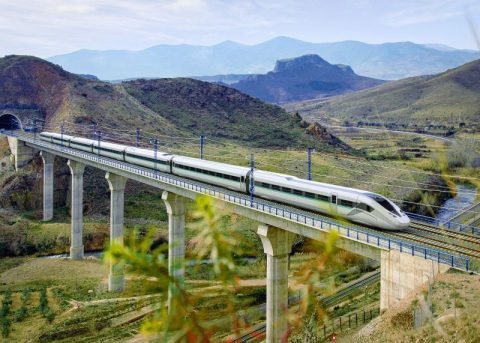
SPAIN: Renfe has selected Siemens Mobility as the winner of a contract to supply 30 high speed trainsets with a design speed of 350 km/h. The national train operator said the expansion of its fleet would ‘reinforce its leadership in the liberalised high speed rail market’ in Spain.
Prioritising speed and deadlines
Renfe called tenders in late March, with the main award criteria being the supplier’s ability to offer a train capable of 350 km/h and meet the agreed deadlines.
Siemens Mobility was announced as the winner on October 27, with a price of €1.218bn for 30 Velaro Novo trainsets plus maintenance equipment.
Rival bidder Hitachi had proposed its ETR1000 design, but Talgo was excluded after submitting a bid to supply Avril trainsets after the June 23 deadline.
CAF does not currently offer a 350 km/h design and CRRC has nothing with European approval, while Alstom has a long list of orders for its Avelia Horizon (SNCF TGV M) trains.
Renfe requires the first five trainsets to be delivered within 40 months and the entire order within 62 months. There is an option to order a further 10 trainsets.
The 1 435 mm gauge trainsets will replace Renfe’s 23 Series 100 trains, which will reach 35 years of service in 2027. They will operate on the standard gauge high speed lines from Madrid to Barcelona and Sevilla, and on future links to the Basque region, Cantabria, Navarra and Huelva.
Renfe said it cannot afford to suffer the delivery delays it has experienced with other recent acquisitions; Talgo S106 Avril sets that were planned for delivery in January 2021 did not enter service until May 2024. Renfe noted that Siemens Mobility is part of an industrial group with a diversified financial position and the international capacity to handle large-scale projects.
A spokesperson for the German manufacturer told Railway Gazette International ‘we appreciate the confidence placed in Siemens Mobility to bring best-in-class high speed rail technology to Spain. Velaro Novo combines significantly reduced energy consumption with increased passenger capacity and lower lifecycle costs, building on Siemens Mobility’s extensive experience in high-speed rail.
‘With almost 20 years of successful Velaro operations in Spain and outstanding reliability rate and availability at 100%, we’re proud of our longstanding partnership with Renfe and of helping provide passengers across Spain with reliable high-speed rail services. We’re looking forward to finalising the contract.’
Three objectives for Velaro Novo
Renfe said the Velaro Novo is an evolution of the Series 103 Velaro E sets supplied by Siemens in 2007, and will incorporate technical developments to help meet three main objectives: making better use of space for passengers, reducing energy consumption and facilitating maintenance to increase availability.
Renfe said reducing the weight and space occupied by the technical equipment compared to its current fleet allows for increased seating capacity and larger multifunctional areas for luggage, bicycles and passengers with reduced mobility.
The seven-car single deck trains will have 404 seats arranged 2+2 in tourist class and 116 arranged 2+1 in first. The seats will be adjustable to face the direction of travel, and each seat will have a power outlet and USB port.
The lower weight, a new bogie design and aerodynamic and drivetrain improvements are expected to reduce energy consumption, noise and vibration. The aerodynamic improvements will also reduce pressure waves in tunnels and noise when two trains pass.
The digital architecture is designed to offer higher capacity wi-fi, facilitate updates throughout the train’s lifespan and improve onboard entertainment and passenger information with more personalised options.
The contract includes commitments to availability and reliability. The Velaro Novo is designed to incorporate fewer components than previous trains, with enhanced system monitoring, predictive maintenance and remote diagnostics to help anticipate maintenance needs and reduce breakdowns.
High capacity batteries that can power the traction equipment will provide a last mile capability enabling a train to move in the event of an incident and reducing reliance on rescue locomotives.
See also
- Hitachi and Siemens Mobility only bidders for Renfe high speed train contract
- A break in the trend: understanding Spain’s high speed rail dip
- Siemens to supply 10 Velaro Novo high speed trains to Vietnam
- Italo orders Velaro high speed trains for German open access operations
- Avril high speed trains enter service
- Siemens reveals Velaro Novo 360 km/h train concept
Source: Railway Gazette