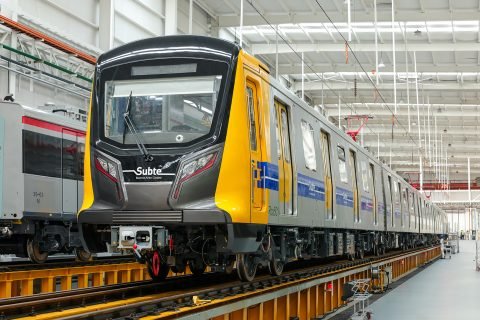
ARGENTINA: CRRC Changchun Railway Vehicles has unveiled in China the first of 10 five-car trainsets it is building for Buenos Aires metro lines A and C. The vehicles were ordered in January 2025 to increase frequencies. The first two trains are scheduled to arrive in Argentina in January and begin testing and commissioning, with the expected entry into service from April 2027. The vehicle features air conditioning, four CCTV cameras per car, and audio and visual passenger information systems. It has non-slip fibreglass seats and dedicated spaces for people with reduced mobility and Braille signage next to doors. ‘We are undertaking a historic transformation of the subway system’, said Javier Ibañez, President of metro development authority Subterráneos de Buenos Aires at the unveiling ceremony on October 23. ‘These cars will allow us to provide better service on Line A and on key corridor Line C, which serves two of the main rail hubs, and the trains for Line B will be ready very soon as well. We have already renovated 21 stations and are carrying out key works to modernise the infrastructure of our century-old network.’ Subterráneos de Buenos Aires has directly awarded Zhuzhou CRRC Times Electric a contract to upgrade the signalling system on metro Line B, including the deployment of CBTC.
ARGENTINA: CRRC Changchun Railway Vehicles has unveiled in China the first of 10 five-car trainsets it is building for Buenos Aires metro lines A and C.
The vehicles were ordered in January 2025 to increase frequencies. The first two trains are scheduled to arrive in Argentina in January and begin testing and commissioning, with the expected entry into service from April 2027.
The vehicle features air conditioning, four CCTV cameras per car, and audio and visual passenger information systems. It has non-slip fibreglass seats and dedicated spaces for people with reduced mobility and Braille signage next to doors.
‘We are undertaking a historic transformation of the subway system’, said Javier Ibañez, President of metro development authority Subterráneos de Buenos Aires at the unveiling ceremony on October 23.
‘These cars will allow us to provide better service on Line A and on key corridor Line C, which serves two of the main rail hubs, and the trains for Line B will be ready very soon as well. We have already renovated 21 stations and are carrying out key works to modernise the infrastructure of our century-old network.’
Subterráneos de Buenos Aires has directly awarded Zhuzhou CRRC Times Electric a contract to upgrade the signalling system on metro Line B, including the deployment of CBTC.
Volkswagen’s latest recall now extends to Audi, affecting more than 9,000 Q4 E-Tron and Q4 Sportback E-Tron vehicles. And just like with the ID.4, owners are being told to limit charging to 80% of the battery’s capacity. more…
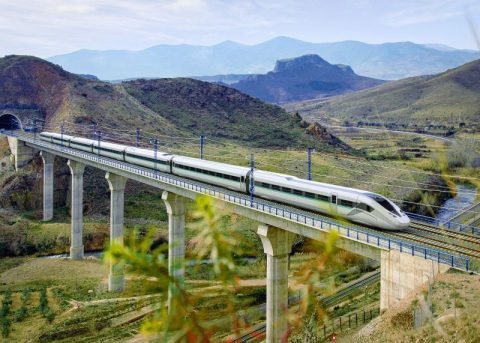
SPAIN: Renfe has selected Siemens Mobility as the winner of a contract to supply 30 high speed trainsets with a design speed of 350 km/h. The national train operator said the expansion of its fleet would ‘reinforce its leadership in the liberalised high speed rail market’ in Spain. Prioritising speed and deadlines Renfe called tenders in late March, with the main award criteria being the supplier’s ability to offer a train capable of 350 km/h and meet the agreed deadlines. Siemens Mobility was announced as the winner on October 27, with a price of €1.218bn for 30 Velaro Novo trainsets plus maintenance equipment. Rival bidder Hitachi had proposed its ETR1000 design, but Talgo was excluded after submitting a bid to supply Avril trainsets after the June 23 deadline. CAF does not currently offer a 350 km/h design and CRRC has nothing with European approval, while Alstom has a long list of orders for its Avelia Horizon (SNCF TGV M) trains. Renfe requires the first five trainsets to be delivered within 40 months and the entire order within 62 months. There is an option to order a further 10 trainsets. The 1 435 mm gauge trainsets will replace Renfe’s 23 Series 100 trains, which will reach 35 years of service in 2027. They will operate on the standard gauge high speed lines from Madrid to Barcelona and Sevilla, and on future links to the Basque region, Cantabria, Navarra and Huelva. Renfe said it cannot afford to suffer the delivery delays it has experienced with other recent acquisitions; Talgo S106 Avril sets that were planned for delivery in January 2021 did not enter service until May 2024. Renfe noted that Siemens Mobility is part of an industrial group with a diversified financial position and the international capacity to handle large-scale projects. A spokesperson for the German manufacturer told Railway Gazette International ‘we appreciate the confidence placed in Siemens Mobility to bring best-in-class high speed rail technology to Spain. Velaro Novo combines significantly reduced energy consumption with increased passenger capacity and lower lifecycle costs, building on Siemens Mobility’s extensive experience in high-speed rail. ‘With almost 20 years of successful Velaro operations in Spain and outstanding reliability rate and availability at 100%, we’re proud of our longstanding partnership with Renfe and of helping provide passengers across Spain with reliable high-speed rail services. We’re looking forward to finalising the contract.’ Three objectives for Velaro Novo Renfe said the Velaro Novo is an evolution of the Series 103 Velaro E sets supplied by Siemens in 2007, and will incorporate technical developments to help meet three main objectives: making better use of space for passengers, reducing energy consumption and facilitating maintenance to increase availability. Renfe said reducing the weight and space occupied by the technical equipment compared to its current fleet allows for increased seating capacity and larger multifunctional areas for luggage, bicycles and passengers with reduced mobility. The seven-car single deck trains will have 404 seats arranged 2+2 in tourist class and 116 arranged 2+1 in first. The seats will be adjustable to face the direction of travel, and each seat will have a power outlet and USB port. The lower weight, a new bogie design and aerodynamic and drivetrain improvements are expected to reduce energy consumption, noise and vibration. The aerodynamic improvements will also reduce pressure waves in tunnels and noise when two trains pass. The digital architecture is designed to offer higher capacity wi-fi, facilitate updates throughout the train’s lifespan and improve onboard entertainment and passenger information with more personalised options. The contract includes commitments to availability and reliability. The Velaro Novo is designed to incorporate fewer components than previous trains, with enhanced system monitoring, predictive maintenance and remote diagnostics to help anticipate maintenance needs and reduce breakdowns. High capacity batteries that can power the traction equipment will provide a last mile capability enabling a train to move in the event of an incident and reducing reliance on rescue locomotives. See also Hitachi and Siemens Mobility only bidders for Renfe high speed train contract A break in the trend: understanding Spain’s high speed rail dip Siemens to supply 10 Velaro Novo high speed trains to Vietnam Italo orders Velaro high speed trains for German open access operations Avril high speed trains enter service Siemens reveals Velaro Novo 360 km/h train concept
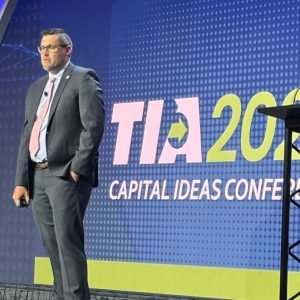
Chattanooga–The Transportation Intermediaries Association (TIA) was quick out of the box earlier this year after two key court decisions that didn’t favor the brokerage community, asking the federal government for some sort of guidance for 3PLs: tell us what sort of carrier hiring practices would protect us. Chris Burroughs is the head of TIA and he told an audience at the FreightWaves Broker Compliance Symposium here on Monday that what the TIA is seeking through its request for a federal rulemaking would take a long time to arrive, earlier efforts having stalled out. “It’s no secret that carrier selection has been problematic for a very long time,” Burroughs said in an interview at the FreightWaves Broker Compliance Symposium here. (Full disclosure: the author of this article conducted the on-stage interview with Burroughs). “I’ve been at TIA for 15 years, and we were having these arguments when I first started that hey, we’ve got to figure out and provide more clarity and eliminate the confusion that exists in the carrier selection process.” The issue is now more stark than ever. While Montgomery vs. Caribe stripped the brokerage community of the liability and negligence protection that had (mostly) been afforded under the Federal Aviation Administration Authorization Act (F4A), it became an even bigger issue not that many weeks later when C.H. Robinson was hit with a more than $600 million nuclear verdict–now at more than $700 million–as a result of a jury award involving a carrier hired by C.H. Robinson (NASDAQ: CHRW) that had a Satisfactory rating from the Federal Motor Carrier Safety Administration (FMCSA). The TIA’s request for a federal rulemaking on the issue occurred between the Montgomery decision and the nuclear verdict in the case of Lipe vs. Lupus Superior. A long history of efforts Burroughs recapped a long list of efforts on the legislative and regulatory side to get some sort of guidance on carrier selection that could be used as part of a courtroom defense. He described negotiations with the association of trial lawyers that would constantly get sidetracked by their opposition as being like Lucy pulling the football away from Charlie Brown. The launch of Commercial, Safety, Accountability scores in 2010 was seen as a way to advance guidance on carrier selection, Burroughs said. “That was supposed to be the answer to tie a data-driven product to a safety rating,” Burroughs said. “Ultimately, that never happened.” Chris Burroughs (l) and John Kingston at FreightWaves’ F3 Broker Compliance Symposium Even the brokerage industry’s desire for changes softened somewhat when the industry began winning some cases through the protection of F4A, Burroughs said. Behind the recent petition for a federal rulemaking, Burroughs said, is saying to FMCSA “hey, you are the federal agency that’s in charge of providing safety ratings to motor carriers. We want you to put forward a federal standard, taking it out of Congress’ hands because of the dysfunction and putting it back in the agency’s hands, where we believe it belongs.” But he added, “rulemaking takes a long time.” Guidance would be a help A more short-term answer might be for FMCSA to issue guidance, Burroughs said. The guidance might say, according to Burroughs, “hey, these are the five or six things, whatever they come up, that should be checked prior to selecting a trucking company, and that would serve as kind of a pseudo carrier selection standard.” FMCSA has a private document of high-risk carriers, Burroughs said. One of the requests TIA has made of the agency is to publish that list as well The brokerage community is also the target of lawsuits filed by plaintiffs who are funded by venture capital companies. (It was discussed how Paul Clement, who represented Shawn Montgomery before the Supreme Court, is the “Michael Jordan” of attorneys who argue before the high court. Burroughs declined with a smile to estimate on what Clement was getting paid by the hour). “They’re seeing blood in the water,” Burroughs said. Tough choices to be made The quandary that C.H. Robinson now faces in Lipe vs. Lupus Superior is that the ruling was not only expensive. It also involved a finding that the driver in the crash, who was killed, was essentially a C.H. Robinson employee. That sort of ruling, if it established a precedent, would open the door to even greater litigation hitting brokers. But the clock is ticking at an annual rate of more than 6% interest on the now $700-million judgement which began at $603 million. A settlement would end the process but leave the finding about the driver’s relationship to C.H. Robinson intact. Burroughs said C.H. Robinson’s strategy is clear: it is going to fight the verdict and not settle the case, which came out of a Dallas County courthouse. “I’ve talked to (C.H. Robinson CEO) Dave Bozeman and (chief legal officer) Dorothy Capers,” Burroughs said. “They’re clearly going through the appeal process. They’re not going to settle the case.” He also expressed confidence based on those conversations that C.H. Robinson can win on appeal. Better news on insurance One of the potential negative impacts from the dual hits of Montgomery and Lipe was expected to be seen in insurance rates paid by brokers. Burroughs said soon after the decision, “there was a two to four week period where rates were extremely high in terms of renewal.” Much of that was timing, he added; TIA members who renewed just before that period “hit the lottery.” But that trend has calmed, according to Burroughts. “We’re not seeing any sort of massive, drastic increase in terms of insurance rates at double digits,” he said. More articles by John Kingston English language rule’s comments bring criticism from Sikh organization FMCSA’s Elison addresses Motus again, still no date on full repair CEO’s letter boasts of lots of arrows pointing up at Triumph Financial The post Federal guidance on carrier selection not around the corner: TIA’s Burroughs appeared first on FreightWaves.