NIO targets 10,000 battery swap stations and $52B in batteries by 2030
Transportationvia Electrek
Quick Read
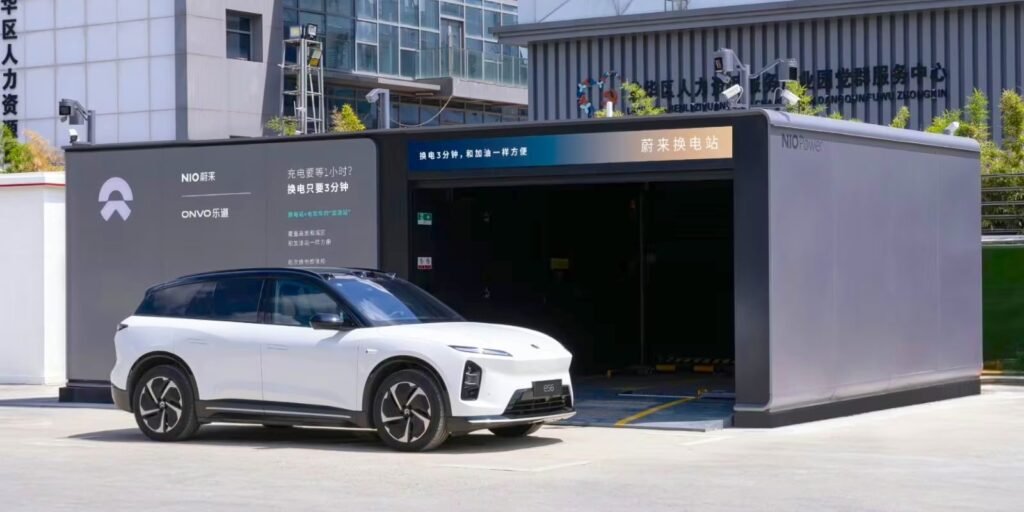
NIO says its energy arm, NIO Power, will operate more than 10,000 battery swap stations and manage over RMB 350 billion ($52 billion) worth of battery packs by 2030. That’s more than double the swap network NIO runs in China today. And it comes from a company that already missed its last big swap station target. more…
NIO says its energy arm, NIO Power, will operate more than 10,000 battery swap stations and manage over RMB 350 billion ($52 billion) worth of battery packs by 2030.
That’s more than double the swap network NIO runs in China today. And it comes from a company that already missed its last big swap station target.
EUROPE: The European Commission has formally approved creation of the European Railway Platform, the new body that gives train operators and related stakeholders a collective voice in shaping EU rules on capacity management, traffic management and performance review. The seven associations that submitted the ERP proposal announced the Commission’s approval on November 24. Following the initial proposal submission, the Commission and the European Network of Rail Regulatory Bodies checked whether the European Railway Platform (ERP) framework offers balanced representation and whether participation is based on equitable, transparent and non-discriminatory criteria. The Commission came to a positive assessment, meaning that ERP can now be formally established. A counterpart to ENIM The body will bring together rail operational stakeholders, and will act as the market-side counterpart to the European Network of Infrastructure Managers (ENIM). Each stakeholder retains the right to express its own position. Railway Undertakings, applicants for infrastructure capacity, service facility operators and other users of railway infrastructure can apply for ERP membership. The design of the platform should let established players, new entrants and organisations with limited resources take part on an equal footing. CER Executive Director Alberto Mazzola welcomed the ratification, saying that the incumbent operators’ trade association had ‘strongly supported the establishment of the European Railway Platform from the outset and considers its successful implementation a key priority. The establishment of the European Railway Platform marks an important step towards translating the new EU capacity management framework into practice. By giving railway undertakings and other capacity applicants a strong and coordinated voice, ERP will help ensure that market needs and operational experience are properly reflected in the implementation of the new rules.’ On the rail freight side of the sector, European Rail Freight Association Secretary General Maria Price said ‘ERFA remains convinced that ERP is a unique solution enabling market actors and infrastructure managers to work together to improve capacity management, operational performance and the competitiveness of rail freight.’ First task: capacity management The founding associations are preparing the inaugural ERP Plenary Assembly, scheduled for December 10 2026. The entity’s first major job will be to coordinate the market’s response to the draft European Framework for Capacity Management, which ENIM is expected to publish before the end of 2026. ERP will then submit consolidated recommendations on behalf of operational stakeholders across Europe. Infrastructure Managers’ forum established to improve capacity management See also: European Parliament approves regulation on railway infrastructure capacity
GERMANY: The Bundestag’s budget committee has signed off Germany’s 2027 draft transport budget. While the transport minister hailed it as a clear signal for more capacity on the railways, with an added €4.34bn in long-term commitments for rail construction, industry associations described it as ‘a black day for rail’. The committee approved the draft budget in the early hours of November 13, after a session that ran until 05.55 and worked through around 2 000 motions. For rail, the principal change against the cabinet’s draft is an increase of €4.34bn in allocations for construction grants under the federal rail needs plan, the binding promises which allow the government and DB to sign multi-year enhancement contracts. What the railway can actually spend next year barely moved: the committee left the federal rail infrastructure budget as drafted at €3bn, €311m more than this year. The transport budget as a whole came in at €25.35bn, €1.08bn below the draft and €2.55bn or 9.2% below the 2026 figure of €27.90bn, largely through cuts to the federal motorway company. ‘Now the expansion of rail infrastructure in Germany is moving forward again’, said Federal Transport Minister Steffen Bilger. ‘The budget committee’s decisions make it possible to pursue central projects in the rail needs plan. The federal government is thereby sending a clear signal for more capacity, higher quality and better connections on rail.’ The sector’s associations, however, were unimpressed. Almost every operating support programme the sector had lobbied to protect from planned cuts, they said, had been left as the government had proposed it, including the subsidies which hold down track access charges and the grants for private sidings for freight. The full Bundestag is due to adopt the budget at the end of November, and changes at that stage are uncommon. However, the coalition is reportedly still negotiating amendments. ‘This Friday the 13th is a black day for rail’, said Oliver Wolff, chief executive of VDV, the German association of transport operators. ‘The increases currently on the table would be in parts ruinous for passenger and rail freight traffic. Short-term certainty should have been created here through track access funding. Companies that procure vehicles and plan services need firm commitments.’ Projects cleared The ministry named five schemes which are to receive funding agreements during 2027, allowing civil works to be tendered: Karlsruhe – Stuttgart – Nürnberg – Leipzig/Dresden route modernisation: Dresden area enhancements; Enhancements at the Riesa node, a capacity bottleneck on the Leipzig – Dresden corridor; Magdeburg – Stendal – Uelzen upgrade: Stendal – Glindenberg section, a freight route between the North Sea ports and central Germany; München – Mühldorf – Freilassing upgrade: planning approval section 1.4, on the route towards Salzburg; Weimar – Gera – Gößnitz upgrade: Weimar – Göschwitz section, part of the Mitte-Deutschland-Verbindung. Planning is to continue beyond the current phase on 10 further projects, among them the Hamburg – Hannover and Hannover – Bielefeld schemes on the north-south axis, Augsburg – Ulm, two grade-separated flyovers serving the Köln rail node, expansion module 1 of the Erfurt combined transport terminal and the Dresden – Praha new line. Planning is also to begin on the Berlin – Angermünde – Pasewalk – Stralsund – Sassnitz route modernisation programme. ‘The funds must now be unblocked’ Both lists follow months of paralysis. In May, the ministry, DB and the Bundesnetzagentur (federal railway authority) were unable to agree financing for a single new scheme, the needs plan having €2.4bn available that year against a requirement the government itself put at around €19.2bn. None was cleared to start construction or even to advance to its next planning stage, and projects already designed and ready to build, among them the Mitte-Deutschland-Verbindung, were left without agreements. The committee has now given the power to sign the long-term contracts which bind the federal budget in later years. On a motion from the governing CDU/CSU and SPD, the authority available for needs plan construction grants was raised by €4.34bn to €8.15bn, covering payments falling due between 2030 and 2046. However, that is also conditional. The new authority is blocked until commitments the government has already made are shifted across to the defence budget, and no timetable has been set. ‘Budget politicians must now unblock the funds quickly so that the large planning backlog on rail projects can clear’, said Allianz pro Schiene Managing Director Dirk Flege. He added that the annual budget cycle was itself a major problem. ‘Every year we face great uncertainty almost until the end of the year over what there will be money for next year and what there won’t. You cannot plan rail infrastructure or modal shift that way.’ The association is pressing for a multi-year rail infrastructure fund, a proposal the SPD parliamentary group has put forward and which the ministry has said it will bring next year. DB InfraGO is raising track access charges well above the rate of inflation, while politicians are cutting the subsidy. Four months of lobbying changes little The cuts the sector had spent four months lobbying against survived almost intact. The subsidy which holds down track access charges for freight falls from €345m to €200m exactly as the government had drafted it, and support for single wagonload traffic was not reinstated, although there are reports the coalition is now looking for around €100m to restore it. On two lines the committee went further than the government proposed, cutting siding grants by 22% to €16.65m and construction grants for the non-federal railways by 9.5% to €41.65m. Across the programmes, Allianz pro Schiene puts freight support down 12% against 2026. Flege called the failure to reverse the summer cuts ‘a severe setback for the sector’, while rail union EVG accused the government of betraying its own freight railway. As for the track access charges themselves, following the budget announcement, BNetzA formally approved DB InfraGO’s track access charges for 2027, which rise by 12.9% for freight, 7.7% for regional passenger services and 5% for long-distance, all from the timetable change on December 13. The charges are set by the operator and approved by the regulator rather than decided in the budget, but the committee’s session was the last opportunity to cushion them, and it passed. For freight the two decisions compound. With the subsidy cut and the charge rise together, Die Güterbahnen calculates the cost of running a freight train rises by around three-quarters. The association, which had asked for the subsidy to be held until the charging system is reformed, said the committee left unused the last remaining political opportunity to correct it. ‘DB InfraGO is raising track access charges well above the rate of inflation, while politicians are cutting the subsidy and simply dropping the reform promised in the coalition agreement’, said Managing Director Peter Westenberger. Regional services, meanwhile, lost the statutory cap on their charges to a European Court of Justice ruling in March, and the federal money the Länder use to buy those services is fixed by separate legislation at a 3% annual increase, so it cannot track the rise. In Sachsen, the Oberelbe transport association has already announced fewer trains from December. The charges could still fall The charges just approved may not be the final word. DB InfraGO says it could lower them once the government settles how much it will pay towards maintaining the network, money the regulator is obliged to count when it decides what the infrastructure manager may charge operators. The more the government puts in, in other words, the less DB InfraGO has to recover from train operation. The regulator has said it would cooperate. That figure is set by a five-year performance agreement with DB InfraGO, published in draft days after the committee sat, which commits more than €80bn to the network between 2027 and 2031. Of that, €18.7bn is for maintenance, falling from €4.2bn next year to €3·4bn by 2030. The ministry says that money will stabilise charges and, together with reforms already under way, fulfils the coalition agreement’s promise, giving operators ‘greater planning certainty’. Bilger has said there will be no broader reform. Die Güterbahnen says the claim is ‘refuted by reality’ and that the contract does nothing concrete to stabilise charges, pointing to DB InfraGO’s provisional application for an average rise of 15.1% in 2028. The draft is out for comment until December 17 and needs the approval of the Bundestag’s budget and transport committees, and of DB’s supervisory board, before it can take effect on January 1 2027. Take a look at Railway Gazette International’s sister title RailFreight.com, which has been following the freight side of the week step by step, from the budget’s cuts to freight support and the 12·9% rise in freight track access charges to the LV InfraGO performance agreement. ‘You cannot build sustainable growth on an unstable foundation,’ says DB CEO
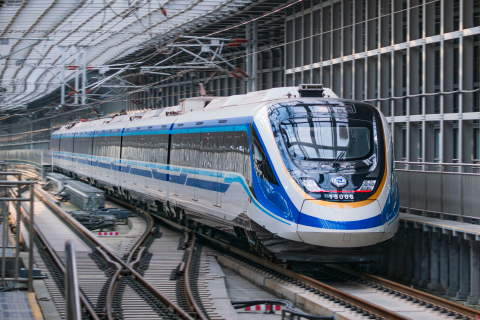
This week’s round-up of news from the global urban rail transport sector, from Railway Gazette International. November saw metro lines opened in Ürümqi, Chongqing and Hefei. Ürümqi gained a 13.9 km second metro line on November 15, with Line 2 opening from Huashan St southeast via the main line station to Nanmen on Line 1. Three days earlier Chongqing opened express metro Line 15, running for 47.9 km from Liangjiang Movie City west to Jingkou. The line has GoA4 automation and brings the total length of the city’s metro to over 600 route-km. On November 19 suburban metro Line S1 opened from central Hefei to Xinqiao International Airport to the northwest. The 31.3 km line operates four-car Type-B trains under GoA4 full automation serving 10 stations. Extensions are under construction at both ends that will bring the full line to 47.5 km. The Hanoi Metropolitan Railway Management Board has formally signed a turnkey contract with the joint venture of property developer Vinhomes and the SGC Investment and Construction subsidiary of industrial conglomerate Vingroup for the delivery of metro lines 1, 2, 8, 10, and 14. The consortium was appointed in June to deliver the five metro lines totalling 267 km. Mayor Kirk Watson has announced that light rail project promoter Austin Transit Partnership will start nine to 12 months of planning for a potential 5 km mostly elevated extension of the future network to serve Austin Bergstrom International Airport. He said ‘my challenge to ATP is to pursue this extension within our existing budget approved by voters — no new taxpayer dollars’. Alstom’s Sri City facility has commenced the manufacturing of 32 three-car Metropolis GoA4 driverless metro cars for Chennai Metro Phase II. The €135m contract awarded by Chennai Metro Rail Ltd in 2025 includes 15 years of comprehensive maintenance. Fortress Solutions is to provide private wireless communications for the Trainguard MT CBTC which Siemens Mobility and LK Comstock are to deploy on the New York Subway’s Fulton-Liberty Line, served by A and C trains. ‘Private wireless connectivity is the backbone that makes modern train control possible’, said Fortress Solutions CEO John Shelnutt on November 17. The Hong Kong government and MTR Corp signed the Northern Link (Part 2) Project Agreement on November 10. MTR Corp said it ‘will proceed at full speed’ with the design and construction of both the Main Line and Spur Line, with the aim of commissioning the entire project no later than 2034. The Part 1 agreement was signed last year; the Part 2 covers the works of the remaining section of Main Line, commercial arrangements and construction of the Spur Line, as well as the future operation, maintenance and asset management arrangements.’ Transport Infrastructure Ireland has issued an Information Memorandum and Pre-Qualification Questionnaire for the Dublin Luas Finglas Main Infrastructure Design & Construction Works contract. This is the first stage of a two-stage procurement process that will lead to the appointment of a contractor for the 4 km tramway extension. Following assessment of the submissions received, a shortlist of bidders will be invited to participate in the subsequent tender. A joint venture of Systra Ardanuy, SGS and DILIGENS has been awarded a contract to supervise the manufacturing and installation of escalators and lifts for stations on the 11 km central section of Barcelona metro Line 9 between La Sagrera and Zona Universitària, which is scheduled to open in 2032. The South Shore Line, utility company NIPSCO and the NiSource Charitable Foundation are to run the Chicago commuter operator’s first Holiday Trains on December 19. Each Holiday Train will feature eight uniquely themed cars: Candy Cane Lane, Jack Frost’s Snowflake Workshop, Gingerbread Cookie Company, Dickens Village, Elf Academy, Santa’s Toy Factory, Frosty’s Snow Fort and Celebration Station, the latter focusing on Hanukkah, Kwanzaa and Christmas. Children will be able to meet Santa Claus, whom the operator notes is an independent contractor and not an employee of the Northern Indiana Commuter Transportation District.