Tesla delivered just 8,295 “Other Models” in Q3 2026, down 48% from a year ago and the lowest total for the category since 2021. With the Model S and Model X out of production, almost all of them were Cybertrucks. That gives us the cleanest look yet at Cybertruck sales. We estimate Tesla delivered 7,000 to 8,000 of the trucks last quarter, a pace of about 30,000 a year from a line it planned for 250,000. more…
Packaged goods supply chains are full of examples of exception requests, like when a retailer asks for a custom pack configuration, a key account needs a special label, or a shipment gets rerouted on short notice to hit a delivery window. Those kinds of exceptions aren’t necessarily problems on their own. Exception handling can look like good customer service. But on Oct. 15, FreightWaves and G3 Logistics are asking what happens when you stop counting those requests one at a time and start adding them up. That’s the topic of The Hidden Cost-to-Serve in Packaged Goods: Managing Rework, Specialized Handling, and Operational Exceptions, a free webinar that will dig into the repack jobs, relabeling work, retailer-specific requirements, and expedited changes that accumulate inside packaged goods networks until they’re no longer exceptions at all. Without visibility into what those exceptions cost, they can be devastating to margins over time. G3 Logistics brings transportation, warehousing, and supply chain expertise to a common packaged goods challenge: customer requests that add work beyond the standard flow. A package change, relabeling request, or tighter delivery window can affect handling, schedules, inventory, and capacity across multiple teams. Seeing those effects together helps leaders understand hidden costs and make more intentional service decisions. Jerry Knight, G3’s Senior Director of Global Logistics, and Nicole Ostertag, Head of Solutions, will explore when a reasonable exception becomes a recurring operating cost—and what should change when it does. A one-off retailer packaging request for a promotion can look like a manageable commercial accommodation, until the extra handling, line interruptions, inventory segregation, and tighter turnaround windows it requires start showing up in every subsequent run for that account. Rework that begins as occasional recovery work (such as relabeling, repacking, or fixing damaged product) can quietly become a standing part of daily operations, its cost buried inside standard labor instead of tracked anywhere finance or ops can see it. The accounts that matter most commercially are often the ones creating the most operational drag, including frequent small runs, narrow delivery windows, or constant manual workarounds to hit a service level that is now taken for granted. The discussion is structured as a working session for supply chain leaders to compare notes on where these costs show up first, which ones are easy to see on a P&L, which stay buried in additional touches and lost throughput, and who in the organization actually owns the decision to say yes to a request. The webinar is designed to give you a sharper read on how to measure hidden costs at the customer, SKU or channel level, where other companies have had success clawing back margin through order rules, packaging redesign, customer segmentation or clearer exception pricing, and a clearer sense of which functions need to be in the same room to make any of it stick. Hidden costs rarely announce themselves as a logistics problem or a warehouse problem. They sit at the intersection of commercial commitments, packaging decisions, and operational execution. Leaders can address them by making exceptions visible before workarounds become part of daily operations. The webinar is free to attend. If you’re responsible for packaging, operations, planning, or customer service in a packaged goods supply chain, you’ll want to be in the room before the hidden costs in your own network get any harder to see. Register for “The Hidden Cost-to-Serve in Packaged Goods” here to save your spot for the Oct. 15 session. The post The Costs You Can’t See in Packaged Goods Supply Chains appeared first on FreightWaves.
Zim Integrated Shipping Services raised its full-year 2026 earnings guidance Oct. 6, citing continued strong market demand and favorable freight-rate momentum. The revised forecast increases the midpoint of its adjusted operating earnings outlook by 72% from guidance issued in August. The Israeli container carrier (NYSE: ZIM) now expects adjusted earnings before interest, taxes, depreciation and amortization of $2.7 billion to $3 billion, up from its previous range of $2 billion to $2.4 billion. Adjusted earnings before interest and taxes are projected at $1.4 billion to $1.7 billion, compared with the earlier forecast of $700 million to $1.1 billion. At the midpoint, the new outlook puts adjusted EBITDA at $2.85 billion, an increase of $650 million, or approximately 30%. The adjusted EBIT midpoint rises to $1.55 billion from $900 million. Both comparisons are against the company’s Aug. 19 forecast for the year ending Dec. 31. window.googletag = window.googletag || {cmd: []}; googletag.cmd.push(function() { var gptSlot = googletag.defineSlot('/21776187881/FW-Responsive-Main_Content-Slot1', [[300, 100], [320, 50], [728, 90], [468, 60]], 'div-gpt-ad-1709668545404-0').defineSizeMapping(gptSizeMaps.banner1).addService(googletag.pubads()); googletag.pubads().enableSingleRequest(); googletag.pubads().collapseEmptyDivs(); googletag.enableServices(); setInterval(function() { if (!document.hidden) { googletag.pubads().refresh([gptSlot]); } }, 30000); }); googletag.cmd.push(function() { googletag.display('div-gpt-ad-1709668545404-0'); }); Zim attributed the upgrade to “continued strong market demand and favorable momentum in freight rates.” The announcement did not provide updated cargo-volume projections or quantify how much of the increase reflected rates rather than shipment demand. The higher outlook comes as Zim awaits completion of its pending acquisition by Hapag-Lloyd. In its announcement, the company identified uncertainty surrounding the transaction, geopolitical instability and fluctuations in freight rates, vessel supply and shipping demand among factors that could cause actual results to differ from its projections. Zim’s guidance uses adjusted financial measures rather than results prepared under International Financial Reporting Standards. The company cautioned that adjusted EBITDA excludes debt-service requirements and capital expenditures and should not be treated as a measure of cash available for its use. Read more articles by Stuart Chirls here. Read more: window.googletag = window.googletag || {cmd: []}; googletag.cmd.push(function() { var gptSlot = googletag.defineSlot('/21776187881/fw-responsive-main_content-slot3', [[728, 90], [468, 60], [320, 50], [300, 100]], 'div-gpt-ad-1665767553440-0').defineSizeMapping(gptSizeMaps.banner1).addService(googletag.pubads()); googletag.pubads().enableSingleRequest(); googletag.pubads().collapseEmptyDivs(); googletag.enableServices(); setInterval(function() { if (!document.hidden) { googletag.pubads().refresh([gptSlot]); } }, 30000); }); googletag.cmd.push(function() { googletag.display('div-gpt-ad-1665767553440-0'); }); New submarine plant planned at Baltimore multimodal hub Xeneta: US-bound container rates peak, but sharp collapse unlikely DP World plots US port comeback with Corpus Christi container terminal Dockworkers protest at Port of Vancouver over automation, AI Savannah port project passes 60% complete mark window.googletag = window.googletag || {cmd: []}; googletag.cmd.push(function() { var gptSlot = googletag.defineSlot('/21776187881/fw-responsive-main_content-slot4', [[300, 100], [320, 50], [728, 90], [468, 60]], 'div-gpt-ad-1709668086344-0').defineSizeMapping(gptSizeMaps.banner1).addService(googletag.pubads()); googletag.pubads().enableSingleRequest(); googletag.pubads().collapseEmptyDivs(); googletag.enableServices(); setInterval(function() { if (!document.hidden) { googletag.pubads().refresh([gptSlot]); } }, 30000); }); googletag.cmd.push(function() { googletag.display('div-gpt-ad-1709668086344-0'); }); The post Zim lifts profit forecast 72% on strong demand appeared first on FreightWaves.
If you’ve ever looked at a cargo e-bike and thought, “Sure, but where am I supposed to put the other six people?”, SixThreeZero may finally have the answer. The company’s latest addition to its growing e-bike and e-trike lineup, the Long Range Luxury Rickshaw, is already a fairly ridiculous machine in its standard form. It combines three wheels, dual motors, rear passenger seating bench, and enough battery capacity to make many electric motorcycles jealous. But start adding its optional passenger trailers, and you can essentially build yourself a seven-person electric bicycle train. more…
Rivian is rolling out Pet Cam, a new feature in software update 2026.36 that lets R2 owners check on a pet left in the vehicle through a live video feed in the Rivian app. It’s exclusive to the R2. R1T and R1S owners get new remote Pet Mode controls instead, and the same update brings the Rivian Assistant to the R2, four months after the SUV launched. more…
Freight of all kinds paced a 5% weekly gain among U.S. railroads from a year ago, according to the Association of American Railroads. For the week ending October 3, total U.S. weekly rail traffic was 529,712 carloads and intermodal units, ahead 5.1% compared with the same week in 2025. A total of 230,711 carloads was better by 2.4% while intermodal volume was 299,001 containers and trailers, up 7.4% on 2025. Seven of 10 carload commodity groups tracked by AAR posted increases. They were topped by metallic ores and metals, 12.8%, closely followed by petroleum and related products, 12.2%. Forest products, which has mostly struggled in a stagnant housing market, took third, up 7.5%. Gran slipped 5.2%, while farm products excluding grain and food, 4.1%, and coal, 0.1%, were weaker y/y. Through the first 39 weeks of 2026, U.S. railroads reported cumulative volume of 8,910,593 carloads, a 2.7% gain, and 11,077,697 intermodal units, ahead 4.2% from the previous year. Total combined U.S. traffic for the first 39 weeks of 2026 was 19,988,290 carloads and intermodal units, an increase of 3.5% y/y. North American rail volume for the week on nine reporting U.S., Canadian and Mexican railroads improved by 1.6% to 335,068 carloads, and 386,372 intermodal units, up 6.9%. Total combined weekly rail traffic in North America was 721,440 carloads and intermodal units, 4.4% better than 2025. North American rail volume for the first 39 weeks of 2026 was 27,399,651 carloads and intermodal units, up 3.1%. Subscribe to FreightWaves’ Rail e-newsletter and get the latest insights on rail freight right in your inbox. Read more articles by Stuart Chirls here. Read more: Union Pacific CEO ‘99.99%’ confident rail merger will win approval Major chemical producer backs UP-NS merger Another strong week for industrial rail freight ‘Higher rates, less reliable service’: Family farmers oppose rail merger STB tabs former BNSF exec as economics director, adds senior adviser The post Climbing intermodal rail volumes more than treble commodities traffic gains appeared first on FreightWaves.
Two logistics and distribution companies have agreed to pay a combined $2 million to resolve federal employment discrimination cases involving allegations that women and other applicants were denied jobs based on sex, race or national origin. The U.S. Equal Employment Opportunity Commission announced Monday that Birchstone Management, a Dallas-based warehousing and logistics management company, agreed to pay $500,000 after an investigation found the company rejected qualified women seeking pallet repair jobs. The settlement comes less than two weeks after the EEOC announced Denver-based Mile Hi Companies would pay $1.5 million to resolve a federal lawsuit alleging discriminatory hiring practices involving Black, female and Afghan applicants. EEOC says Birchstone rejected women for pallet repair jobs The EEOC said its investigation found that Birchstone Management turned away a qualified woman who applied for a pallet repairer position at the company’s Spokane Valley, Washington, location solely because of her sex. The agency said the practice extended beyond one applicant and location. Since at least May 2020, Birchstone allegedly rejected other qualified female applicants for pallet repair jobs in Spokane Valley; Amarillo and Houston, Texas; Lakewood, Washington; and Las Vegas. Instead, according to the EEOC, Birchstone hired men with similar or fewer qualifications or continued looking for male applicants. “I showed up ready to demonstrate my ability to do the job, only to be told that the company only hires men,” the applicant who filed the charge said in the EEOC announcement. “I hope this case helps employers stop labeling jobs as ‘women’s work’ or ‘men’s work.’” Birchstone agreed to provide $55,000 to the woman and establish a $445,000 settlement fund for other affected applicants. The agreement resulted from the EEOC’s pre-litigation conciliation process rather than a lawsuit. Along with monetary relief, Birchstone must revise its hiring and recruitment policies, provide training to personnel involved in hiring at several locations, audit its employment recordkeeping annually and report to the EEOC for two years. Mile Hi Foods settles EEOC lawsuit for $1.5M The Birchstone settlement follows a Sept. 25 announcement that Mile Hi Companies, a Denver-based distributor of food and paper products, agreed to pay $1.5 million to settle an EEOC lawsuit filed in 2024. The allegations in that case extended beyond sex discrimination. The EEOC alleged Mile Hi denied employment opportunities to Black, female and Afghan applicants beginning in 2015. According to the agency’s lawsuit, the company’s CEO directed employees to limit the percentage of Black applicants hired, not hire women for warehouse positions and stop hiring Afghan applicants for bakery jobs. When the company’s human resources manager opposed those directives, the EEOC alleged Mile Hi retaliated against her by harassing and eventually firing her. The EEOC filed the lawsuit in September 2024 after the agency said efforts to reach a settlement through its administrative conciliation process were unsuccessful. Under a three-year consent decree, Mile Hi must provide monetary relief to the former HR manager and affected applicants. The company also must review its employment policies, train employees and managers on anti-discrimination laws, maintain applicant records and periodically report its compliance efforts to the EEOC. Women remain underrepresented in transportation The cases come as the transportation industry continues to grapple with attracting and retaining women in jobs historically dominated by men. A 2024 American Transportation Research Institute study found significant barriers for women entering and remaining in trucking, ranging from negative stereotypes and company culture to inadequate facilities and gender harassment. ATRI surveyed nearly 1,500 current and former truck drivers and also conducted interviews and focus groups with drivers, motor carriers and truck-driving schools. Women accounted for roughly half of the driver survey respondents. Women reported experiencing 11 of 12 problems examined by researchers more frequently than men. About 17% of female respondents said they encountered harassment or discrimination daily, roughly twice the rate reported by male drivers. Why it matters: The settlements highlight persistent barriers for women seeking jobs in traditionally male-dominated freight and logistics occupations, an issue also documented in transportation industry research. More FreightWaves articles by Noi Mahoney: TA Services acquires 2 Texas cross-border carriers, adds 133 trucks DP World plots US port comeback with Corpus Christi container terminal FMCSA restores 30-day HOS relief for truckers during emergencies The post Logistics firms to pay $2M to settle hiring discrimination cases appeared first on FreightWaves.
Europe has spent years encouraging people to ditch cars and get around on bicycles and e-bikes instead. And in many places, it’s working. But all of those increasingly sophisticated electric bicycles have created an unexpected new problem: there aren’t nearly enough people to fix them. more…
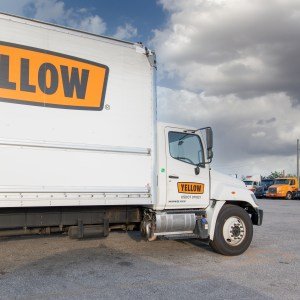
Yellow Corp. Teamsters will receive some WARN Act money even though two separate courts found the company was not liable for failing to give 60 days’ advance notice as required by federal law ahead of its July 2023 shutdown. A Tuesday memo from a Teamsters director to Yellow Corp. local unions said the IBT had reached a settlement in principle with the bankrupt estate allowing the additional claims. The plan includes approximately $17.2 million in claims pertaining to the WARN Act. The deal represents five days of damages under the federal law, with employees falling under the New Jersey WARN Act receiving 30 days of damages. The agreement also calls for the allowance of $1.2 million in grievance claims that were pending when the company shut down, and $1.8 million in claims for unused personal holidays for New York, New Jersey, Pennsylvania and Western Teamsters that are allowed per their contracts. The memo also reiterated a prior agreement in which the estate will pay employee claims totaling $71.5 million for paid time off, sick leave and other claims. “The Teamsters leadership chose full payment on contract claims and some recovery on the WARN Act over years of additional litigation on the WARN Act claims with an uncertain outcome,” the memo said. The deal still has to be signed by both parties and approved by a federal bankruptcy court in Delaware. However, the memo said no further objections are expected, noting that Yellow’s largest shareholder, MFN Partners, has withdrawn its objection to a bankruptcy plan confirmation. Teamsters that were employed by Yellow are expected to receive full payment on their PTO and sick-time claims. A per-person cap of $22,650 is in place ($15,150 for priority claims and $7,500 for additional benefit claims). The memo noted that a few employees have claims exceeding the cap amount and that excess amounts will be paid at the same rate as general unsecured claims, which is projected to be less than 20%. Payments are expected to be distributed “within months” of the court’s approval, assuming no further appeals. Yellow terminated 3,500 nonunion employees on July 28, 2023, and 22,000 union employees two days later. The company filed for bankruptcy on Aug. 6, 2023. The bankruptcy court previously determined that Yellow was a “liquidating fiduciary” winding down affairs, not an operating business, at the time of the layoffs, thus exempt from WARN Act requirements. That decision also said Yellow appeared to act in good faith, but that if the court was found incorrect on its view of the WARN requirements, back pay and benefits should be limited to just 14 days, not the 60 days requested. The U.S. District Court in Delaware later affirmed the bankruptcy court’s finding, adding that the company also qualified under a separate exemption as a faltering company. Why it matters? Former employees have some clarity on their financial recovery, which now includes reduced WARN Act payments. Full payment of accrued PTO and sick leave will be distributed within months of the bankruptcy court granting final approval. More FreightWaves articles by Todd Maiden: LTL survey: Old Dominion, Daylight Transport take home top honors again Transportation prices surge as capacity tightens further in September STG Logistics announces new CEO, board members The post Yellow Corp., Teamsters settle on WARN Act claims appeared first on FreightWaves.
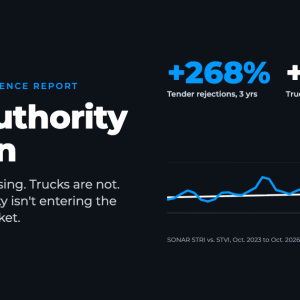
The short answer No. As of October 2026, new trucking capacity is not entering the freight market, even after a full year of elevated tender rejections. SONAR data shows tractors in new for-hire fleets fell to 19,520 in August, while the SONAR Truckload Rejection Index (STRI) held near 14%, about three times its 2023–2025 range. In past cycles, high rejections pulled new trucks into the market within a few quarters. This time they haven’t. Operating authority counts are rising, but authorities don’t measure trucks. SONAR’s new Sitrep, The Authority Illusion, lays out the data. Key takeaways New capacity is shrinking, not growing. Tractors in new for-hire fleets fell to 19,520 in August 2026, down about 14% from the first-half average. Rejections are up 268% in three years. Volume is up 9%. The market is tight because trucks are leaving, not because freight is surging. Authority counts are misleading. Net authority additions hit five-year highs above 2,000 a week in August and September 2026, but much of that reflects FMCSA’s Motus system rollout. Estimated new grants ran about 17% below the first quarter. Fewer new carriers are actually starting. Only about two in three new interstate registrants buy liability insurance, down from more than nine in ten in 2019. Expect a tight market through early 2027. Rising insurance costs and a narrowing pool of compliant drivers are keeping new capacity out. How is this freight cycle different from 2020–2022? In the last cycle, new capacity answered the price signal. In this one, it hasn’t. When STRI spiked in mid-2020, tractors in new for-hire fleets started climbing within a couple of quarters and peaked in mid-2022 at about 47,000. This cycle runs the other way. New-fleet tractors fell from that 2022 peak, bottomed in early 2025, ticked up in the spring, then flattened. STRI began rising sharply in fall 2025, yet new-fleet tractor counts have since turned lower. Total for-hire tractors fell by about 51,000 in August alone. Tender rejections rising in 2025–2026 while tractors in new for-hire fleets fall. Has truckload freight volume increased? Barely. Over the three years ending October 2026, the SONAR Truckload Volume Index (STVI) is up 9%, while STRI is up 268%. At their early-summer 2026 peak, rejections were up more than 350%. If demand were driving the market, those two lines would move together. Instead, carriers are rejecting nearly four times as many loads on roughly the same volume. That gap normally closes as new trucks enter and rejections fall back. It hasn’t closed. The American Transportation Research Institute (ATRI) reaches the same conclusion, describing 2026’s rate gains as a supply-side recovery. Truckload volume up 9% while tender rejections are up 268% over three years. Why are trucking authorities rising if capacity isn’t? Because an operating authority is permission to haul, not a truck. A one-truck owner-operator and a 5,000-truck fleet each count as one authority. From 2019 to 2022, total authorities rose 51% while for-hire tractors rose just 12%. The 2026 jump is also largely administrative. Net authority additions topped 2,000 a week in late August and late September, the highest in five years. Over the same stretch, FMCSA’s new Motus registration system paused deactivations and cleared a backlog of applications and reinstatements. Net revocations turned negative for the first time since at least 2019, and estimated new authority grants ran about 17% below the first quarter. Weekly net authority additions spike above 2,000 in late 2026. What’s keeping new trucking capacity out of the market? Three pressures are raising the cost of entry at the same time. A narrower pool of compliant drivers. As of January 2, 2026, 202,345 CDL and permit holders were in prohibited status in FMCSA’s Drug and Alcohol Clearinghouse. A non-domiciled CDL rule effective March 16, 2026 could affect up to 194,000 drivers over time. English language proficiency enforcement now takes about 2,700 drivers out of service a month, according to SONAR data. Rising insurance costs. Liability and cargo premiums rose 3.9% in 2025 to about 10.6 cents a mile, even as crash rates fell, and kept climbing in early 2026, according to ATRI. For a small carrier, a lapsed policy means a revoked authority. Thin margins. Truckload operating margins were barely positive in 2025, which makes adding trucks hard to justify. The largest carriers are feeling it too. In second-quarter 2026 results, Schneider called the market driver-constrained, and Knight-Swift and Werner said driver availability was limiting their fleets. What should shippers expect over the next six months? Expect the truckload market to stay tight through early 2027, with STRI well above the 4% to 6% range of 2023 through 2025. The fastest source of relief is parked trucks: ATRI found about 10% of carriers’ trucks sat without a driver in 2025. They return only if carriers can find compliant drivers to seat them. The signals that will show the turn first: Tractor counts and new-fleet tractors rising for two or more consecutive months STRI falling while STVI holds steady First-time insurance filings, not authority counts, picking up Frequently asked questions Is trucking capacity growing in 2026? No. Measures of trucks actually running are falling: total for-hire tractors fell about 51,000 in August 2026, and new fleets reporting miles are at their lowest since early 2020. Only authority counts are rising. What is a trucking operating authority? An operating authority, or MC number, is FMCSA’s permission for a company to haul regulated freight for hire across state lines. It says nothing about how many trucks the company runs or whether they are moving. Why are tender rejections high if freight volume is flat? Because capacity has left the market. With fewer trucks and compliant drivers available, carriers reject more contracted loads even when volume barely changes. What is the best indicator of real trucking capacity? Tractor counts, fleets reporting miles, and tender rejections. First-time insurance filings are a better gauge of new entry than authority or registration counts. Why did net revocations turn negative in 2026? FMCSA’s Motus rollout paused USDOT deactivations and processed a backlog of reinstatements, so reinstatements outnumbered revocations. It was an administrative effect, not a wave of new carriers. Read the full Sitrep The Authority Illusion covers seven years of authority, tractor, insurance and registration data, a 2026 capacity scorecard, and the indicators shippers should watch instead. Read the full Sitrep inside FreightWaves Market Monitor or the SONAR platform. For real-time tender rejections, volumes and carrier fleet data, subscribe to SONAR. Sources: SONAR (STRI, STVI, TCFHN, TCFH, CDNCA, CDNR, ELPVOOS); ATRI, An Analysis of the Operational Costs of Trucking: 2026 Update; FMCSA Drug and Alcohol Clearinghouse Monthly Report, December 2025; Transport Topics, Schneider expects supply reduction momentum through 2026; FMCSA Licensing & Insurance and Company Census data. The post Is Trucking Capacity Coming Back? Why New Capacity Isn’t Entering the 2026 Freight Market appeared first on FreightWaves.