Schneider National announced Thursday it has inked a deal to utilize Norfolk Southern’s rail network in the East. The announcement was in conjunction with the multimodal transportation provider’s third-quarter report, which was slightly worse than expected. New Norfolk Southern service agreement Schneider said its new service agreement with Norfolk Southern (NYSE: NSC) will make the company the only entirely asset-based provider on a single-line transcontinental railroad in the U.S., assuming the railroad’s merger with peer Union Pacific (NYSE: UNP) is approved. (Schneider transferred its Western intermodal business to Union Pacific in 2023.) Schneider’s intermodal service is executed with its own drivers and tractors, chassis (23,900), containers (26,800) and over 60 rail hubs in North America. “As we transition our primary eastern rail provider to Norfolk Southern, we’ll expand access to key markets, increase network flexibility and create new opportunities to better serve our customers,” said Michael Baumgardt, executive vice president of intermodal and logistics at Schneider. “It will strengthen Schneider’s competitive position and enhance the reliable service experience our customers expect.” window.googletag = window.googletag || {cmd: []}; googletag.cmd.push(function() { var gptSlot = googletag.defineSlot('/21776187881/FW-Responsive-Main_Content-Slot1', [[300, 100], [320, 50], [728, 90], [468, 60]], 'div-gpt-ad-1709668545404-0').defineSizeMapping(gptSizeMaps.banner1).addService(googletag.pubads()); googletag.pubads().enableSingleRequest(); googletag.pubads().collapseEmptyDivs(); googletag.enableServices(); setInterval(function() { if (!document.hidden) { googletag.pubads().refresh([gptSlot]); } }, 60000); }); googletag.cmd.push(function() { googletag.display('div-gpt-ad-1709668545404-0'); }); The new service begins in January. Schneider pointed to the success it has had with CPKC’s (NYSE: CP) cross-border, steel-wheel service as a factor in its decision to switch providers. Schneider said the move doesn’t jeopardize its existing relationship with CPKC. Schneider was an early user of the Southeast Mexico Express (SMX), a joint offering from CSX (NASDAQ: CSX) and CPKC, connecting Mexico to Texas and to the Southeast U.S. “I mean, if you look at the UP today, we’re using the CPKC out of Mexico, despite the fact that they have a service,” said Jim Filter, Schneider president and CEO, on a call with analysts. “And they continue to operate with us and love everything that we’re doing with them, but they understand there’s a place that we don’t use them. And so, it’s not that unusual that you’re not going to go with one provider for everything.” Noisy Q3 on path to recovery Schneider (NYSE: SNDR) reported adjusted earnings per share of 29 cents for the third quarter, a penny below consensus but 17 cents higher year over year. Net interest expense was a 5-cent y/y tailwind, in part due to a reversal of interest accruals tied to a claim settlement (3 cents). A lower tax rate also helped slightly. But a separate claim in its logistics segment partially offset these benefits. Consolidated revenue of $1.59 billion was 9% higher y/y and slightly better than the $1.58-billion consensus estimate. It raised the bottom end of its full-year adjusted EPS guidance range by 10 cents to a new range of $1 to $1.10. The consensus estimate was $1.06 at the time of the print. (The company reported full-year 2025 adjusted EPS of 63 cents.) Truckload revenue (ex-fuel) was flat y/y at $625 million as an 8% increase in revenue per truck (ex-fuel) was offset by an 8% decline in average trucks in service. The utilization metric was 3% higher y/y for its dedicated fleet and 21% higher for the one-way fleet. window.googletag = window.googletag || {cmd: []}; googletag.cmd.push(function() { var gptSlot = googletag.defineSlot('/21776187881/fw-responsive-main_content-slot3', [[728, 90], [468, 60], [320, 50], [300, 100]], 'div-gpt-ad-1665767553440-0').defineSizeMapping(gptSizeMaps.banner1).addService(googletag.pubads()); googletag.pubads().enableSingleRequest(); googletag.pubads().collapseEmptyDivs(); googletag.enableServices(); setInterval(function() { if (!document.hidden) { googletag.pubads().refresh([gptSlot]); } }, 60000); }); googletag.cmd.push(function() { googletag.display('div-gpt-ad-1665767553440-0'); }); One-way contract renewals averaged just under 20% in the quarter, as management said that the capacity crackdown is expanding. This allowed the fleet to return to profitability. The company has sold dedicated service on 850 trucks this year, but is still working to offset a previously disclosed customer loss. The TL unit reported a 93% operating ratio (inverse of operating margin), which was 380 basis points better y/y, but 120 bps worse than the second quarter. Intermodal revenue (ex-fuel) increased 2% y/y to $288 million. A 2% decline in loads was offset by a 3% increase in revenue per load (ex-fuel). Intermodal contract renewals are “comfortably in the mid-single-digit range,” management said. The unit reported a 92.1% OR, 190 bps better y/y. The logistics segment reported breakeven results as a confidential claim settlement negatively impacted the period. window.googletag = window.googletag || {cmd: []}; googletag.cmd.push(function() { var gptSlot = googletag.defineSlot('/21776187881/fw-responsive-main_content-slot4', [[300, 100], [320, 50], [728, 90], [468, 60]], 'div-gpt-ad-1709668086344-0').defineSizeMapping(gptSizeMaps.banner1).addService(googletag.pubads()); googletag.pubads().enableSingleRequest(); googletag.pubads().collapseEmptyDivs(); googletag.enableServices(); setInterval(function() { if (!document.hidden) { googletag.pubads().refresh([gptSlot]); } }, 60000); }); googletag.cmd.push(function() { googletag.display('div-gpt-ad-1709668086344-0'); }); Net debt leverage was 0.1x at the end of the quarter, down from 0.3x at the end of 2025. Schneider lowered its full-year net capex plan to a range of $325 million to $350 million. Net capex totaled $289 million in 2025. Why it matters? Schneider’s new service agreement with Norfolk Southern expands its market access and potentially establishes it as a unique asset-based provider on a single-line transcontinental rail network alongside its growing cross-border intermodal service. Meanwhile, Schneider’s results serve as a bellwether for the health of the truckload and intermodal markets. More FreightWaves articles by Todd Maiden: FedEx Freight sees volumes stabilize, eyes Q4 margin improvement Saia’s expanded terminal network delivers record revenue, tonnage XPO’s pricing, operating initiatives drive Q3 beat The post Schneider partners with Norfolk Southern; raises outlook despite Q3 miss appeared first on FreightWaves.
Schneider National announced Thursday it has inked a deal to utilize Norfolk Southern’s rail network in the East. The announcement was in conjunction with the multimodal transportation provider’s third-quarter report, which was slightly worse than expected.
New Norfolk Southern service agreement
Schneider said its new service agreement with Norfolk Southern (NYSE: NSC) will make the company the only entirely asset-based provider on a single-line transcontinental railroad in the U.S., assuming the railroad’s merger with peer Union Pacific (NYSE: UNP) is approved. (Schneider transferred its Western intermodal business to Union Pacific in 2023.)
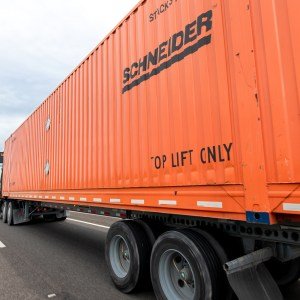
Schneider’s intermodal service is executed with its own drivers and tractors, chassis (23,900), containers (26,800) and over 60 rail hubs in North America.
“As we transition our primary eastern rail provider to Norfolk Southern, we’ll expand access to key markets, increase network flexibility and create new opportunities to better serve our customers,” said Michael Baumgardt, executive vice president of intermodal and logistics at Schneider. “It will strengthen Schneider’s competitive position and enhance the reliable service experience our customers expect.”
window.googletag = window.googletag || {cmd: []}; googletag.cmd.push(function() { var gptSlot = googletag.defineSlot(‘/21776187881/FW-Responsive-Main_Content-Slot1’, [[300, 100], [320, 50], [728, 90], [468, 60]], ‘div-gpt-ad-1709668545404-0’).defineSizeMapping(gptSizeMaps.banner1).addService(googletag.pubads()); googletag.pubads().enableSingleRequest(); googletag.pubads().collapseEmptyDivs(); googletag.enableServices(); setInterval(function() { if (!document.hidden) { googletag.pubads().refresh([gptSlot]); } }, 60000); });
googletag.cmd.push(function() { googletag.display(‘div-gpt-ad-1709668545404-0’); });The new service begins in January.
Schneider pointed to the success it has had with CPKC’s (NYSE: CP) cross-border, steel-wheel service as a factor in its decision to switch providers. Schneider said the move doesn’t jeopardize its existing relationship with CPKC. Schneider was an early user of the Southeast Mexico Express (SMX), a joint offering from CSX (NASDAQ: CSX) and CPKC, connecting Mexico to Texas and to the Southeast U.S.
“I mean, if you look at the UP today, we’re using the CPKC out of Mexico, despite the fact that they have a service,” said Jim Filter, Schneider president and CEO, on a call with analysts. “And they continue to operate with us and love everything that we’re doing with them, but they understand there’s a place that we don’t use them. And so, it’s not that unusual that you’re not going to go with one provider for everything.”
Noisy Q3 on path to recovery
Schneider (NYSE: SNDR) reported adjusted earnings per share of 29 cents for the third quarter, a penny below consensus but 17 cents higher year over year. Net interest expense was a 5-cent y/y tailwind, in part due to a reversal of interest accruals tied to a claim settlement (3 cents). A lower tax rate also helped slightly. But a separate claim in its logistics segment partially offset these benefits.
Consolidated revenue of $1.59 billion was 9% higher y/y and slightly better than the $1.58-billion consensus estimate.
It raised the bottom end of its full-year adjusted EPS guidance range by 10 cents to a new range of $1 to $1.10. The consensus estimate was $1.06 at the time of the print. (The company reported full-year 2025 adjusted EPS of 63 cents.)
Truckload revenue (ex-fuel) was flat y/y at $625 million as an 8% increase in revenue per truck (ex-fuel) was offset by an 8% decline in average trucks in service. The utilization metric was 3% higher y/y for its dedicated fleet and 21% higher for the one-way fleet.
window.googletag = window.googletag || {cmd: []}; googletag.cmd.push(function() { var gptSlot = googletag.defineSlot(‘/21776187881/fw-responsive-main_content-slot3’, [[728, 90], [468, 60], [320, 50], [300, 100]], ‘div-gpt-ad-1665767553440-0’).defineSizeMapping(gptSizeMaps.banner1).addService(googletag.pubads()); googletag.pubads().enableSingleRequest(); googletag.pubads().collapseEmptyDivs(); googletag.enableServices(); setInterval(function() { if (!document.hidden) { googletag.pubads().refresh([gptSlot]); } }, 60000); });
googletag.cmd.push(function() { googletag.display(‘div-gpt-ad-1665767553440-0’); });One-way contract renewals averaged just under 20% in the quarter, as management said that the capacity crackdown is expanding. This allowed the fleet to return to profitability.
The company has sold dedicated service on 850 trucks this year, but is still working to offset a previously disclosed customer loss.
The TL unit reported a 93% operating ratio (inverse of operating margin), which was 380 basis points better y/y, but 120 bps worse than the second quarter.
Intermodal revenue (ex-fuel) increased 2% y/y to $288 million. A 2% decline in loads was offset by a 3% increase in revenue per load (ex-fuel). Intermodal contract renewals are “comfortably in the mid-single-digit range,” management said. The unit reported a 92.1% OR, 190 bps better y/y.
The logistics segment reported breakeven results as a confidential claim settlement negatively impacted the period.
window.googletag = window.googletag || {cmd: []}; googletag.cmd.push(function() { var gptSlot = googletag.defineSlot(‘/21776187881/fw-responsive-main_content-slot4’, [[300, 100], [320, 50], [728, 90], [468, 60]], ‘div-gpt-ad-1709668086344-0’).defineSizeMapping(gptSizeMaps.banner1).addService(googletag.pubads()); googletag.pubads().enableSingleRequest(); googletag.pubads().collapseEmptyDivs(); googletag.enableServices(); setInterval(function() { if (!document.hidden) { googletag.pubads().refresh([gptSlot]); } }, 60000); });
googletag.cmd.push(function() { googletag.display(‘div-gpt-ad-1709668086344-0’); });Net debt leverage was 0.1x at the end of the quarter, down from 0.3x at the end of 2025. Schneider lowered its full-year net capex plan to a range of $325 million to $350 million. Net capex totaled $289 million in 2025.
Why it matters? Schneider’s new service agreement with Norfolk Southern expands its market access and potentially establishes it as a unique asset-based provider on a single-line transcontinental rail network alongside its growing cross-border intermodal service. Meanwhile, Schneider’s results serve as a bellwether for the health of the truckload and intermodal markets.
More FreightWaves articles by Todd Maiden:
- FedEx Freight sees volumes stabilize, eyes Q4 margin improvement
- Saia’s expanded terminal network delivers record revenue, tonnage
- XPO’s pricing, operating initiatives drive Q3 beat
The post Schneider partners with Norfolk Southern; raises outlook despite Q3 miss appeared first on FreightWaves.
Source: FreightWaves