PORTUGAL: Construction of Portugal’s first high speed line was formally launched with a ceremony on October 12. Diogo Ferreira Nunes reports from Aveiro. The north-south high speed rail corridor linking Porto Campanhã station with Lisboa Oriente, 290 km to the south, is to be built in three phases. The double-track line will largely be built on a dedicated alignment using Iberia’s 1 668 mm gauge to allow easy integration with the conventional rail network. The route is being designed for operation at up to 300 km/h. First section of line The first section of the high speed line will run over a 71 km section from Porto to Oiã, near Aveiro. It is being built by the AVAN consortium (previously known as LusoLav), which is led by Mota-Engil and includes Teixeira Duarte, Alves Ribeiro, Casais, Conduril and Gabriel Couto. Construction will involve 4 000 workers, with completion planned by the end of 2030 to enable the section to open in 2031. It will include eight tunnels and 15 viaducts, including a road and rail bridge across the River Douro. The line will pass below the town of Vila Nova de Gaia in a tunnel, where a station with 405 m long platforms will be located 60 m below the city centre. This station will offer connections to Metro do Porto’s Yellow Line and the future Rubi Line, and will have two above-ground office buildings on the northern and southern sides as well as 475 parking spaces. PPP concession The first section is being developed under a 30-year public-private partnership concession with a total budget of €2.651bn, of which only €628m is to be provided by the state. The AVAN consortium members are investing €165m in the project, and a syndicate of 13 commercial and institutional lenders is lending €1bn for 25 to 28 years. The European Investment Bank is providing a 28-year loan of €844m, and the EU is contributing €450m from the Connecting Europe Facility. There is also mezzanine funding of €52m. ‘The Portuguese PPP model here for Lisboa – Porto is undoubtedly one of the best practices that we want to bring forward in the future’, said Philippe Chantraine, head of the transport investment unit at the European Commission’s Directorate-General for Mobility & Transport, at the groundbreaking ceremony. ‘This approach enables continued infrastructure development and strategic investments in the structural foundations of the economy while minimising reliance on public funds, limiting pressure on budgets and avoiding additional public debt burdens.’ Next sections National operator CP has prequalified Alstom and Talgo for a contract to supply 12 high speed trains, and expects to award the contract by the end of Q1 2027. Rail infrastructure manager Infraestruturas de Portugal hopes that the second and third sections of high speed line running 60 km from Oiã to Soure near Coimbra and 130 km from Soure to Carregado near Lisboa will be completed by 2032. Once completed, the journey time from Porto to Lisboa is expected to be cut from 2 h 48 min to 1 h 20 min. See also Portugal to request use of broad gauge for Porto – Lisboa high speed line First Porto – Lisboa high speed line concession package awarded Porto – Lisboa high speed project and Rail Baltica lead latest Connecting Europe Facility grant allocations
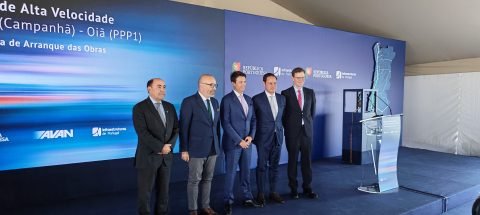
PORTUGAL: Construction of Portugal’s first high speed line was formally launched with a ceremony on October 12. Diogo Ferreira Nunes reports from Aveiro.
The north-south high speed rail corridor linking Porto Campanhã station with Lisboa Oriente, 290 km to the south, is to be built in three phases. The double-track line will largely be built on a dedicated alignment using Iberia’s 1 668 mm gauge to allow easy integration with the conventional rail network. The route is being designed for operation at up to 300 km/h.
First section of line
The first section of the high speed line will run over a 71 km section from Porto to Oiã, near Aveiro. It is being built by the AVAN consortium (previously known as LusoLav), which is led by Mota-Engil and includes Teixeira Duarte, Alves Ribeiro, Casais, Conduril and Gabriel Couto.
Construction will involve 4 000 workers, with completion planned by the end of 2030 to enable the section to open in 2031.
It will include eight tunnels and 15 viaducts, including a road and rail bridge across the River Douro.
The line will pass below the town of Vila Nova de Gaia in a tunnel, where a station with 405 m long platforms will be located 60 m below the city centre. This station will offer connections to Metro do Porto’s Yellow Line and the future Rubi Line, and will have two above-ground office buildings on the northern and southern sides as well as 475 parking spaces.
PPP concession
The first section is being developed under a 30-year public-private partnership concession with a total budget of €2.651bn, of which only €628m is to be provided by the state.
The AVAN consortium members are investing €165m in the project, and a syndicate of 13 commercial and institutional lenders is lending €1bn for 25 to 28 years. The European Investment Bank is providing a 28-year loan of €844m, and the EU is contributing €450m from the Connecting Europe Facility. There is also mezzanine funding of €52m.
‘The Portuguese PPP model here for Lisboa – Porto is undoubtedly one of the best practices that we want to bring forward in the future’, said Philippe Chantraine, head of the transport investment unit at the European Commission’s Directorate-General for Mobility & Transport, at the groundbreaking ceremony. ‘This approach enables continued infrastructure development and strategic investments in the structural foundations of the economy while minimising reliance on public funds, limiting pressure on budgets and avoiding additional public debt burdens.’
Next sections
National operator CP has prequalified Alstom and Talgo for a contract to supply 12 high speed trains, and expects to award the contract by the end of Q1 2027.
Rail infrastructure manager Infraestruturas de Portugal hopes that the second and third sections of high speed line running 60 km from Oiã to Soure near Coimbra and 130 km from Soure to Carregado near Lisboa will be completed by 2032.
Once completed, the journey time from Porto to Lisboa is expected to be cut from 2 h 48 min to 1 h 20 min.
See also
- Portugal to request use of broad gauge for Porto – Lisboa high speed line
- First Porto – Lisboa high speed line concession package awarded
- Porto – Lisboa high speed project and Rail Baltica lead latest Connecting Europe Facility grant allocations
Source: Railway Gazette