RUSSIA: Transmashholding’s Demikhovo factory has completed assembly of a hydrogen fuel cell powered passenger trainset for operation on the island of Sakhalin, and work is underway on a second. The project to produce Russia’s first hydrogen-powered passenger train and establish a common low-floor train design for future urban, suburban and regional trains is being developed jointly by TMH, Russian Railways, Rosatom and the Sakhalin regional government under an agreement signed in 2019. The trainset is based on TMH’s new low-floor design used for EP5N electric multiple-units, and will be available in two configurations. A two-car passenger unit with an additional hydrogen power module will have a range exceeding 700 km, while a three-car passenger unit with the same power module will offer more than 480 km. Onboard batteries will provide an additional range of 40 km and 80 km respectively. Testing of the first trainset is scheduled to begin in November followed by certification trials in 2027. It is expected to enter service by the end of 2027 on Sakhalin, where a hydrogen technology testing centre is being developed. In 2020 Russian Railways completed a programme launched in 2003 to convert Sakhalin’s rail network to 1 520 mm broad gauge from the 1 067 mm gauge which was a legacy of Japanese rule before World War II.
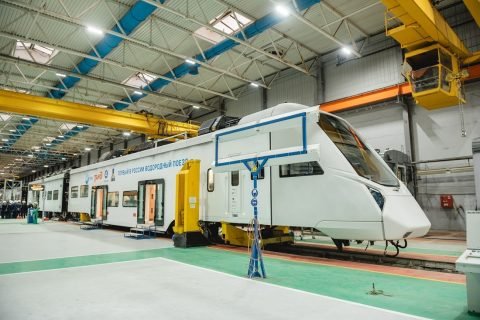
RUSSIA: Transmashholding’s Demikhovo factory has completed assembly of a hydrogen fuel cell powered passenger trainset for operation on the island of Sakhalin, and work is underway on a second.
The project to produce Russia’s first hydrogen-powered passenger train and establish a common low-floor train design for future urban, suburban and regional trains is being developed jointly by TMH, Russian Railways, Rosatom and the Sakhalin regional government under an agreement signed in 2019.
The trainset is based on TMH’s new low-floor design used for EP5N electric multiple-units, and will be available in two configurations.
A two-car passenger unit with an additional hydrogen power module will have a range exceeding 700 km, while a three-car passenger unit with the same power module will offer more than 480 km. Onboard batteries will provide an additional range of 40 km and 80 km respectively.
Testing of the first trainset is scheduled to begin in November followed by certification trials in 2027. It is expected to enter service by the end of 2027 on Sakhalin, where a hydrogen technology testing centre is being developed.
In 2020 Russian Railways completed a programme launched in 2003 to convert Sakhalin’s rail network to 1 520 mm broad gauge from the 1 067 mm gauge which was a legacy of Japanese rule before World War II.
Source: Railway Gazette