TechCrunch Disrupt 2026 starts in 4 days — lock in your pass savings of up to $100 before prices rise
Technology
Quick Read
Four days until TechCrunch Disrupt 2026 starts, when 10,000 founders, investors, and tech leaders gather in San Francisco's Moscone West on October 13-15. Save up to $100 on your price. Plus, save 50% on a second pass of the same type.
Four days until TechCrunch Disrupt 2026 starts, when 10,000 founders, investors, and tech leaders gather in San Francisco’s Moscone West on October 13-15. Save up to $100 on your price. Plus, save 50% on a second pass of the same type.
TechCrunch Disrupt 2026 takes place October 13-15 in San Francisco. Over 300 startups will show what they’ve built to 10,000 tech leaders. Plus, 250+ speakers are ready to share insights across 200+ sessions. Register before doors open to save up to $100 and get a second pass at 50% off.
For about a decade, the mainstream understanding has been that psychedelics cause chaos in the brain. Brain networks—the stable patterns of communication that handle vision, attention, or our sense of self, and more—loosen and start talking to each other all at once. EEG traces get noisier and more complex. “Think of the networks of the brain as highways,” says Devon Stoliker, a neuroscientist at Monash University. “Under psychedelics, these highways break down into many different directions.” In a recent Nature study, Stoliker’s team designed an experiment to test whether these directions are truly chaotic and random. Researchers gathered 62 people who had never taken a psychedelic before, gave them 19 milligrams of psilocybin, a common psychedelic found in certain fungi, and scanned their brains. Then, they used AI to analyze the drugged and sober brain scans. What emerged was not exactly chaos. An uninterrupted trip Stoliker thinks chaos is not a satisfactory explanation for psychedelics’ effect on the brain. “It never really explained why an individual would have a meaningful experience, why they might have insight, why they might experience clarity, and why these might translate into positive psychological changes,” Stoliker says. To investigate if there are other explanations, he and his colleagues designed a study called PsiConnect.Read full article Comments
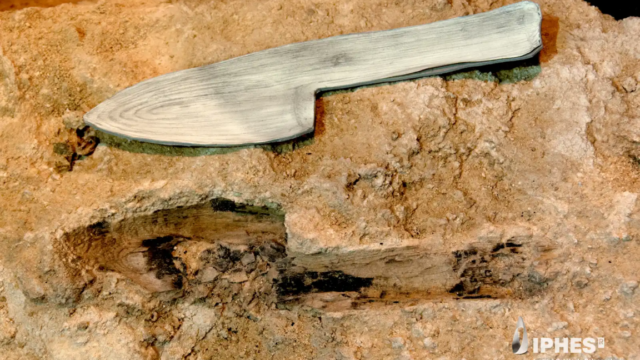
The Stone Age owes its name to tools that survived to our time. The material early humans worked with most, though, was probably wood because it is so much easier to process. Unfortunately, we know very little about Paleolithic woodwork because wood rots relatively quickly. But at Abric Romaní, a rock shelter in Capellades, west of Barcelona, mineral-rich water coated wooden Neanderthal tools in a limestone-like crust. When wood rotted away, it left behind hollow molds that faithfully reflect its shape. In a recent Science Advances study, a team of Spanish archaeologists has cataloged 597 wooden remains from Neanderthal living areas dating from 62,000 to 40,000 years ago. They found spears, digging sticks, bark trays, parts of shelters, and a club unlike anything seen before, suggesting Neanderthals were likely much more than just Homo sapiens’ dumber cousins. Beyond hunting gear The oldest wooden artifacts we have are mostly weapons. They include spears from a German town called Schöningen, a spear tip from Clacton-on-Sea in England, and the spear found alongside an elephant skeleton in Lehringen, Germany. Most came from waterlogged sediments, where a lack of oxygen slowed decay.Read full article Comments