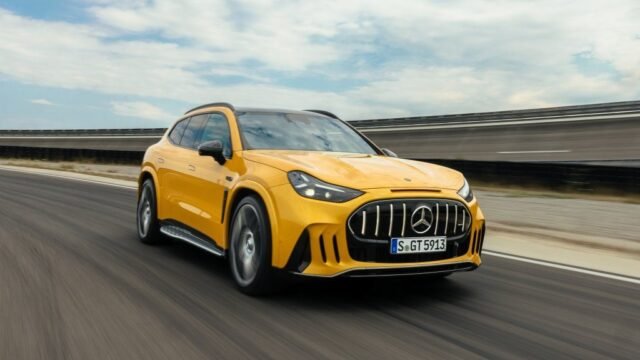
Mercedes-AMG’s first ground-up SUV is a 1,150hp electric beast
Transportationvia The Verge Transportation
Quick Read
Earlier this year, Mercedes' AMG performance brand grabbed our attention with the GT four-door coupe, a souped-up sports sedan with three axial flux motors delivering over 1,150 horsepower. Well, now meet its beefier cousin, the 2028 Mercedes-AMG GT SUV, an equally powerful, ultra-fast-charging electric people-hauler. The AMG GT SUV (say that five times fast) marks the first time in the performance brand's 59-year history that it has developed a full-size SUV entirely in-house from the ground up. Scheduled to hit the US next summer, the new EV is built on Merc's high-performance AMG.EA architecture to combine sports-car handling with full-s … Read the full story at The Verge.
Earlier this year, Mercedes’ AMG performance brand grabbed our attention with the GT four-door coupe, a souped-up sports sedan with three axial flux motors delivering over 1,150 horsepower. Well, now meet its beefier cousin, the 2028 Mercedes-AMG GT SUV, an equally powerful, ultra-fast-charging electric people-hauler.
The AMG GT SUV (say that five times fast) marks the first time in the performance brand’s 59-year history that it has developed a full-size SUV entirely in-house from the ground up. Scheduled to hit the US next summer, the new EV is built on Merc’s high-performance AMG.EA architecture to combine sports-car handling with full-s …
Chart of the Week: Accepted SONAR Tender Volume Index, SONAR Tender Rejection Index SONAR: ASTVI.USA, STRI.USA The truckload market is heading into the holidays with almost no slack. The Accepted SONAR Truckload Volume Index (ASTVI), which measures only the loads carriers accept, has fallen more than 4% over the past four weeks to 9,518. That’s its lowest level outside a holiday week since January. Normally, a drop like that would give carriers room to breathe. Instead, the national rejection rate (STRI) has barely moved and is holding near 13.9%. A year ago, the market entered peak season with rejections under 6%, and the ASTVI was roughly 2% higher. That suggests the market has regained little, if any, efficiency over the past year. Fewer accepted loads after 11 months of elevated rates is not what many expected. In the early phase of COVID, carriers appeared to hit their limit with the ASTVI around 11,500 in the fall of 2020. Rejection rates were near 25%, a sign that demand was well beyond what carriers could handle. By the spring of 2021, carriers were accepting more than 10% more loads, even with rejection rates still elevated. That market was certainly tighter than today’s. Even so, most would expect accepted volumes to have improved by now after months of elevated rates. A supply-led cycle The two cycles differ in several ways. The biggest difference is that the COVID cycle was driven more by rising demand than by falling supply. Tender volumes rose nearly 50% year over year from September 2019 to September 2020, and accepted volumes rose 20%. That surge quickly used up all the slack in what had been an oversupplied market. The current cycle seemed to appear almost out of nowhere. It first showed up during the 2025 holiday season, when rejection rates and spot rates ran well above the previous three years. Many still questioned it, because trucking demand was actually weaker. Winter Storm Fern in late January was the second catalyst. It pushed tender rejections and spot rates higher, and neither has meaningfully retreated since. Again, demand wasn’t the driver; limited capacity was. Barriers to entry The other major difference from the last inflationary cycle is that barriers to entry are much higher now. English language proficiency enforcement, stricter rules on non-domiciled CDLs and tougher immigration policies are keeping a large pool of potential drivers out of the industry. The Montgomery v. Caribe ruling has an indirect effect on drivers, because brokers are now less likely to use carriers with poor safety records. As of this past summer, close to 2% of carriers with substandard safety scores had been removed from service, according to GenLogs. Rising costs Diesel prices have spiked at times, making it hard for smaller carriers to manage cash flow. Retail diesel prices are up 73% year over year. Dry van spot rates are up a still-impressive 43%, but they haven’t kept pace with fuel over the past few months. That gap squeezes carrier profitability, a pressure that was largely missing in the COVID era, when diesel prices actually fell in 2020. Carriers that made it through the difficult stretch from mid-2022 to late last year are hesitant to invest in growth. Borrowing costs are much higher, and the low-cost government lending that helped carriers during COVID isn’t available. Supply always moves more slowly than demand, and it now faces more headwinds than in any recent cycle. Even with economic concerns, transportation procurement teams should prepare for a market that stays tighter for longer, into 2027. About the Chart of the Week The FreightWaves Chart of the Week is a chart selection from SONAR that provides an interesting data point to describe the state of the freight markets. A chart is chosen from thousands of potential charts on SONAR to help participants visualize the freight market in real time. Each week a Market Expert will post a chart, along with commentary, live on the front page. After that, the Chart of the Week will be archived on FreightWaves.com for future reference. SONAR aggregates data from hundreds of sources, presenting the data in charts and maps and providing commentary on what freight market experts want to know about the industry in real time. The FreightWaves data science and product teams are releasing new datasets each week and enhancing the client experience. To request a SONAR demo, click here. The post No signs of truckload capacity recovering appeared first on FreightWaves.
Mercedes-AMG has unveiled the GT SUV, an all-electric performance SUV with up to 1,153 hp from three axial-flux motors and DC fast charging at up to 710 kW. It’s AMG’s answer to the Porsche Cayenne Electric, and on paper, it may be more impressive. The first units hit US dealerships in summer 2027. more…
On a rainy Saturday morning in Charlotte, inside the brand new North American headquarters of Daimler Truck Financial Services, four of the company’s senior leaders traded the usual press-conference script for something closer to a fireside chat, and over the better part of an hour they said more about where this industry is actually heading, from the engine under your hood to the driver who may one day not be in the seat to the rising cost of borrowing money against a truck, than most carriers will hear in a year of official announcements. The panel brought together a rare mix of global and local perspective. Eva Scherer, chief financial officer of Daimler Truck Holding AG, carried the worldwide view. Stephan Unger, chairman of Daimler Truck Financial Services, which operates across 21 countries, spoke to how the financing side of the business is changing. Kevin Bangston, president and CEO of Daimler Truck Financial Services USA LLC, handled the view from the United States, Canada, and Mexico. Goetz Johanning, head of strategy and realization for the North American financial services arm, moderated. The session was set up as a conversation rather than a presentation, and the candor showed. Here is what matters in it for carriers of every size, from the single-truck owner-operator to the mega fleet, pulled apart and put in plain terms. The EPA 2027 Engine Is Real, And The Pre-Buy Never Came Start with the question on every buyer’s mind, because the answer shapes equipment decisions for the next two years. Daimler is going to market with a fully EPA 2027 compliant Detroit engine, and Scherer was clear that the company is not playing games with emissions credits or non-conformance penalties as a way around the standard. The strategy is a compliant engine, full stop. window.googletag = window.googletag || {cmd: []}; googletag.cmd.push(function() { var gptSlot = googletag.defineSlot('/21776187881/FW-Responsive-Main_Content-Slot1', [[300, 100], [320, 50], [728, 90], [468, 60]], 'div-gpt-ad-1709668545404-0').defineSizeMapping(gptSizeMaps.banner1).addService(googletag.pubads()); googletag.pubads().enableSingleRequest(); googletag.pubads().collapseEmptyDivs(); googletag.enableServices(); setInterval(function() { if (!document.hidden) { googletag.pubads().refresh([gptSlot]); } }, 60000); }); googletag.cmd.push(function() { googletag.display('div-gpt-ad-1709668545404-0'); }); The reassurance she offered carriers is built on continuity. The new Detroit engine shares roughly two-thirds of its parts with the current generation, which the company is framing as a reliability story rather than a leap into the unknown, paired with what it describes as competitive pricing. On top of that, Scherer said the new engines deliver about three percent better fuel economy, which over a year of real miles is a number worth paying attention to. What has not happened is just as telling. Daimler released its 2027 price list in September, and there was no spike in orders. Normally a coming emissions change triggers a pre-buy, a rush to purchase trucks under the old standard before the new one lands. This time the industry is sitting on its hands, and the reason is uncertainty. With ambiguity still hanging over the final 2027 rules, the engine strategies, and the penalty structure, buyers are in wait-and-see mode. Scherer said all the major manufacturers are fully booked for the rest of this year and that customers are positioning for orders next year, but they are not committing yet. For a small carrier, the read is simple. There is no stampede to beat, which means less pressure to make a rushed, expensive decision in a fog of regulatory uncertainty. The Freight Recovery Is Real, And So Is The Diesel Risk The panel was refreshingly plain about the pain of the last few years. A multi-year freight recession hurt Daimler’s own credit portfolio, and the company did not pretend otherwise. Bangston described coming into this year cautiously optimistic, watching a recovery driven by capacity leaving the market rather than by a surge in demand, with pricing power returning as that capacity bled out. By the second quarter, he said, renegotiated rates started showing up in the financials of on-highway customers, and the portfolio moved from stabilizing to performing meaningfully better. That is the clearest signal yet from a lender’s seat that the small and mid-sized carriers who survived are starting to breathe again. The one threat still hanging over all of it is the price of diesel, and here the panel gave a data point every carrier should sit with. Bangston estimated that customers are able to pass on roughly 70 percent of diesel cost through fuel surcharges, which leaves about 30 percent that carriers absorb themselves. That gap is exactly where thin margins get thinner when diesel spikes, and with recent price pressure tied to a string of geopolitical events, the leadership was openly wary about where fuel goes from here. For an owner-operator without the surcharge leverage a large fleet commands, that uncovered slice of fuel cost is the number that can quietly decide a year. Financing Is Getting More Expensive, And That Changes The Math If there was one theme the finance leaders kept circling back to, it was that money itself has gotten more expensive, and that it is reshaping how carriers buy trucks. Unger laid it out bluntly. Interest rates are high around the world, spreads are widening, and sovereign debt is sitting at elevated levels that he expects to persist. As financing gets more expensive, he said, more customers are coming to Daimler’s captive finance arm specifically for help, because a captive lender that only finances trucks, and that understands trucking through its cycles, can structure around a downturn in ways a general bank will not. The company leans on an A credit rating and a balance sheet it calls rock solid to back that up. window.googletag = window.googletag || {cmd: []}; googletag.cmd.push(function() { var gptSlot = googletag.defineSlot('/21776187881/fw-responsive-main_content-slot3', [[728, 90], [468, 60], [320, 50], [300, 100]], 'div-gpt-ad-1665767553440-0').defineSizeMapping(gptSizeMaps.banner1).addService(googletag.pubads()); googletag.pubads().enableSingleRequest(); googletag.pubads().collapseEmptyDivs(); googletag.enableServices(); setInterval(function() { if (!document.hidden) { googletag.pubads().refresh([gptSlot]); } }, 60000); }); googletag.cmd.push(function() { googletag.display('div-gpt-ad-1665767553440-0'); }); The bigger shift underneath that is the move away from simply buying a truck and bolting on a loan at the end. Daimler is pushing hard toward bundling, wrapping financing, maintenance, repair contracts, insurance, telematics, extended warranty, and residual-value packaging into what increasingly looks like a single monthly rate. Unger pointed to Europe, where the company runs more than 6,000 trucks in short-term and long-term rental through a unit called Charterway, and where full-service leasing and rental are growing fast. In North America, Daimler delivers that full-service leasing through partnerships with Penske and Ryder rather than running the fleet itself. Bangston was careful not to oversell the trend. He said North America is seeing more interest in bundling but not a fundamental shift out of ownership and into leasing, and no dramatic change in the owning-versus-leasing mix at the moment. The takeaway for a small carrier weighing its next purchase is that the options are widening, from straight ownership with a plan to remarket in three years, to an operating lease with its own financial advantages, to bundled service packages, and the right answer depends on how much flexibility and predictability your operation actually needs. Driverless Trucks Are Closer Than The Timeline Suggests The most forward-looking part of the conversation was autonomy, and Daimler’s framing was concrete rather than hand-wavy. Scherer said the company expects to get the driver out on its first route by the end of this year, then build mileage from there, targeting commercialization at scale toward 2028. The platform is an autonomy-ready Freightliner Cascadia with full redundancy in braking and steering, paired with a virtual driver from Torc Robotics, the company’s autonomous subsidiary. Two points from that discussion matter for the rest of the industry. First, the system is being built to be modular rather than locked to a single autonomy provider, so the redundant chassis can in principle work with different virtual-driver companies. Second, and more important for how this hits the market, the business model splits into separate revenue streams. You buy or finance the truck and chassis as you always have, and the virtual driver comes as a per-mile software-as-a-service layer on top. That is a genuinely different way to pay for a truck, and Daimler says it will finance whatever shape the autonomous model ultimately takes. Scherer also noted how fast the underlying capability is moving, describing a shift from older imitation-based training to reinforcement learning that lets a truck handle routes it has never seen before. Autonomy will still roll out on defined lanes that expand gradually, with safety as the gating factor, but her message was that the pace of expansion is accelerating and the next two years will show real ground covered. window.googletag = window.googletag || {cmd: []}; googletag.cmd.push(function() { var gptSlot = googletag.defineSlot('/21776187881/fw-responsive-main_content-slot4', [[300, 100], [320, 50], [728, 90], [468, 60]], 'div-gpt-ad-1709668086344-0').defineSizeMapping(gptSizeMaps.banner1).addService(googletag.pubads()); googletag.pubads().enableSingleRequest(); googletag.pubads().collapseEmptyDivs(); googletag.enableServices(); setInterval(function() { if (!document.hidden) { googletag.pubads().refresh([gptSlot]); } }, 60000); }); googletag.cmd.push(function() { googletag.display('div-gpt-ad-1709668086344-0'); }); Electric, Hydrogen, And The Patience Behind The Strategy On powertrain, Daimler described what it calls a dual-track approach, and it was candid that North America and Europe are moving at different speeds. In North America the priority is squeezing more efficiency out of diesel, with the compliant 2027 engine now and further efficiency steps planned toward 2030 and beyond. In Europe, where regulation is forcing the pace, the company is pushing much harder on zero-emission trucks and is also investing in hydrogen for the 2030s. Scherer offered a striking figure to show the company is not standing still on electric, saying its flagship long-haul electric model in Europe holds a 38 percent market share there, well above its overall share, and that the newest battery technology it runs in Europe can be brought into North American products like the electric Cascadia relatively quickly once real demand materializes. The company’s stance, which it calls the speed of right, is that customers and markets will decide the pace, and it will be ready either way rather than forcing a transition the market is not asking for. On charging infrastructure, the position was equally disciplined. Daimler does not intend to pour large capital into building charging at scale, preferring to support customers with depot and warehouse charging and to kickstart activity through selective partnerships. Why It Matters Everything the panel laid out, the compliant 2027 engine with its roughly three percent fuel-economy gain, the recovery finally showing up in rate renegotiations, the rising cost of money, and the roughly 70 percent of diesel cost carriers can pass through, points to a single reality for anyone running trucks, which is that the uncovered edges of this market, the 30 percent of a fuel spike you eat and the higher payment you now carry, are exactly where a thin margin gets decided. For small carriers and owner-operators, the smart move is to read this as the honest lender’s-eye view it is, make equipment decisions on your own breakeven rather than on fear of a 2027 deadline that is not actually triggering a pre-buy, and watch the per-mile autonomous model closely, because it is an early signal of how the whole economics of owning a truck may one day be priced. This article is based on a panel discussion with Daimler Truck and Daimler Truck Financial Services leadership at the DTFS North American headquarters in Charlotte, North Carolina, featuring Eva Scherer, CFO of Daimler Truck Holding AG, Stephan Unger, chairman of Daimler Truck Financial Services, and Kevin Bangston, president and CEO of Daimler Truck Financial Services USA LLC, with Goetz Johanning of DTFS USA moderating. Figures and forward-looking statements are as presented by the executives. window.googletag = window.googletag || {cmd: []}; googletag.cmd.push(function() { var gptSlot = googletag.defineSlot('/21776187881/fw-responsive-main_content-slot5', [[728, 90], [468, 60], [320, 50], [300, 100]], 'div-gpt-ad-1665767778941-0').defineSizeMapping(gptSizeMaps.banner1).addService(googletag.pubads()); googletag.pubads().enableSingleRequest(); googletag.pubads().collapseEmptyDivs(); googletag.enableServices(); setInterval(function() { if (!document.hidden) { googletag.pubads().refresh([gptSlot]); } }, 60000); }); googletag.cmd.push(function() { googletag.display('div-gpt-ad-1665767778941-0'); }); The post What Daimler’s Finance And Global Chiefs Revealed About Diesel, Driverless Trucks, And The Future Of The Industry appeared first on FreightWaves.