Harbinger is building the unsexy EVs that keep the economy moving
Transportationvia The Verge Transportation
Quick Read
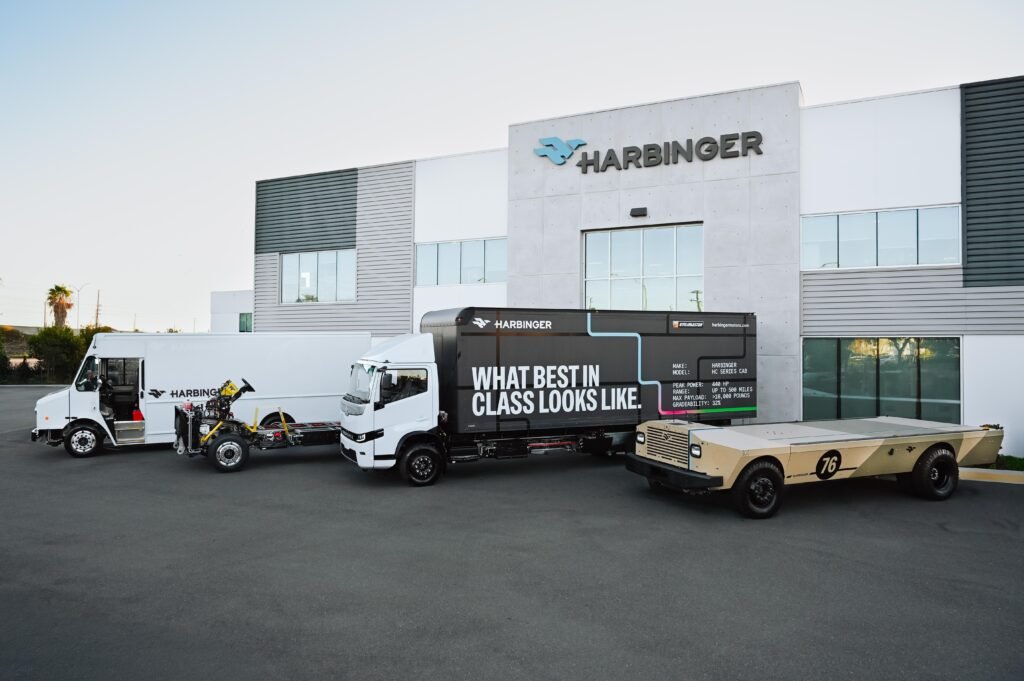
While legacy automakers tap the brakes on electric vehicles, one startup is hitting the accelerator. Earlier this month, electric truck maker Harbinger raised $240 million in a Series D round, capping a banner stretch that includes a $300 million order from FedEx and a new defense contract with the US military. Harbinger is stacking up wins by skipping the consumer EV hype cycle altogether and focusing on the unglamorous workhorses that keep the economy running: Class 4-6 delivery vans and box trucks. The company's thesis is simple: go after the overlooked commercial segments where legacy trucks are weak and giant automakers can't be bother … Read the full story at The Verge.
While legacy automakers tap the brakes on electric vehicles, one startup is hitting the accelerator. Earlier this month, electric truck maker Harbinger raised $240 million in a Series D round, capping a banner stretch that includes a $300 million order from FedEx and a new defense contract with the US military.
Harbinger is stacking up wins by skipping the consumer EV hype cycle altogether and focusing on the unglamorous workhorses that keep the economy running: Class 4-6 delivery vans and box trucks. The company’s thesis is simple: go after the overlooked commercial segments where legacy trucks are weak and giant automakers can’t be bother …
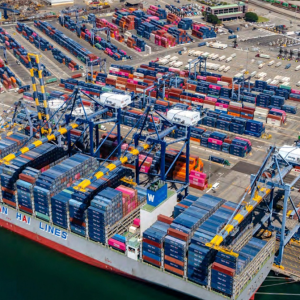
The Pacific Maritime Association and International Longshore and Warehouse Union Local 26 have reached a tentative contract agreement covering about 250 watchmen at the ports of Los Angeles and Long Beach, averting an immediate strike threat at the busiest U.S. trade gateway. The agreement, under federal mediation, remains subject to ratification by Local 26 members. The existing contract will be extended while that process proceeds, the PMA said. In its announcement, the employers’ association thanked the Federal Mediation and Conciliation Service, the U.S. Department of Labor and Local 26’s bargaining committee for their work. It said the agreement would provide greater certainty for the ports, cargo owners, supply-chain workers and the regional and national economies. No terms or timeline for ratification were disclosed. window.googletag = window.googletag || {cmd: []}; googletag.cmd.push(function() { var gptSlot = googletag.defineSlot('/21776187881/FW-Responsive-Main_Content-Slot1', [[300, 100], [320, 50], [728, 90], [468, 60]], 'div-gpt-ad-1709668545404-0').defineSizeMapping(gptSizeMaps.banner1).addService(googletag.pubads()); googletag.pubads().enableSingleRequest(); googletag.pubads().collapseEmptyDivs(); googletag.enableServices(); setInterval(function() { if (!document.hidden) { googletag.pubads().refresh([gptSlot]); } }, 60000); }); googletag.cmd.push(function() { googletag.display('div-gpt-ad-1709668545404-0'); }); The tentative settlement follows more than a year of bargaining. The previous contract expired in July 2025, and subsequent extensions allowed negotiations to continue. The latest deadline had been set for 12:01 a.m. Nov. 21, raising the prospect of a walkout if the parties failed to reach a deal or agree to another extension. Union members had authorized a strike in late October. Federally mediated negotiations resumed Friday after an earlier bargaining session ended without a breakthrough. Before the settlement, PMA said its offer included a $3,200 one-time bonus and wage increases that would lift average annual earnings for full-time watchmen from more than $170,000 to $198,000. The employers’ proposal also included continued fully employer-paid healthcare for active workers and retirees and higher pension benefits. FreightWaves has reached out to Local 26 for comment. Local 26’s watchmen provide security at six container terminals across the two ports. Their duties include controlling terminal-gate access, conducting security patrols and reporting safety issues. There were concerns that cargo operations would be disrupted if other union workers honored watchmen picket lines. PMA has said Local 26 represents roughly 2% of ILWU workers at the two ports. window.googletag = window.googletag || {cmd: []}; googletag.cmd.push(function() { var gptSlot = googletag.defineSlot('/21776187881/fw-responsive-main_content-slot3', [[728, 90], [468, 60], [320, 50], [300, 100]], 'div-gpt-ad-1665767553440-0').defineSizeMapping(gptSizeMaps.banner1).addService(googletag.pubads()); googletag.pubads().enableSingleRequest(); googletag.pubads().collapseEmptyDivs(); googletag.enableServices(); setInterval(function() { if (!document.hidden) { googletag.pubads().refresh([gptSlot]); } }, 60000); }); googletag.cmd.push(function() { googletag.display('div-gpt-ad-1665767553440-0'); }); Why it matters: The agreement reduces the immediate risk of a labor disruption at the nation’s busiest container port complex, where interruptions could affect cargo owners and businesses throughout the supply chain. Read more articles by Stuart Chirls here. Read more: window.googletag = window.googletag || {cmd: []}; googletag.cmd.push(function() { var gptSlot = googletag.defineSlot('/21776187881/fw-responsive-main_content-slot4', [[300, 100], [320, 50], [728, 90], [468, 60]], 'div-gpt-ad-1709668086344-0').defineSizeMapping(gptSizeMaps.banner1).addService(googletag.pubads()); googletag.pubads().enableSingleRequest(); googletag.pubads().collapseEmptyDivs(); googletag.enableServices(); setInterval(function() { if (!document.hidden) { googletag.pubads().refresh([gptSlot]); } }, 60000); }); googletag.cmd.push(function() { googletag.display('div-gpt-ad-1709668086344-0'); }); Zim Q3 profit surges to $830 million as freight rates jump 55% Ship pilot indicted after fatal Houston collision linked to cellphone distraction LA-Long Beach port strike risk grows as employers say ILWU talks stalled Maersk and Hapag-Lloyd restore Asia-Europe Suez routes as U.S. shippers watch capacity and costs Red Sea overcapacity looms as ocean container spot rates still 50% above year-ago window.googletag = window.googletag || {cmd: []}; googletag.cmd.push(function() { var gptSlot = googletag.defineSlot('/21776187881/fw-responsive-main_content-slot5', [[728, 90], [468, 60], [320, 50], [300, 100]], 'div-gpt-ad-1665767778941-0').defineSizeMapping(gptSizeMaps.banner1).addService(googletag.pubads()); googletag.pubads().enableSingleRequest(); googletag.pubads().collapseEmptyDivs(); googletag.enableServices(); setInterval(function() { if (!document.hidden) { googletag.pubads().refresh([gptSlot]); } }, 60000); }); googletag.cmd.push(function() { googletag.display('div-gpt-ad-1665767778941-0'); }); The post Tentative union deal averts strike at Port of LA-Long Beach appeared first on FreightWaves.
Small businesses shipping goods to overseas customers are the primary beneficiaries of a new AI-powered tool developed by DHL Express that simplifies product classification required on customs declarations and ensures descriptions are accurate. The parcel and freight transportation company said last week that its smart identification capability is now available in the United States and a handful of other countries in the Americas. The launch marks the first time AI-powered item identification has been integrated at scale into a live, customer-facing international express booking process, according to DHL Express. Other freight management firms are also offering ways to ease customs compliance burdens for customers. Flexport, for example, this year added an AI classification tool to its customs software suite that generates a suggested tariff code. FedEx and UPS have digital trade tools designed to help customers review tariff code classifications and other document requirements, and accurately include duty calculations at checkout from online stores, but they don’t use AI to essentially replace a complex task the way DHL does with photo identification. window.googletag = window.googletag || {cmd: []}; googletag.cmd.push(function() { var gptSlot = googletag.defineSlot('/21776187881/FW-Responsive-Main_Content-Slot1', [[300, 100], [320, 50], [728, 90], [468, 60]], 'div-gpt-ad-1709668545404-0').defineSizeMapping(gptSizeMaps.banner1).addService(googletag.pubads()); googletag.pubads().enableSingleRequest(); googletag.pubads().collapseEmptyDivs(); googletag.enableServices(); setInterval(function() { if (!document.hidden) { googletag.pubads().refresh([gptSlot]); } }, 60000); }); googletag.cmd.push(function() { googletag.display('div-gpt-ad-1709668545404-0'); }); Every item in a package needs an adequate description on the customs form so customs authorities can assess duties, check compliance and clear goods. Shippers are required to state what the item is, what it is made of and its intended purpose. Inaccurate or incomplete item descriptions are a common cause of customs delays and shipment holds. The new capability uses advanced computer vision to analyze a customer-generated photo of an item and instantly generate a structured, customs-compliant description, with the goal of improving data quality and reducing the potential for customs delays. “For many businesses, one of the most challenging parts of international shipping is simply describing what they are sending to meet regulatory requirements,” said Greg Hewitt, CEO, DHL Express U.S., in a news release. “With AI-powered item identification, we’re taking the guesswork out of that process. Customers can simply take a photo and get a customs-compliant description in seconds, making it easier to get shipments right from the start and move them across borders with greater speed and confidence.” The capability is particularly valuable for small and medium-sized enterprises , which represent approximately 86% of DHL Express customers in the U.S. Unlike larger companies that may have dedicated customs and trade compliance specialists, smaller businesses often have fewer resources to navigate complex international shipping requirements. As more SMEs explore international markets, the need for simple, intuitive tools to help them get shipments right from the start continues to grow. The number of small businesses in the U.S. using DHL Express for exports has increased 6% year over year, underscoring the opportunity to make international shipping more accessible. The capability is particularly relevant as U.S. businesses expand trade with China, Hong Kong, Canada and Australia, and across growing sectors including e-commerce, manufacturing, automotive and fashion. DHL said using the capability is simple. Customers photograph an item with a standard smartphone or connected device, and the AI system identifies the object and generates a structured description within seconds. Customers can review, edit or override the suggested description before submitting their shipment. No DHL Express account is required. The U.S. is one of 10 markets in the Americas where the capability is now live, joining Brazil, Canada, Chile, Colombia, Costa Rica, Ecuador, Guatemala, Mexico and Peru. window.googletag = window.googletag || {cmd: []}; googletag.cmd.push(function() { var gptSlot = googletag.defineSlot('/21776187881/fw-responsive-main_content-slot3', [[728, 90], [468, 60], [320, 50], [300, 100]], 'div-gpt-ad-1665767553440-0').defineSizeMapping(gptSizeMaps.banner1).addService(googletag.pubads()); googletag.pubads().enableSingleRequest(); googletag.pubads().collapseEmptyDivs(); googletag.enableServices(); setInterval(function() { if (!document.hidden) { googletag.pubads().refresh([gptSlot]); } }, 60000); }); googletag.cmd.push(function() { googletag.display('div-gpt-ad-1665767553440-0'); }); The launch is part of ongoing investments by DHL in digital technologies aimed at facilitating international shipping tasks. DHL said the new capability will be rolled out to more markets in 2027. The DHL Group generated revenues of approximately 82.9 billion euros, equivalent to $91 billion in 2025. During the third quarter, DHL’s revenue increased 12.6% year over year to $25.4 billion. RELATED STORIES: DHL calls out air cargo contribution to 16% Q3 profit gain The post DHL Express makes customs clearance easier for small cross-border shippers appeared first on FreightWaves.
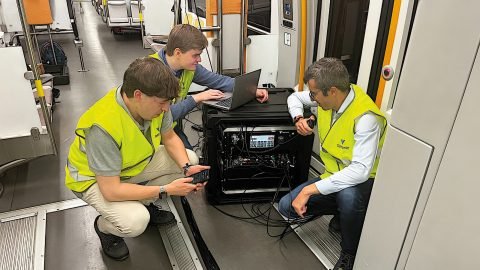
Spain is at the forefront of pan-European efforts to bring equipment underpinning the emerging FRMCS telecoms standards towards the field testing stage. Mike Bent reports. Momentum is building behind the task of upgrading railway telecoms from the increasingly obsolete GSM-R to the futureproofed 5G standard, FRMCS. Initial laboratory tests of the next-generation communications technology are being managed by the Europe’s Rail Joint Undertaking through the FP2-MORANE-2 research initiative (RG 8.26 p17). Led by UIC, the multidisciplinary consortium delivering FP2-MORANE-2 includes suppliers’ association UNIFE, 11 railway operators and infrastructure managers, suppliers Alstom, CAF, Ericsson, Eviden, Frequentis, Funkwerk, Hitachi Rail GTS, Kontron, Nokia, RideOnTrack, Siemens, Teltronic and Viavi Solutions, plus two mobile network operators, KPN and Telia. Meanwhile, work continues across the sector to agree on the standards and regulatory framework that will define FRMCS implementation in Europe. Practical trials of the technology on operational railways are now getting underway for the first time, with Spain emerging as an important proving ground. Mission-critical communications In early December 2024, at the Rail Live! trade show in the Spanish capital, Madrid-based Teltronic held a presentation showing how broadband networks and MCX (Mission Critical Services) technology could be of use in developing train-to-ground communications (voice and video transmission) using TETRA (Terrestrial Trunked Radio), and 4G and 5G broadband networks. While the presentation was in progress, live demonstrations of how these systems could be used were conducted using MCX technology, communicating with an Urbos tram in service in Zaragoza. Communications from Zaragoza were connected not only to the IFEMA trade fair in Madrid but also simultaneously with other light rail control rooms. This presentation was the forerunner to the practical trials to establish next-generation radio coverage on two sections of railway as part of the FRMCS programme. Radio trials in the Basque region Following three years of preparations, in June 2025 the MoySEST consortium, led by Teltronic and including Kenmei, Nemergent Solutions SL and S2Grupo, started overnight tests using a CAF-built Class 900 EMU on the metre-gauge network in the Basque region. The tests were supported through the EU’s Recovery & Resilience Plan under the ÚNICO SG Sectorial programme and delivered by operator Euskotren and regional infrastructure manager Eusko Trenbide Sarea. The EMU was fitted out as a mobile laboratory for use on a test zone around Durango, where the station is underground. The goal was to validate a new communications system based on broadband 5G, Teltronic’s Novax MCX and advanced cybersecurity. The tests showed that the communications architecture would be suitable for future tests of FRMCS functionality, indicating good coverage in the open air and in tunnels, stability, latency and cybersecurity performance. 900 km Test runs logged by an ADIF laboratory train on a private 5G network Fast trains, fast radio Following the initial tests on the narrow gauge, in early 2026, Teltronic deployed a private 5G high frequency (24 GHz) network on a 37 km section of the Albacete – Alacant high speed line. This telecoms network had been designed in-house specifically with high speed rail networks in mind, to comply with the standards laid down for FRMCS. At speeds above 200 km/h it is necessary to eliminate Doppler effects. One of ADIF’s laboratory trains was equipped with an onboard unit enabling it to transmit voice, data and video communications, and the tests evaluated transmission of data including continuous geolocations and simulated train control information. These tests sought to simulate a typical commercial service running at up to 200 km/h. One of the main practical problems was finding ‘windows’ between commercial services in which installation of the wayside equipment could take place. A ‘ground’ base was established in a control room at Bonete, roughly halfway between Albacete and La Encina. Over 900 km of test runs were made, and Teltronic and partners reported positive results in establishing 5G radio coverage, with quality of service and transmission rates meeting the emerging requirements for FRMCS, and the system proved robust against breaches of cybersecurity. From radio coverage to FRMCS testing Jesús Santiago Molina, Head of Railway Radio Communications and Power Supply at ADIF, Sara Caramés Saa, FRMCS & Railway Communications Expert and Technical Assistance to ADIF, and Adrián Antonio Moli Díaz, R&D Project Manager at ADIF, explain to Benjámin Zelki about the infrastructure manager’s progress in bringing FRMCS testing to Spain. Can you summarise the benefits that you expect to see from the transition from GSM-R to FRMCS? From ADIF’s perspective, FRMCS should not be considered simply as a replacement for GSM-R, but as the communications platform that will support the next stage of railway digitalisation. GSM-R has played a fundamental role in European railways and has provided a highly reliable communications system for more than two decades. However, it is based on 2G technology, which is nearing the end of its life cycle. FRMCS is therefore intended both to ensure the long-term continuity of mission-critical railway communications and provide capabilities that go significantly beyond those available with GSM-R. “ ‘The aim is not to replace one telecoms system with another, but to establish a platform capable of evolving as railway applications and telecommunications technologies develop’ Adrián Antonio Moli Díaz, R&D Project Manager, ADIF ” One of the main benefits is the ability to support much greater volumes of data and a broader range of mission-critical services, while meeting the performance and quality-of-service requirements of railway operations. This will be important for the evolution of applications such as ETCS, Automatic Train Operation, operational voice and Railway Emergency Calls. It will also support train monitoring and diagnostic systems such as TCMS, and for future possible applications that will emerge as railway operation becomes increasingly digital and automated. Another major advantage is the evolution towards a more flexible architecture in which railway applications are less dependent on a specific generation of mobile technology. This is particularly important from the long-term perspective of an infrastructure manager: the aim is not simply to replace one telecommunications system with another, but to establish a platform capable of evolving as both railway applications and telecommunications technologies develop. Therefore, the expected benefits are not only increased bandwidth or the advantages of 5G technology. For ADIF, the real value of FRMCS relies in combining mission-critical reliability with greater capacity, flexibility and scalability, creating the foundation for the future digital railway. What is the state of progress so far in FRMCS testing on the high speed network? ADIF is deploying a high speed FRMCS demonstrator on a 60 km section of the Albacete –Alacant line. This test environment will provide the opportunity to assess the future railway communication system under demanding operational conditions. The infrastructure works required for the deployment have already been completed. ADIF is currently carrying out the fibre optic installations needed to provide dedicated connections to the different FRMCS radio sites. Installation of the FRMCS radio equipment is scheduled to start this month. This will be followed by system integration and commissioning activities in preparation for the field-test campaign, which is planned to take place between April and June 2027. The purpose of the tests will go beyond validating radio coverage. They will assess the FRMCS architecture under real high speed rail conditions, including mobility and handover performance, continuity of communications, end-to-end system behaviour and the performance of the railway applications and mission-critical services supported by the network. How has ADIF found the experience of preparing for FRMCS so far? At this stage, no FRMCS tests have yet been carried out on railway tracks in Spain, so it would be premature to draw conclusions from the field-testing phase. However, ADIF already has relevant experience with technologies that form part of the evolution towards FRMCS, while laboratory validation activities for FP2-MORANE-2 are currently underway. ADIF also gained relevant experience through its participation in the MoySEST project, led by Teltronic. These trials assessed a train-to-ground critical communications approach based on private 5G and MCX technology in a real railway environment. Although the deployment did not use the specific FRMCS frequency bands or interfaces, it provided useful pre-FRMCS experience with some of the technologies on which the future telecoms platforms will be based. Within FP2-MORANE-2, laboratory validation is now being used to integrate the different system components and, importantly, to de-risk the test cases before moving them to the railway environment. This allows potential issues to be identified and test procedures to be validated before field tests start. The next step will be the two Spanish trials: one on the Asunción Universidad – Matallana line from January to March 2027, followed by Albacete – Alacant from April to June 2027. These two very different environments will allow ADIF to assess FRMCS under both conventional and high speed operating conditions. Can you explain how the narrow gauge trials between Asunción Universidad and Matallana will work? The Asunción Universidad – Matallana section, which forms part of the metre-gauge León – Guardo line, is ADIF’s second Spanish FRMCS field-test environment within the FP2-MORANE-2 programme. Infrastructure preparation in this section is at an advanced stage, with 85% of the works completed. The remaining activities are mainly minor works associated with transmission and power supply. Installation of the FRMCS radio equipment is due to begin between the last week of September and the first week of October. Once installation and integration have been completed, the field test campaign around León is scheduled to run from January to March 2027. This location provides a very different environment from the high speed line: a metre-gauge regional railway with lower traffic density and more challenging topographical conditions. The broader León – Guardo corridor is also being used by ADIF as a test environment for other railway innovation initiatives, including new approaches to the deployment of ERTMS on lower-density lines (RG 4.26 p41). Regarding commercial operation, it is important to distinguish between the current pre-commercial demonstrators and a future operational deployment of FRMCS. The purpose of the Spanish FP2-MORANE-2 installations is to validate the specifications and operational performance of FRMCS and to gain experience that will contribute to the further development of the system. They should not be regarded as the start of a commercial network roll-out. This article first appeared in the October 2026 issue of Railway Gazette International Read the issue ERTMS: Working to reduce complexity and cost