Data centers are turning to old jet engines as the wait for power grows
Technologyvia TechCrunch
Quick Read
The years-long wait for access to the grid and new turbines is causing data center builders to turn to an unusual, less-efficient and less environmentally friendly solution: once-discarded jet engines.
The years-long wait for access to the grid and new turbines is causing data center builders to turn to an unusual, less-efficient and less environmentally friendly solution: once-discarded jet engines.
Sixty years ago, after two failed attempts, Ford won the 24 Hours of Le Mans with its GT40 race car. In the years since, the Blue Oval has been back to France more than a few times, with varying success. It could never replicate the GT40’s success winning overall, but it celebrated the 40th anniversary with a class win. Now it wants another shot at the really big trophy, and it debuted the car during the Detroit Lions-Chicago Bears football game today: meet the GT41. “Revealing the Ford GT41 is a significant moment for everyone involved in this program,” said Dan Sayers, manager of Ford Racing’s Hypercar program. “It's the result of an enormous amount of work across our engineering, design, and development teams and an important milestone on our journey towards 2027. We know the scale of the challenge ahead—the level of competition in Hypercar is incredibly high, and there are no shortcuts to success. Our focus has been on building the right foundations, bringing together the right people and making sure we learn as much as possible from every stage of development.” The video was directed by Zack Snyder and features Matt Damon’s voice-over. Like many other entrants in the World Endurance Championship’s Hypercar class, Ford has chosen the rear-wheel-drive LMDh technical approach rather than building the GT41 entirely from scratch, as Ferrari and Aston Martin do with their cars. LMDh cars start with one of four approved carbon fiber chassis—in this case, Ford is working with Oreca, which has also partnered with Genesis and Acura.Read full article Comments
Much of the focus for human-caused climate change is on fossil fuels, which are creating most of our problems. But land use change is also a large component of the story, accounting for about one-third of total historical CO2 emissions. Deforestation plays a major role here, but practices like draining wetlands also factor in. Exactly how much of our history of eliminating wetlands has contributed to warming is challenging to figure out. But thanks to new sources of data that measure emissions from today’s surviving wetlands, it’s possible to put a better number on it. A new study led by Jevan Yu at MIT focuses on peatlands—environments like bogs and fens where organic matter accumulates into thick layers of material. Some 600 billion tons of carbon are held in these vast stores of peat, which is more than you can find in all the world’s living vegetation, the researchers note. Because these areas are permanently inundated, any oxygen in the water is quickly used up, leaving the job of decaying all that organic matter to anaerobic bacteria that work much more slowly and don't digest everything. So instead of seeing organic carbon turning into the CO2 gas released by aerobic bacteria, in peatlands, a subset of it gradually turns into methane gas. Methane is an even more potent greenhouse gas than CO2 itself and ultimately gets oxidized into CO2. That means there’s a little trade-off from peatlands—most of the carbon they have is kept out of the atmosphere, but the carbon that does escape does so as methane.Read full article Comments
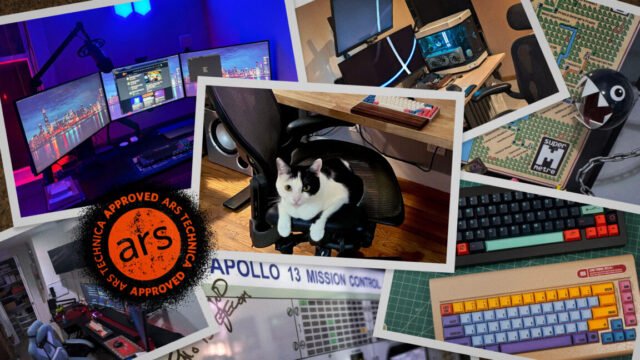
Ars Technica is a place that has always leaned into remote working. Since its beginnings in 1998, Ars has never had a single, central office—a setup that makes for a great commute to work, with little risk of getting stuck in traffic. As Ars staffers step away from their desks for a few days to spend some time with family and friends, we wanted to give you a look inside our home offices. We've got all sorts of setups, tucked into basements, dens, spare bedrooms, apartment corners, and lofts. They run the gamut from minimalist "here's my laptop and monitor" setups to "I really like collecting things." Without any further ado, let's dig in: Jeremy Hsu Living in a New York apartment means being smart with available space. Credit: Jeremy Hsu/Ars Technica As an apartment dweller in New York City, I’ve usually set up my home work station in a small corner of my residence along with sometimes decamping for local cafes or coworking spaces. My current hodgepodge of equipment is probably on the minimal side compared to many members of the Ars team.Read full article Comments