INDIA: Prime Minister Narendra Modi and Chief Minister of Tamil Nadu Joseph Vijay opened Chennai Metro’s 15 km Yellow Line on October 11. The elevated route between Poonamallee Bypass and Vadapalani forms the first operational stretch of Phase II Corridor 4, serving 11 stations. Inaugural passenger services on the Yellow Line commenced on October 11, and a full service ran the day after. No fewer than 25 474 passenger journeys were recorded during the first five hours of operation. The route connects western suburbs with the city centre to reduce commuting times. The stations served include Porur Junction, Porur Bypass, Iyappanthangal and Vadapalani. Services operated by Chennai Metro Rail Ltd run between 07.00 and 21.00 each day. On weekdays peak-hour services run every 10 min, whilst off-peak trains operate at 15 min intervals. Sunday services run every 15 min. Double-decker viaduct traverses congested corridor The Yellow Line project cost approximately Rs49bn (€490m). Infrastructure consulting and engineering firm AECOM served as General Consultant and contributed to the detailed design work. Regional Director Sunil Kumar Reddy Kasa says the alignment includes ‘a unique 3.7 km double-decker viaduct traversing one of Chennai’s busiest traffic corridors’. The line is served by 36 Alstom Metropolis three-car trainsets. The trains were ordered under a €124m contract awarded in 2023 and are designed in Bengaluru and manufactured at Alstom’s plant in Sri City, Andhra Pradesh. In March 2023, Chennai Metro Rail Ltd awarded a contract covering signalling, train control and video management for all three Phase II corridors to a consortium of Hitachi Rail STS and Hitachi Rail STS India. The signalling systems will support driverless train operation, with ATO expected to be activated in mid-2027, subject to further testing and safety certification. Phase II network expansion targets 2028 Chennai’s existing metro network comprises two operational corridors with a combined route length of 54 km built as Phase I, which opened progressively in 2015-22. The new Yellow Line connects with the existing metro network at Vadapalani. The wider Phase II project covers 118.9 km across three corridors, adding 128 stations in total. The expansion includes Corridor 3 from Madhavaram to SIPCOT, Corridor 4 to Lighthouse and Corridor 5 to Sholinganallur. India’s Ministry of Housing & Urban Affairs approved the project at an estimated cost of Rs630bn (€5.9 bn). CMRL plans to complete the entire Phase II network by the end of 2028. Chennai metro trains to be fitted with anti-drag system to detect trapped saris and bags See also Infographic: Indian metros – route-km open, under construction or planned (as at August 2025) Delhi Metro International Ltd formed to target global markets
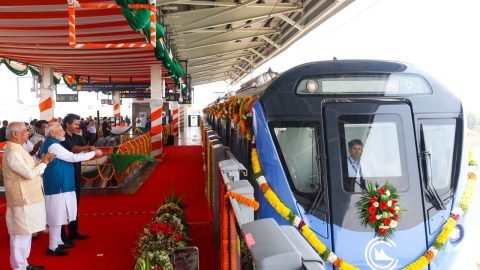
INDIA: Prime Minister Narendra Modi and Chief Minister of Tamil Nadu Joseph Vijay opened Chennai Metro’s 15 km Yellow Line on October 11. The elevated route between Poonamallee Bypass and Vadapalani forms the first operational stretch of Phase II Corridor 4, serving 11 stations.
Inaugural passenger services on the Yellow Line commenced on October 11, and a full service ran the day after. No fewer than 25 474 passenger journeys were recorded during the first five hours of operation.
The route connects western suburbs with the city centre to reduce commuting times. The stations served include Porur Junction, Porur Bypass, Iyappanthangal and Vadapalani.
Services operated by Chennai Metro Rail Ltd run between 07.00 and 21.00 each day. On weekdays peak-hour services run every 10 min, whilst off-peak trains operate at 15 min intervals. Sunday services run every 15 min.
Double-decker viaduct traverses congested corridor
The Yellow Line project cost approximately Rs49bn (€490m).
Infrastructure consulting and engineering firm AECOM served as General Consultant and contributed to the detailed design work. Regional Director Sunil Kumar Reddy Kasa says the alignment includes ‘a unique 3.7 km double-decker viaduct traversing one of Chennai’s busiest traffic corridors’.
The line is served by 36 Alstom Metropolis three-car trainsets. The trains were ordered under a €124m contract awarded in 2023 and are designed in Bengaluru and manufactured at Alstom’s plant in Sri City, Andhra Pradesh.
In March 2023, Chennai Metro Rail Ltd awarded a contract covering signalling, train control and video management for all three Phase II corridors to a consortium of Hitachi Rail STS and Hitachi Rail STS India.
The signalling systems will support driverless train operation, with ATO expected to be activated in mid-2027, subject to further testing and safety certification.
Phase II network expansion targets 2028
Chennai’s existing metro network comprises two operational corridors with a combined route length of 54 km built as Phase I, which opened progressively in 2015-22.
The new Yellow Line connects with the existing metro network at Vadapalani.
The wider Phase II project covers 118.9 km across three corridors, adding 128 stations in total. The expansion includes Corridor 3 from Madhavaram to SIPCOT, Corridor 4 to Lighthouse and Corridor 5 to Sholinganallur.
India’s Ministry of Housing & Urban Affairs approved the project at an estimated cost of Rs630bn (€5.9 bn). CMRL plans to complete the entire Phase II network by the end of 2028.
Chennai metro trains to be fitted with anti-drag system to detect trapped saris and bags
See also
- Infographic: Indian metros – route-km open, under construction or planned (as at August 2025)
- Delhi Metro International Ltd formed to target global markets
Source: Railway Gazette