BYD builds 150,000th commercial NEV – an 800 hp Q3 electric semi truck
Transportation
Quick Read
The BYD Q3 battery-electric semi truck shown here marked a major production milestone this week, becoming the 150,000th new energy commercial vehicle to roll off the assembly line at BYD’s truck plant in Huai’an, Jiangsu province. more…
The BYD Q3 battery-electric semi truck shown here marked a major production milestone this week, becoming the 150,000th new energy commercial vehicle to roll off the assembly line at BYD’s truck plant in Huai’an, Jiangsu province.
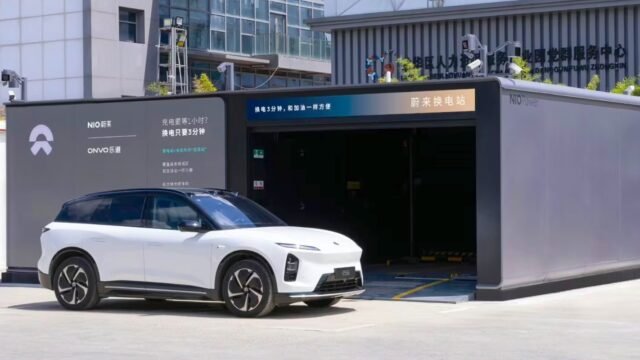
While oil prices and range anxiety dominate Western EV headlines, Nio’s battery-swap system in China keeps reaching new milestones that prove the technology can rival a traditional refueling infrastructure at scale, performing 1.2 million battery swaps over the holiday. more…
I'm bouncing down the road in San Carlos, California, zipping past behemoth tech companies like EA and Oracle, in America's smallest electric truck. The Telo MT1 (which stands for "mini truck") unquestionably turns heads because it looks so remarkably different from everything else on the market right now. It has a nearly cab-over design, meaning that front-seat passengers sit almost directly over the front axle. It looks a lot like a Japanese kei truck, with a super-short nose and four doors. People stop to stare as we sit at stoplights or roll silently past. The interior is surprisingly spacious, and while the seats are firm, they're n … Read the full story at The Verge.
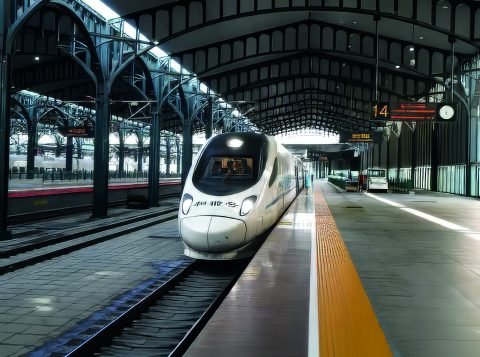
No less than 1 444.9 km of Chinese high speed lines opened between June and the end of September. Reflecting the challenging topography now facing builders, bridges and tunnels account for 88% of the cumulative route length of these new lines, as Toma Bačić, Benjámin Zelki and Andy Hellawell explain. The Chinese high speed network passed the 50 000 route-km mark with the usual end-of-year wave of openings in December, and five more corridors have followed in recent months, peaking with an assorted opening of four lines on September 28. One common feature of the newest lines is the exceptionally high proportion of bridges and tunnels, which are intended to overcome extremely challenging terrain, including mountain ranges, coastal features and even areas of permafrost. North-south corridor opens The 552 km Xiong’an – Shangqiu high speed corridor (marked with E on the map) opened on September 28, linking the Xiong’an satellite city south of Beijing with Shangqiu. It provides another north-south axis between the capital and Hefei, and 93% of it is being built on bridges. The fastest travel time from Xiong’an to Shangqiu is 2 h 27 min. Far north link A 318 km long, 250 km/h high speed railway in the northeast corner of the country also opened on September 28. Linking Harbin and Yichun (map: D), this route traverses a permafrost zone in Heilongjiang Province, and as a result of this and other areas of challenging terrain, bridges and causeways account for no less than 72% of the total alignment. The Passenger-Dedicated Line brought the journey time between Harbin and Yichun down from the earlier best of approximately 7 h to 2 h. Xi’an – Wuhan corridor complete The 256.9 km long Xi’an – Shiyan section of the Xi’an – Wuhan corridor (A) started the summer opening wave on June 30. This 350 km/h corridor cuts through the Qinling mountains and completed the last missing link on the Xi’an – Wuhan corridor in the centre of the country. Roughly 95% or 242.9 km of the PDL runs on bridges or in tunnels, with 42 tunnels giving a combined length of no less than 200 km. Described as one of the most technically demanding high speed routes inaugurated this year, it is also referred to as the ‘Cloud Railway’, reflecting the high viaducts that link the tunnelled sections through various valleys and gorges. Xi’an Dong high speed station was inaugurated alongside the completion of the project, simultaneously being met by an extension of Xi’an metro Line 5 to serve it. The new main line station features no fewer than 27 platform tracks. Initially these will be used for services to and from Chongqing and Wuhan, but the new interchange has been designed with provision for further routes to be opened in the future. Xi’an – Ankang opens The 180 km long, 350 km/h PDL linking Xi’an Dong to Ankang Xi (B) also opened on September 28. It is the first section of a corridor that is being developed between Xi’an and Chongqing in central China. No less than 90% of the alignment is being built on bridges or in tunnels, and China Telecom reports that the line has 4G and 5G coverage throughout. An end-to-end journey will take less than 1 h, compared to 3 h via existing routes. Yichang – Xingshan corridor Also on September 28, revenue services started on the 109 km long, 350 km/h speed Yichang – Xingshan high speed line (F). As well as providing earlier missing regional connectivity, it also forms part of an alternative alignment for the Shanghai – Chongqing – Chengdu line or the so-called Yangtze River corridor. Of the 101 km of newly built alignments, 81 km runs in a total of 23 tunnels, and another 21 km is built on bridges, taking a total of 94.4% of the line to run in tunnels or on bridges. The fastest travel time from Yichang North to Xingshan is 30 min. High speed branch The shortest route among the new openings, a 37 km branch off the Hangzhou – Taizhou high speed line opened on August 8. This 350 km/h line links Wenling, south of Taizhou with the coastal area of Yuhuan (C). It is served by an extension of CR’s Hangzhou – Taizhou high speed trains and other services. No less than 90.3% of this coastal railway was built in tunnels or on bridges, with 17 structures spanning over 16 km and 13 tunnels covering more than 18 km. Finally, a Y-shaped network is expected to open later in October. It is to link Fuyang on the Beijing – Hefei north-south corridor to Huaibei and Bengbu (G), with a total of 302 km of new alignment. This article first appeared in the October 2026 issue of Railway Gazette International Read the issue See also China: ‘Eight by eight’ network nears completion with latest wave of openings China – country map