Linking Delhi with the satellite city of Meerut 82 km to the northeast, the Namo Bharat dedicated commuter railway was fully commissioned earlier this year. Shalabh Goel, Managing Director of project promoter NCRTC, tells Benjámin Zelki that the concept is ripe for emulation in other Indian cities. ‘The idea of RRTS is to give people around large metropolises access to jobs from up to 200 km from the city centres, allowing them to commute very fast, comfortably and affordably’, says Shalabh Goel, Managing Director of the National Capital Region Transport Corp, speaking to Railway Gazette International during the InnoTrans 2026 trade fair in Berlin. NCRTC is a joint venture of the national government and the state governments of Delhi, Haryana, Rajasthan and Uttar Pradesh. The Delhi – Meerut Regional Rapid Transit System — subsequently branded as the Namo Bharat service — was opened in phases between October 2023 and February 22 this year. ‘We are very proud of what we call the Namo Bharat experience’, says Goel. ‘Our level of customer safety is very high. Our service is also very affordable. It costs just Rs.2.6 (€0.024) per km, meaning Rs.210 (€1.97) for the 82 km end-to-end journey. ’The trains link Sarai Kale Khan in Delhi with Modipuram, north of Meerut, serving the satellite cities of Meerut and Ghaziabad, while providing interchange to three Delhi Metro lines in the capital. Namo Bharat serves a total of 16 stations and shares tracks with local trains branded as Meerut Metro for a 23 km section of the corridor. The metro operation links 13 stations, eight of which are not served by the express trains on the main route. Opening of the Namo Bharat corridor cut the typical commuting time between Meerut and Delhi from about 3 h to 1 h in peak hours. 4G telecommunications A notable feature of RRTS is its use of what is termed ETCS Hybrid Level 3 train control, supporting attended automatic train operation. The radio network for the train control data runs on an LTE/4.9G backbone, rather than using the increasingly obsolete 2G which is the European standard for GSM-R. The fully redundant private network was supplied by Nokia. The ETCS architecture adopted by RRTS uses virtual fixed blocks, which enable the block sections to be shortened and headways reduced to 180 sec. NCRTC says the automated operation is made possible by continuously monitoring and adjusting train speeds. Energy saving All the station roofs and the main depot at Duhai are equipped with solar panels. ‘Two of our stations are net zero compliant, meaning all of that station’s energy usage is produced by solar panels.’, Goel explains. ‘Now we are just deploying a large land-based solar array, equipped with panels able to generate 110 MWp. This would provide no less than 60% of our energy needs from clean energy.’ Integrated and smart ticketing is another focus, Goel says. ‘Our ticketing system is integrated with the national common mobility card system. We have focused on multimodality and built park and ride facilities at stations when developing the Namo Bharat route.’ Extension plans Delhi city map Click to explore Plans have been finalised for two further RRTS lines to serve large satellite cities around Delhi. One would run north to Karnal, and another would run southwest to Gurugram, connecting Delhi International Airport and continuing to Behror. These two lines and the Meerut route would all meet at the Sarai Kale Khan hub in Delhi. Elsewhere, plans are making progress for a series of suburban rail links that would avoid the congested heart of the city. Goel reports that a detailed design process is underway for two proposed routes: Noida – Faridabad – Gurugram, and Gaziabad – Jewar Noida International Airport. Ready to go nationwide Goel feels that the RRTS concept has already been successful enough to be exported beyond Delhi. ‘It would be worth launching RRTS services to allow commuting to job opportunities around other metropolises in India.’ The 2026 Economic Survey of India, prepared by the Ministry of Finance, identified potential for about 2 900 km of additional RRTS corridors in different parts of the country, for which design works could be carried out in the future. NCRTC is already undertaking detailed design work on two corridors outside the capital region. One would link Lucknow to Kanpur in Uttar Pradesh, and the other would connect Patna with Gaya in Bihar. The lines in the capital region would be constructed and managed by NCRTC, and Goel confirms that ‘we have all the manpower, technology and know-how to execute such projects in other parts of the country as well.’ Blending metro and main line features The Namo Bharat service uses a high speed, high frequency, high capacity regional route, blending metro and main line railway characteristics in a fashion that had not been tried in India before. This includes longer distances between stations than a typical suburban railway and a design speed of 180 km/h. The intention was to develop a short-distance inter-city service between the capital and Meerut. Revenue earning trains are limited to 160 km/h, giving a comemrcial average of around 90 km/h including stops. Train interiors have a 2+2 seating configuration, tailored for longer-distance suburban operations. At the same time, the express trains share tracks with what is effectively a metro operation in Meerut. Most of the line is elevated, but there are tunnelled sections in the centres of Delhi and Meerut. Unlike most of the Indian Railways network, the line has been built to 1 435 mm gauge. As of October 2026, the railway was handling an average daily ridership of around 120 000, with a single-day peak of 168 000 passengers recorded in August. NCRTC reports that ridership continues to grow on a daily basis. Services are being run for NCRTC by Deutsche Bahn International Operations under a 12-year contract awarded in July 2022. Services run at 10 min headways between 06.00 and 23.00 every day. Bombardier Transportation (now Alstom) supplied railway systems for RRTS and 30 six-car Namo Bharat EMUs under a May 2020 contract which also included 10 three-car high-capacity units to operate the Meerut Metro local service. The 25 kV 50 Hz trainsets were built at Alstom’s Savli plant in Gujarat, in line with the government’s Make in India programme. This article first appeared in the November 2026 issue of Railway Gazette International Read the issue
Linking Delhi with the satellite city of Meerut 82 km to the northeast, the Namo Bharat dedicated commuter railway was fully commissioned earlier this year. Shalabh Goel, Managing Director of project promoter NCRTC, tells Benjámin Zelki that the concept is ripe for emulation in other Indian cities.
‘The idea of RRTS is to give people around large metropolises access to jobs from up to 200 km from the city centres, allowing them to commute very fast, comfortably and affordably’, says Shalabh Goel, Managing Director of the National Capital Region Transport Corp, speaking to Railway Gazette International during the InnoTrans 2026 trade fair in Berlin.
NCRTC is a joint venture of the national government and the state governments of Delhi, Haryana, Rajasthan and Uttar Pradesh. The Delhi – Meerut Regional Rapid Transit System — subsequently branded as the Namo Bharat service — was opened in phases between October 2023 and February 22 this year.
‘We are very proud of what we call the Namo Bharat experience’, says Goel. ‘Our level of customer safety is very high. Our service is also very affordable. It costs just Rs.2.6 (€0.024) per km, meaning Rs.210 (€1.97) for the 82 km end-to-end journey.
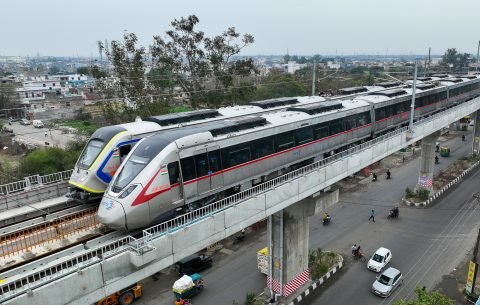
’The trains link Sarai Kale Khan in Delhi with Modipuram, north of Meerut, serving the satellite cities of Meerut and Ghaziabad, while providing interchange to three Delhi Metro lines in the capital.
Namo Bharat serves a total of 16 stations and shares tracks with local trains branded as Meerut Metro for a 23 km section of the corridor. The metro operation links 13 stations, eight of which are not served by the express trains on the main route. Opening of the Namo Bharat corridor cut the typical commuting time between Meerut and Delhi from about 3 h to 1 h in peak hours.
4G telecommunications
A notable feature of RRTS is its use of what is termed ETCS Hybrid Level 3 train control, supporting attended automatic train operation. The radio network for the train control data runs on an LTE/4.9G backbone, rather than using the increasingly obsolete 2G which is the European standard for GSM-R. The fully redundant private network was supplied by Nokia.
The ETCS architecture adopted by RRTS uses virtual fixed blocks, which enable the block sections to be shortened and headways reduced to 180 sec. NCRTC says the automated operation is made possible by continuously monitoring and adjusting train speeds.
Energy saving
All the station roofs and the main depot at Duhai are equipped with solar panels. ‘Two of our stations are net zero compliant, meaning all of that station’s energy usage is produced by solar panels.’, Goel explains.
‘Now we are just deploying a large land-based solar array, equipped with panels able to generate 110 MWp. This would provide no less than 60% of our energy needs from clean energy.’
Integrated and smart ticketing is another focus, Goel says. ‘Our ticketing system is integrated with the national common mobility card system. We have focused on multimodality and built park and ride facilities at stations when developing the Namo Bharat route.’
Extension plans
Delhi city map Click to explore
Plans have been finalised for two further RRTS lines to serve large satellite cities around Delhi. One would run north to Karnal, and another would run southwest to Gurugram, connecting Delhi International Airport and continuing to Behror. These two lines and the Meerut route would all meet at the Sarai Kale Khan hub in Delhi.
Elsewhere, plans are making progress for a series of suburban rail links that would avoid the congested heart of the city. Goel reports that a detailed design process is underway for two proposed routes: Noida – Faridabad – Gurugram, and Gaziabad – Jewar Noida International Airport.
Ready to go nationwide
Goel feels that the RRTS concept has already been successful enough to be exported beyond Delhi. ‘It would be worth launching RRTS services to allow commuting to job opportunities around other metropolises in India.’
The 2026 Economic Survey of India, prepared by the Ministry of Finance, identified potential for about 2 900 km of additional RRTS corridors in different parts of the country, for which design works could be carried out in the future.
NCRTC is already undertaking detailed design work on two corridors outside the capital region. One would link Lucknow to Kanpur in Uttar Pradesh, and the other would connect Patna with Gaya in Bihar.
The lines in the capital region would be constructed and managed by NCRTC, and Goel confirms that ‘we have all the manpower, technology and know-how to execute such projects in other parts of the country as well.’
Blending metro and main line features
The Namo Bharat service uses a high speed, high frequency, high capacity regional route, blending metro and main line railway characteristics in a fashion that had not been tried in India before.
This includes longer distances between stations than a typical suburban railway and a design speed of 180 km/h. The intention was to develop a short-distance inter-city service between the capital and Meerut. Revenue earning trains are limited to 160 km/h, giving a comemrcial average of around 90 km/h including stops. Train interiors have a 2+2 seating configuration, tailored for longer-distance suburban operations.
At the same time, the express trains share tracks with what is effectively a metro operation in Meerut. Most of the line is elevated, but there are tunnelled sections in the centres of Delhi and Meerut. Unlike most of the Indian Railways network, the line has been built to 1 435 mm gauge.
As of October 2026, the railway was handling an average daily ridership of around 120 000, with a single-day peak of 168 000 passengers recorded in August. NCRTC reports that ridership continues to grow on a daily basis.
Services are being run for NCRTC by Deutsche Bahn International Operations under a 12-year contract awarded in July 2022. Services run at 10 min headways between 06.00 and 23.00 every day.
Bombardier Transportation (now Alstom) supplied railway systems for RRTS and 30 six-car Namo Bharat EMUs under a May 2020 contract which also included 10 three-car high-capacity units to operate the Meerut Metro local service.
The 25 kV 50 Hz trainsets were built at Alstom’s Savli plant in Gujarat, in line with the government’s Make in India programme.
This article first appeared in the November 2026 issue of Railway Gazette International
Read the issue
Source: Railway Gazette