SONAR’s new sitrep traces diesel from crude to truck stop and explains why prices are holding near record highs, even as Brent drops. Diesel is expensive because refined product supply, not crude, is the bottleneck. Middle East and Russian refinery damage, longer tanker routes and thin U.S. inventories have pushed the diesel crack spread to about three times its early-2026 level. window.googletag = window.googletag || {cmd: []}; googletag.cmd.push(function() { var gptSlot = googletag.defineSlot('/21776187881/FW-Responsive-Main_Content-Slot1', [[300, 100], [320, 50], [728, 90], [468, 60]], 'div-gpt-ad-1709668545404-0').defineSizeMapping(gptSizeMaps.banner1).addService(googletag.pubads()); googletag.pubads().enableSingleRequest(); googletag.pubads().collapseEmptyDivs(); googletag.enableServices(); setInterval(function() { if (!document.hidden) { googletag.pubads().refresh([gptSlot]); } }, 60000); }); googletag.cmd.push(function() { googletag.display('div-gpt-ad-1709668545404-0'); }); SONAR’s truck stop diesel index (DTS.USA) was $6.23 per gallon on Nov. 9, 2026, up 65% from $3.78 a year earlier. That is about $0.89 per mile in fuel at 7 miles per gallon. SONAR’s new sitrep, Diesel 101: Prices and Logistics Markets, breaks down where that price comes from and what it means for carriers, shippers and brokers. Key takeaways Crude is falling faster than diesel. Brent is down 21% from its Oct. 30 high, but truck stop diesel is down only 2.5%. The crack spread is doing the work. The diesel crack against Brent was $2.51 per gallon on Nov. 9, versus a $0.87 average in January and February. Retail lags wholesale. The FUELS spread (truck stop minus rack) widened to $1.52 from $1.23 on Oct. 30 as rack prices fell faster than pump prices. EIA sees higher diesel for longer. Its November outlook raised the 2027 retail diesel forecast 12%, to $5.03 per gallon from $4.49. The index in your contract matters. On Nov. 9, SONAR’s daily truck stop price was about 10.5 cents above EIA’s weekly national average. Where $6.23 comes from The sitrep splits the Nov. 9 truck stop price into three parts using SONAR daily data: Crude is only about 35% of the truck stop price, and refining is now the largest piece. That is why a $25-per-barrel drop in Brent since Oct. 30 has barely moved the pump. Why diesel is so expensive now Less product supply abroad. IEA puts Middle East refined product exports at 1.9 million barrels per day, against 4.7 million before the war. Longer, riskier shipping. The Strait of Hormuz closure and the Red Sea blockade have stretched some tanker voyages from about 24 to 54 days. No spare U.S. refining capacity. Refineries ran at 96% in the third quarter, with less capacity than in 2019. Exports pull fuel abroad. U.S. distillate exports topped their 2021 to 2025 highs in six of seven months through July. Thin inventories. Distillate stocks were 13% below the five-year average in late September; East Coast stocks were 32% below. What comes next EIA’s November Short-Term Energy Outlook forecasts retail diesel at $6.05 per gallon in the fourth quarter of 2026, easing to $4.80 by the fourth quarter of 2027. At 7 mpg, that is $0.86 per mile now and $0.69 per mile by late 2027. EIA cautions that Middle East flows remain fragile, so short-term volatility will exceed its monthly path. window.googletag = window.googletag || {cmd: []}; googletag.cmd.push(function() { var gptSlot = googletag.defineSlot('/21776187881/fw-responsive-main_content-slot3', [[728, 90], [468, 60], [320, 50], [300, 100]], 'div-gpt-ad-1665767553440-0').defineSizeMapping(gptSizeMaps.banner1).addService(googletag.pubads()); googletag.pubads().enableSingleRequest(); googletag.pubads().collapseEmptyDivs(); googletag.enableServices(); setInterval(function() { if (!document.hidden) { googletag.pubads().refresh([gptSlot]); } }, 60000); }); googletag.cmd.push(function() { googletag.display('div-gpt-ad-1665767553440-0'); }); What it means for logistics Carriers: Your real exposure is the daily truck stop price, while many surcharge tables follow a weekly index that lags it. Shippers: Check which index and reset date your fuel surcharge uses; weekly indices lag the market in both directions. Brokers: Spot quotes embed a fuel assumption that can go stale within a week while the crack spread is moving. What’s inside the full sitrep How crude becomes diesel, and why a 42-gallon barrel yields only about 12 gallons of it Brent, WTI, rack and truck stop prices put on one per-gallon basis A worked 3-2-1 crack spread example across four SONAR crude series A refiner-profit model linking crack spreads to industry net income A 2026 event timeline from the Hormuz closure to the November Brent plunge EIA quarterly forecasts converted to fuel cost per mile and per truck-year The leading indicators to watch for the next move Subscribe to SONAR to read the full Diesel 101 sitrep → or checkout FreightWaves Market Monitor which also include SONAR research. Frequently asked questions Why is diesel so expensive right now? Refined product supply is the bottleneck, not crude. Damage to Middle East and Russian refineries, longer tanker routes around Hormuz and the Red Sea, and thin U.S. distillate inventories have pushed the diesel crack spread to about three times its early-2026 level. Why hasn’t diesel fallen as much as crude oil? Brent fell 21% from Oct. 30 to Nov. 9, 2026, but truck stop diesel fell only 2.5%. The diesel crack ($2.51 per gallon) and the FUELS spread between truck stop and rack prices ($1.52) absorbed most of the decline. What is the diesel crack spread? The diesel crack is the difference between the wholesale ULSD price and the cost of crude, a measure of refining margin. Measured as SONAR ULSDR minus Brent per gallon, it was $2.51 on Nov. 9, 2026, versus a $0.87 average in January and February. window.googletag = window.googletag || {cmd: []}; googletag.cmd.push(function() { var gptSlot = googletag.defineSlot('/21776187881/fw-responsive-main_content-slot4', [[300, 100], [320, 50], [728, 90], [468, 60]], 'div-gpt-ad-1709668086344-0').defineSizeMapping(gptSizeMaps.banner1).addService(googletag.pubads()); googletag.pubads().enableSingleRequest(); googletag.pubads().collapseEmptyDivs(); googletag.enableServices(); setInterval(function() { if (!document.hidden) { googletag.pubads().refresh([gptSlot]); } }, 60000); }); googletag.cmd.push(function() { googletag.display('div-gpt-ad-1709668086344-0'); }); What is the difference between the rack price and the truck stop price? The rack price (SONAR ULSDR) is the wholesale ULSD price at fuel terminals. The truck stop price (SONAR DTS) adds delivery, taxes and retail margin. The gap between them is SONAR’s FUELS spread. What is the diesel price forecast for 2027? EIA’s November 2026 Short-Term Energy Outlook forecasts retail diesel averaging $5.03 per gallon in 2027, up from $4.49 in its October outlook, with the fourth quarter of 2027 at $4.80. The post Diesel 101: Why Truck Stop Diesel Is Still Above $6 a Gallon as Crude Falls appeared first on FreightWaves.
SONAR’s new sitrep traces diesel from crude to truck stop and explains why prices are holding near record highs, even as Brent drops.
Diesel is expensive because refined product supply, not crude, is the bottleneck. Middle East and Russian refinery damage, longer tanker routes and thin U.S. inventories have pushed the diesel crack spread to about three times its early-2026 level.
window.googletag = window.googletag || {cmd: []};
googletag.cmd.push(function() {
var gptSlot = googletag.defineSlot(‘/21776187881/FW-Responsive-Main_Content-Slot1’, [[300, 100], [320, 50], [728, 90], [468, 60]], ‘div-gpt-ad-1709668545404-0’).defineSizeMapping(gptSizeMaps.banner1).addService(googletag.pubads());
googletag.pubads().enableSingleRequest();
googletag.pubads().collapseEmptyDivs();
googletag.enableServices();
setInterval(function() {
if (!document.hidden) { googletag.pubads().refresh([gptSlot]); }
}, 60000);
});
googletag.cmd.push(function() { googletag.display(‘div-gpt-ad-1709668545404-0’); });
SONAR’s truck stop diesel index (DTS.USA) was $6.23 per gallon on Nov. 9, 2026, up 65% from $3.78 a year earlier. That is about $0.89 per mile in fuel at 7 miles per gallon. SONAR’s new sitrep, Diesel 101: Prices and Logistics Markets, breaks down where that price comes from and what it means for carriers, shippers and brokers.
Key takeaways
- Crude is falling faster than diesel. Brent is down 21% from its Oct. 30 high, but truck stop diesel is down only 2.5%.
- The crack spread is doing the work. The diesel crack against Brent was $2.51 per gallon on Nov. 9, versus a $0.87 average in January and February.
- Retail lags wholesale. The FUELS spread (truck stop minus rack) widened to $1.52 from $1.23 on Oct. 30 as rack prices fell faster than pump prices.
- EIA sees higher diesel for longer. Its November outlook raised the 2027 retail diesel forecast 12%, to $5.03 per gallon from $4.49.
- The index in your contract matters. On Nov. 9, SONAR’s daily truck stop price was about 10.5 cents above EIA’s weekly national average.
Where $6.23 comes from
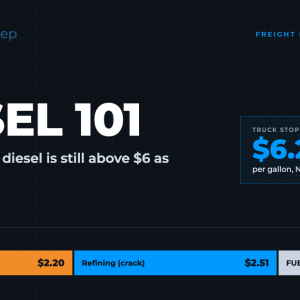
The sitrep splits the Nov. 9 truck stop price into three parts using SONAR daily data:
Crude is only about 35% of the truck stop price, and refining is now the largest piece. That is why a $25-per-barrel drop in Brent since Oct. 30 has barely moved the pump.
Why diesel is so expensive now
- Less product supply abroad. IEA puts Middle East refined product exports at 1.9 million barrels per day, against 4.7 million before the war.
- Longer, riskier shipping. The Strait of Hormuz closure and the Red Sea blockade have stretched some tanker voyages from about 24 to 54 days.
- No spare U.S. refining capacity. Refineries ran at 96% in the third quarter, with less capacity than in 2019.
- Exports pull fuel abroad. U.S. distillate exports topped their 2021 to 2025 highs in six of seven months through July.
- Thin inventories. Distillate stocks were 13% below the five-year average in late September; East Coast stocks were 32% below.
What comes next
EIA’s November Short-Term Energy Outlook forecasts retail diesel at $6.05 per gallon in the fourth quarter of 2026, easing to $4.80 by the fourth quarter of 2027. At 7 mpg, that is $0.86 per mile now and $0.69 per mile by late 2027. EIA cautions that Middle East flows remain fragile, so short-term volatility will exceed its monthly path.
window.googletag = window.googletag || {cmd: []};
googletag.cmd.push(function() {
var gptSlot = googletag.defineSlot(‘/21776187881/fw-responsive-main_content-slot3’, [[728, 90], [468, 60], [320, 50], [300, 100]], ‘div-gpt-ad-1665767553440-0’).defineSizeMapping(gptSizeMaps.banner1).addService(googletag.pubads());
googletag.pubads().enableSingleRequest();
googletag.pubads().collapseEmptyDivs();
googletag.enableServices();
setInterval(function() {
if (!document.hidden) { googletag.pubads().refresh([gptSlot]); }
}, 60000);
});
googletag.cmd.push(function() { googletag.display(‘div-gpt-ad-1665767553440-0’); });
What it means for logistics
- Carriers: Your real exposure is the daily truck stop price, while many surcharge tables follow a weekly index that lags it.
- Shippers: Check which index and reset date your fuel surcharge uses; weekly indices lag the market in both directions.
- Brokers: Spot quotes embed a fuel assumption that can go stale within a week while the crack spread is moving.
What’s inside the full sitrep
- How crude becomes diesel, and why a 42-gallon barrel yields only about 12 gallons of it
- Brent, WTI, rack and truck stop prices put on one per-gallon basis
- A worked 3-2-1 crack spread example across four SONAR crude series
- A refiner-profit model linking crack spreads to industry net income
- A 2026 event timeline from the Hormuz closure to the November Brent plunge
- EIA quarterly forecasts converted to fuel cost per mile and per truck-year
- The leading indicators to watch for the next move
Subscribe to SONAR to read the full Diesel 101 sitrep → or checkout FreightWaves Market Monitor which also include SONAR research.
Frequently asked questions
Why is diesel so expensive right now? Refined product supply is the bottleneck, not crude. Damage to Middle East and Russian refineries, longer tanker routes around Hormuz and the Red Sea, and thin U.S. distillate inventories have pushed the diesel crack spread to about three times its early-2026 level.
Why hasn’t diesel fallen as much as crude oil? Brent fell 21% from Oct. 30 to Nov. 9, 2026, but truck stop diesel fell only 2.5%. The diesel crack ($2.51 per gallon) and the FUELS spread between truck stop and rack prices ($1.52) absorbed most of the decline.
What is the diesel crack spread? The diesel crack is the difference between the wholesale ULSD price and the cost of crude, a measure of refining margin. Measured as SONAR ULSDR minus Brent per gallon, it was $2.51 on Nov. 9, 2026, versus a $0.87 average in January and February.
window.googletag = window.googletag || {cmd: []};
googletag.cmd.push(function() {
var gptSlot = googletag.defineSlot(‘/21776187881/fw-responsive-main_content-slot4’, [[300, 100], [320, 50], [728, 90], [468, 60]], ‘div-gpt-ad-1709668086344-0’).defineSizeMapping(gptSizeMaps.banner1).addService(googletag.pubads());
googletag.pubads().enableSingleRequest();
googletag.pubads().collapseEmptyDivs();
googletag.enableServices();
setInterval(function() {
if (!document.hidden) { googletag.pubads().refresh([gptSlot]); }
}, 60000);
});
googletag.cmd.push(function() { googletag.display(‘div-gpt-ad-1709668086344-0’); });
What is the difference between the rack price and the truck stop price? The rack price (SONAR ULSDR) is the wholesale ULSD price at fuel terminals. The truck stop price (SONAR DTS) adds delivery, taxes and retail margin. The gap between them is SONAR’s FUELS spread.
What is the diesel price forecast for 2027? EIA’s November 2026 Short-Term Energy Outlook forecasts retail diesel averaging $5.03 per gallon in 2027, up from $4.49 in its October outlook, with the fourth quarter of 2027 at $4.80.
The post Diesel 101: Why Truck Stop Diesel Is Still Above $6 a Gallon as Crude Falls appeared first on FreightWaves.
Source: FreightWaves