DENMARK: Lokaltog has selected Stadler to supply four RS Zero battery railcars for the Jægersborg – Nærum line north of København, the first commercial tender selection for the type. Stadler told Railway Gazette International it was ‘very happy to have succeeded’ with the debut order, with the trans expected to enter service from 2031. Lokaltog announced on October 6 that it had chosen Stadler and Swiss electrification specialist Furrer+Frey to supply the four battery-electric railcars and related charging equipment for the 7.8 km line. The trains are due to enter service in the first half of 2031, replacing four RegioSprinter diesel trains which date from 1999. Stadler says Lokaltog expects the switch to save around 800 tonnes of CO₂ a year. The RS Zeros, derived from Stadler’s RegioShuttle RS1 diesel railcar, will be built at Stadler’s Berlin Pankow plant. ‘The RS Zeros for Denmark will be equipped with DC standstill charging through a small DC pantograph’, Stadler Deputy Group CEO and Head of Marketing & Sales Ansgar Brockmeyer told Railway Gazette International. The contract has yet to be signed, and neither Lokaltog nor Stadler has disclosed its value. Lokaltog, owned by København-area public transport authority Movia, will finance the trains with loans guaranteed by Region Hovedstaden, which also subsidises the line’s operation. The operator expects to sign in January or February 2027, once the purchase has been approved by the councils of Region Hovedstaden and its successor, Region Østdanmark, which is being established on January 1 2027. Stadler said many regional lines across Europe like those in northern Denmark would have to continue operating without full electrification into the near future, with the RS Zero offering an economically viable and environmentally friendly way to modernise them. ‘We are very happy that we have succeeded and have sold the first RS Zero trainsets’, Brockmeyer stated. Replacing the RegioShuttle Stadler is positioning the new rolling stock to fill the same role as its predecessor. ‘The RS Zero has been developed as a replacement for the RegioShuttle that saved many branch lines from closure and even helped to reactivate some’, Brockmeyer said. ‘We have sold more than 500 Shuttles, mainly in Germany and the Czech Republic, and hence these are main target markets. However, we also see a huge demand for the RS Zeros in other countries where the concept of a single-car railbus is established; for example Hungary, Romania, Poland and even France.’ Until now, the firmest interest had come from the German Land of Thüringen, which agreed in 2024 to trial a hydrogen prototype in passenger service once it is approved. Stadler plans to apply for approval in 2027. Prototype RS Zero hydrogen or battery railcar for secondary lines Waiting for the right train Region Hovedstaden first launched procurement for new Nærumbanen trains in 2019 and opted for battery power in 2021, when they were expected to enter service in 2025. The difficulty was finding one that would fit, with the platform lengths limiting trains to 38·5 m and a bridge over the Mølleå river restricting axle loads to 16 tonnes, ruling out standard battery trains. With few suitable designs on offer, Lokaltog halted the procurement in December 2022. Even in June 2024 it still expected to deploy light rail vehicles that would have required lower platforms. Stadler unveiled the RS Zero two months later as a lightweight main line railcar more appropriate for this kind of branch line, with a 600 mm entrance height close to the line’s 550 mm platforms. Region Hovedstaden approved a new tender later that year, and Lokaltog launched it in 2025. Three bidders were prequalified, including Turkey’s Bozankaya, but only Stadler and Croatian manufacturer Končar submitted compliant offers, which Lokaltog said were closely matched. Lokaltog said the winning bid falls within the budget of its 2024 business case, which put charging, depot and platform works at DKr147m (€19.7m) including contingencies, with the cost of buying and running the trains covered by an average increase of DKr1.6m (€215 000) a year in Lokaltog’s operating contract over their 35-year life. Charging and the grid Lokaltog has planned for charging points at both ends of the line and at the depot, with Stadler and Furrer+Frey having already delivered similar battery train and charging systems in Germany and France. To give the trains time to charge, Region Hovedstaden decided in 2024 that the line, which carries around 775 000 passengers a year, should have a train every 15 min all day, instead of every 10 min at peak times and every 20 min otherwise. The chargers will also need a grid connection, which has already become a problem for Lokaltog’s larger battery fleet. Lokaltog has 24 Stadler Flirt Akku multiple-units on order for three other lines on Sjælland, due to enter service in 2028-30. Denmark’s state-owned transmission system operator Energinet, however, stopped accepting new applications for large connections in March after a surge in demand from data centres, leaving the charging station needed for 10 of them without a firm connection date. The delay has raised fears among regional politicians that the trains could stand idle after delivery. Energinet has since lifted its moratorium and expects to tell transport project promoters in the first half of November whether they can be connected. Lokaltog’s announcement did not say whether a connection for the Nærum chargers has been secured. Danish battery train order signed
DENMARK: Lokaltog has selected Stadler to supply four RS Zero battery railcars for the Jægersborg – Nærum line north of København, the first commercial tender selection for the type. Stadler told Railway Gazette International it was ‘very happy to have succeeded’ with the debut order, with the trans expected to enter service from 2031.
Lokaltog announced on October 6 that it had chosen Stadler and Swiss electrification specialist Furrer+Frey to supply the four battery-electric railcars and related charging equipment for the 7.8 km line. The trains are due to enter service in the first half of 2031, replacing four RegioSprinter diesel trains which date from 1999. Stadler says Lokaltog expects the switch to save around 800 tonnes of CO₂ a year.
The RS Zeros, derived from Stadler’s RegioShuttle RS1 diesel railcar, will be built at Stadler’s Berlin Pankow plant. ‘The RS Zeros for Denmark will be equipped with DC standstill charging through a small DC pantograph’, Stadler Deputy Group CEO and Head of Marketing & Sales Ansgar Brockmeyer told Railway Gazette International.
The contract has yet to be signed, and neither Lokaltog nor Stadler has disclosed its value. Lokaltog, owned by København-area public transport authority Movia, will finance the trains with loans guaranteed by Region Hovedstaden, which also subsidises the line’s operation. The operator expects to sign in January or February 2027, once the purchase has been approved by the councils of Region Hovedstaden and its successor, Region Østdanmark, which is being established on January 1 2027.
Stadler said many regional lines across Europe like those in northern Denmark would have to continue operating without full electrification into the near future, with the RS Zero offering an economically viable and environmentally friendly way to modernise them. ‘We are very happy that we have succeeded and have sold the first RS Zero trainsets’, Brockmeyer stated.
Replacing the RegioShuttle
Stadler is positioning the new rolling stock to fill the same role as its predecessor. ‘The RS Zero has been developed as a replacement for the RegioShuttle that saved many branch lines from closure and even helped to reactivate some’, Brockmeyer said. ‘We have sold more than 500 Shuttles, mainly in Germany and the Czech Republic, and hence these are main target markets. However, we also see a huge demand for the RS Zeros in other countries where the concept of a single-car railbus is established; for example Hungary, Romania, Poland and even France.’
Until now, the firmest interest had come from the German Land of Thüringen, which agreed in 2024 to trial a hydrogen prototype in passenger service once it is approved. Stadler plans to apply for approval in 2027.
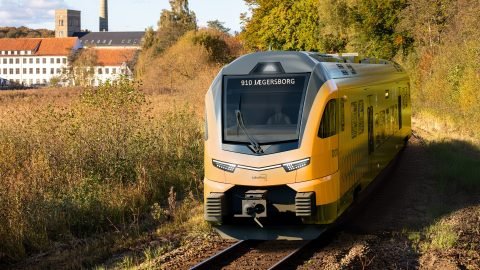
Prototype RS Zero hydrogen or battery railcar for secondary lines
Waiting for the right train
Region Hovedstaden first launched procurement for new Nærumbanen trains in 2019 and opted for battery power in 2021, when they were expected to enter service in 2025. The difficulty was finding one that would fit, with the platform lengths limiting trains to 38·5 m and a bridge over the Mølleå river restricting axle loads to 16 tonnes, ruling out standard battery trains.
With few suitable designs on offer, Lokaltog halted the procurement in December 2022. Even in June 2024 it still expected to deploy light rail vehicles that would have required lower platforms. Stadler unveiled the RS Zero two months later as a lightweight main line railcar more appropriate for this kind of branch line, with a 600 mm entrance height close to the line’s 550 mm platforms.
Region Hovedstaden approved a new tender later that year, and Lokaltog launched it in 2025. Three bidders were prequalified, including Turkey’s Bozankaya, but only Stadler and Croatian manufacturer Končar submitted compliant offers, which Lokaltog said were closely matched.
Lokaltog said the winning bid falls within the budget of its 2024 business case, which put charging, depot and platform works at DKr147m (€19.7m) including contingencies, with the cost of buying and running the trains covered by an average increase of DKr1.6m (€215 000) a year in Lokaltog’s operating contract over their 35-year life.
Charging and the grid
Lokaltog has planned for charging points at both ends of the line and at the depot, with Stadler and Furrer+Frey having already delivered similar battery train and charging systems in Germany and France. To give the trains time to charge, Region Hovedstaden decided in 2024 that the line, which carries around 775 000 passengers a year, should have a train every 15 min all day, instead of every 10 min at peak times and every 20 min otherwise.
The chargers will also need a grid connection, which has already become a problem for Lokaltog’s larger battery fleet. Lokaltog has 24 Stadler Flirt Akku multiple-units on order for three other lines on Sjælland, due to enter service in 2028-30. Denmark’s state-owned transmission system operator Energinet, however, stopped accepting new applications for large connections in March after a surge in demand from data centres, leaving the charging station needed for 10 of them without a firm connection date.
The delay has raised fears among regional politicians that the trains could stand idle after delivery. Energinet has since lifted its moratorium and expects to tell transport project promoters in the first half of November whether they can be connected. Lokaltog’s announcement did not say whether a connection for the Nærum chargers has been secured.
Danish battery train order signed
Source: Railway Gazette