Kazakhstan – Uzbekistan freight railway opens to relieve border crossing
Transportationvia Railway Gazette
Quick Read
KAZAKHSTAN: Freight trains have begun using the Darbaza – Maktaaral railway in the Turkistan region, which has been built as part of a 286bn tenge project to provide an alternative freight route to Uzbekistan to relieve congestion on the main Saryagash – Toshkent corridor. The 128 km single-track railway connects Darbaza on Kazakhstan’s existing network with Maktaaral near the Uzbek border, providing access to the Maktaaral – Sirdaryo border crossing. This increases capacity for international traffic by providing an alternative to the congested Saryagash border crossing. The line also provides a direct rail connection between the Maktaaral and Zhetysay districts and the rest of Kazakhstan, eliminating the need to transit Uzbekistan. The government confirmed the start of traffic on November 4, with the first train carrying coal for export to Uzbekistan. The new route is expected to accommodate up to 20 million tonnes of freight annually, Construction works The project was officially launched in November 2023, with construction getting underway in 2024. Integra Construction KZ was the main contractor. The engineering works include three stations, two passing loops, 33 bridges and 129 drainage culverts, together with associated signalling, power supply and maintenance infrastructure. One of the largest structures is a six-span steel bridge over the Syr Darya river. The bridge has two 66 m end spans and four intermediate spans of 88 m, supported by foundations with bored piles reaching depths of up to 41 m. Completion of the final works and full commissioning of the line are scheduled for December. See also Kazakhstan begins work on additional rail link to Uzbekistan Kazakhstan, Uzbekistan, Turkmenistan, Kyrgyzstan & Tajikistan – country map
KAZAKHSTAN: Freight trains have begun using the Darbaza – Maktaaral railway in the Turkistan region, which has been built as part of a 286bn tenge project to provide an alternative freight route to Uzbekistan to relieve congestion on the main Saryagash – Toshkent corridor.
The 128 km single-track railway connects Darbaza on Kazakhstan’s existing network with Maktaaral near the Uzbek border, providing access to the Maktaaral – Sirdaryo border crossing. This increases capacity for international traffic by providing an alternative to the congested Saryagash border crossing. The line also provides a direct rail connection between the Maktaaral and Zhetysay districts and the rest of Kazakhstan, eliminating the need to transit Uzbekistan.
The government confirmed the start of traffic on November 4, with the first train carrying coal for export to Uzbekistan. The new route is expected to accommodate up to 20 million tonnes of freight annually,
Construction works
The project was officially launched in November 2023, with construction getting underway in 2024. Integra Construction KZ was the main contractor.
The engineering works include three stations, two passing loops, 33 bridges and 129 drainage culverts, together with associated signalling, power supply and maintenance infrastructure.
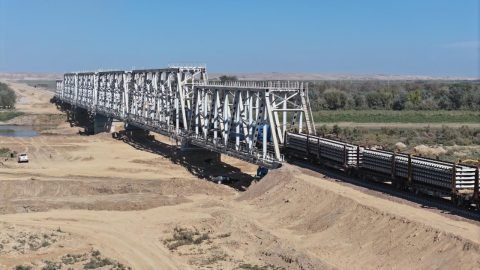
One of the largest structures is a six-span steel bridge over the Syr Darya river. The bridge has two 66 m end spans and four intermediate spans of 88 m, supported by foundations with bored piles reaching depths of up to 41 m.
Completion of the final works and full commissioning of the line are scheduled for December.
See also
Kazakhstan begins work on additional rail link to Uzbekistan
Kazakhstan, Uzbekistan, Turkmenistan, Kyrgyzstan & Tajikistan – country map
Import volumes at major U.S. container ports are expected to ease through the end of 2026 after September marked the busiest month of the year. That would cap an extended shipping peak driven by tariff changes and sustained consumer spending. Ports tracked by the National Retail Federation handled 2.37 million twenty-foot equivalent units, or TEUs, of loaded imports in September. That was an increase of 3.4% from August and 12.6% from a year earlier. September was also the third-busiest month since the report began tracking imports, behind only May 2022, when volume reached 2.4 million TEUs, and July 2025, at 2.39 million, according to the report. “U.S. ports have seen high volume levels throughout this year’s longer-than-usual peak season and numbers are still strong even as the season winds down,” said Jonathan Gold, NRF’s vice president for supply chain and customs policy, in the release. The prolonged surge has created backups at some ports, particularly on the West Coast, where containers have faced extended waits for transfer to trains, Gold said. Despite those delays, most holiday merchandise has already arrived, and retailers are coordinating with transportation partners to keep remaining shipments moving. Labor uncertainty has added another concern at the ports of Los Angeles and Long Beach. Employers and International Longshore and Warehouse Union Local 26, which represents watchmen at several container terminals, reached a short-term contract extension while bargaining continues. The agreement has been extended three times, most recently through Nov. 20. A long-term settlement remains outstanding following the expiration of the previous contract in July 2025. The extended peak was attributed to retailers adjusting shipment schedules around tariff changes, continuing a pattern of frontloading that began in 2025. Expectations for another prolonged surge initially faded after the Supreme Court struck down the high “Liberation Day” tariffs. But new tariffs introduced in the second quarter prompted another wave of imports beginning in May and continuing through mid-October, as consumers supported the influx despite rising inflation. Although monthly volumes are projected to decline from September’s high, the report expects imports to remain above year-earlier levels through December. October, for which final figures were not yet available, was projected at 2.26 million TEUs, up 9.1% year over year. November was forecast at 2.05 million TEUs, up 1.2%, followed by December at 2.03 million, up 1.3%. Those projections would bring full-year imports at the ports covered by the report to approximately 26 million TEUs, an increase of 2% from 2025. The outlook turns softer in early 2027. January imports are forecast at 2.04 million TEUs, down 3% from a year earlier; February at 1.89 million, down 0.5%; and March at 1.92 million, down 11.2%. Read more articles by Stuart Chirls here. Read more: Cosco profit rockets 81% as ocean freight revenue climbs in Q3 Asia-U.S. West Coast ocean container spot rates up 343% since start of Iran war, says Xeneta Strike at Los Angeles-Long Beach port delayed as union contract talks continue North America container imports rise 9% as as freight pricing pressures mount Maersk raises profit outlook as earnings surge, but shares slide on expectations miss The post Retailers forecast U.S. imports to stay elevated through 2026 after breakout peak season appeared first on FreightWaves.
Wing, the drone delivery business of Alphabet (NASDAQ: GOOG), said it will invest $125 million to build a 15,000-square foot manufacturing facility in Fort Worth, Texas, over the next two years to meet growing interest from retailers in ultra-fast delivery. The company also plans to launch drone delivery in Japan, in partnership with KDDI Corp. New U.S. rules of the road, expected at any moment, will serve as a trigger for widespread expansion, Wing said.The new Texas facility will be able to produce tens of thousands of unmanned aerial aircraft each year, supporting Wing’s aggressive plan to expand drone delivery service nationwide as consumers increasingly opt for the convenience of home delivery for last-minute needs, Wing announced Friday. Some of the investment will also support r&d in California. The news release is the first time Wing has given projections for its fleet size. Wing, which operates from more than 70 sites, is working to expand to nearly 20 U.S. markets next year, making drone delivery available to more than 40 million people through its partnership with Walmart. Wing currently operates limited service in five metropolitan areas, including Central Florida, Houston, Atlanta and Dallas-Fort Worth. The partners say the drone delivery network will stretch across more than 270 store locations across the nation, including Los Angeles, Cincinnati, San Diego, Miami and Philadelphia. Cruising at speeds up to 60 mph, Wing’s aircraft can carry up to five pounds of goods. Wing says it has made more than 1 million residential deliveries so far, usually within 30 minutes. In September, Wing began a pilot delivery program for Lowe’s, enabled by the DoorDash marketplace. Fast-casual restaurant Panera is testing Wing delivery in North Carolina. Walmart is not relying on a single drone delivery provider. Last week, it announced plans to create a nationwide delivery network operated by Zipline from 300 store locations. Zipline said it raised $1.5 billion to ramp up manufacturing of its aircraft. Why It Matters: Drones are the latest front in the quick commerce wars, offering retailers and marketplaces another mode for satisfying consumer expectations for convenience and speed when ordering online. Orders prepared at fulfillment centers are typically delivered in one to five days by courier companies, while store-to-door fulfillment takes advantage of app-based delivery platforms and crowd-sourced drivers to make deliveries in one to three hours. Regulatory Opening The Federal Aviation Administration’s highly anticipated rulemaking on beyond-visual-line-of-sight is expected to unleash the next-generation of commercial drone activity as operators will be able to scale drone delivery and other applications more broadly. Under the current process, operators are required to operate drones within visual line of sight unless holding an individual waiver. The final rule, under review by the White House since July, was delayed from its February publication because administration officials wanted to make sure it could accommodate future technology developments and didn’t favor large companies. Industry officials have chaffed at the lengthy rulemaking process, saying the lack of certainty about rules of the road is inhibiting investment. As proposed, the BVLOS rule would allow drone operations to occur at or below 400 feet above ground level from pre-designated, secure-access locations. All operators will need FAA approval for the area where they intend to fly and indicate the approximate number of daily operations, as well as takeoff, landing and loading areas. Drone operators will have to utilize Automated Data Service Providers to support large-scale BVLOS activity and ensure drones are safely separated from each other and manned aircraft. A BVLOS operator could be its own data service provider or contract with another company. Drones also would have technologies that enable them to automatically detect and avoid crewed aircraft broadcasting their position with ADS-B surveillance technology. Large fleets like those of Wing would require an FAA operating certificate, with the agency conducting more oversight of ongoing operations and requiring operators to develop a safety management system and training program. On Monday, the FAA issued the first of its kind authorization for a drone to fly beyond the operator’s visual line of sight from the U.S. coastline over the Gulf of Mexico. The authorization allows Skyways to operate its autonomous V2 vertical takeoff and landing aircraft from Shell’s SPLC facility in Gibson, Louisiana, to a Shell platform in the Gulf to inspect a pipeline right-of-way and simulate delivery of equipment to the platform. In a sign that the drone space is becoming more attractive from an investment standpoint, Axon Enterprise Inc., a public safety and defense technology company best known for making Taser electroshock weapons, last week announced a $1.2 billion investment in Skydio, increasing its ownership stake in the drone company to 37%. Skydio sells drones for physical security, mapping, asset inspection and national security applications. Japan Wing is partnering with KDDI Corp. to bring its drone delivery service to select areas in Japan by the end of 2027. Demand for new delivery options is expected to be strong because of a declining working-age population and a declining delivery driver workforce. Initial deployment will focus on food delivery. The companies will work with local governments and other partners to expand service to daily necessities, over-the-counter medications, and small retail items, according to an Oct. 26 news release. Wing will provide autonomous drones, flight systems and automated ground infrastructure while KDDI, a telecommunications company, will provide the communication infrastructure, regulatory compliance and market development. Zipline noise breakthrough Meanwhile, Zipline has reengineered how its drones fly to reduce noise, a common complaint heard in neighborhoods, the company said last month. While most drones must continuously run all their motors in order to stay in the air, Zipline drones feature a fixed wing that allows them to fly like planes and turn off all but one motor once they reach cruising speed and altitude. With dynamic flying, Zipline drones now transition to on-wing flight more efficiently while producing less noise, using wind and gravity to accelerate and decelerate, similar to birds taking advantage of air currents. Instead of static, pre-planned trajectories, Zipline’s dynamic flying optimizes for reduced sound by balancing wind, altitude, and speed. As a Zipline drone takes off, it uses its weather sensors to measure the real-time wind conditions. It then combines that data with a custom sound model to determine the quietest way to transition to on-wing flight, such as dipping its nose to gain speed like a bike going downhill, or popping upwards to quietly slow down at the end of a flight. Now deployed fleetwide, sound-optimized dynamic flying reduces flight times too, Zipline said. Flight times are 53 seconds shorter on average because of faster transitions in and out of on-wing flight. Click here for more FreightWaves/American Shipper stories by Eric Kulisch. Write to Eric Kulisch at ekulisch@freightwaves.com. RELATED STORIES: Walmart to take drone delivery nationwide as Zipline raises $1.5B DoorDash launches retail returns service, self-designed drones Lowe’s test drives drone delivery Amazon drone delivery expansion targets 500 cities by year’s end The post Wing to invest $125M in drone manufacturing plant appeared first on FreightWaves.
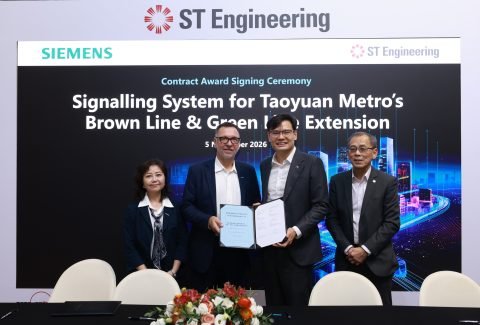
TAIWAN: ST Engineering’s Urban Solutions business has awarded Siemens Mobility contracts to supply its Signaling X technology to Taiwan for the first time, as part of the Taoyuan Brown Line and Green Line Extension projects. Brown and Green lines Earlier this year a consortium of ST Engineering and Hyundai Rotem was awarded the S$840m turnkey rail services contract to equip the 11.4 km Brown Line, which will link the Huilong terminus of the Orange Line in the west of New Taipei to Taoyuan main line station. ST Engineering is responsible for overall project management and systems integration, along with delivery of the signalling to support GoA4 fully automated train operation, trackwork, some civil works, electrical equipment including SCADA, communications and automatic fare collection systems and platform screen doors. Hyundai Rotem will provide the rolling stock and power supply systems. ST Engineering and Hyundai Rotem were also awarded the GEM01 contract to supply rolling stock and electrical and mechanical systems for the 7.2 km MRT Green Line Extension running west from Bade to Zhongli railway station. Commissioning of both projects is scheduled for the mid-2030s Signaling X Siemens Mobility’s Signaling X concept is designed to support a move from hardware-centric signalling systems to a software-defined virtualised architecture. This enables multiple safety-critical and non-safety-critical signalling, train control and related IT systems to run on commercial off-the-shelf hardware, potentially allowing the control of an entire metro network from a single cloud-based data centre. The virtualised architecture should enable operators to modernise and scale their infrastructure independently of specific hardware lifecycles, offering simpler maintenance and more efficient spare parts management. Taking Signaling X into Taiwan ‘marks a major milestone in the digitalisation of rail transport as we deploy our new generation of software-defined signalling technology’, said Marc Ludwig, Executive Vice-President of Rail Infrastructure at Siemens Mobility, when the contracts were signed on November 5. ‘Together with ST Engineering, we are building on our existing experience in Taoyuan to reduce interface complexity and support efficient project delivery, while providing the foundation for safe, reliable and fully automated operations.’ See also Taoyuan Brown Line construction starts as systems and rolling stock contract awarded Construction of Taoyuan’s Green Line officially begins Siemens launches first live urban Signaling X trial in Germany Siemens Mobility launches hardware-independent Signaling X in the metro market Signaling X launched to harmonise main line and urban rail data management