The Wirye Line tramway in Seoul is set to open this year as the first modern tram line in South Korea, followed by a 38.1 km line in Daejeon. However, the already-tendered Ulsan tramway is being challenged by a newly elected mayor, while Hwaseong is exploring how best to realise its two-line network following six unsuccessful calls for tenders. Benjámin Zelki investigates. Seoul is on course to bring trams back to South Korea. The start of passenger-carrying test operations on the 5.4 km Wirye Line is scheduled by the end of the year. The return of trams to Seoul comes almost 60 years after the last section of the city’s legacy network closed in 1968. Construction work on the Wirye Line started in 2023, and test runs with the first vehicle have been underway at Korea Railroad Research Institute’s Osong test track since September 2025. Seoul city map Click to explore The catenary-free tramway will serve 12 stops, improving access to the centre of the Wirye district which lies in the southeast of the urban area. The route runs south from the Macheon terminus of metro Line 5 before splitting; one branch serves Namwirye on metro Line 8, and the other runs west to Bokjeong on Line 8 and the Suin-Bundang Line, which was created in 2020 through the merger of the Suin and Bundang suburban lines. Daejeon in full swing The city of Daejeon started construction on its first light rail line in December 2024, and works are now underway across all the scheme’s 14 contractual packages. Named Line 2 to follow on from the city’s sole metro line, the 38.1 km route will run in a loop around the city centre, with a one-stop branch in the southwest and a four-stop branch in the northeast. There will be a total of 45 stops, including five interchanges with metro Line 1. Part of the alignment will be in tunnel, and the entire line will be catenary-free. An increased budget of 1.51tr won for the project was announced by Daejeon Mayor Lee Jang-woo in August 2024. The city council confirmed in June this year that the opening of Line 2 was expected in the second half of 2030, two years later than originally planned. Ulsan project review In contrast to the progress in the capital and Daejeon, the delivery of Ulsan’s 10.9 km tram Line 1 has encountered several roadblocks. Preliminary works began in April for the catenary-free tram line with 15 stops, which is intended to link Taehwagang railway station in the city centre with Sinbok to the west. The current timescale envisages that the main civil works would start in February 2027, with the total cost of the scheme originally estimated at 381bn won. However, Kim Sang-wook, who was elected as mayor of Ulsan in local elections at the start of June, initiated a review on June 25, issuing a ‘temporary suspension’ of the project. This was lifted on July 31, allowing the works to resume for now, but the city has reportedly been seeking legal ways to abort the project without incurring a significant loss. The local authority had until August 29 to terminate the main works contracts, citing unforeseen circumstances, although this would have left it facing some liabilities for compensation relating to the construction and rolling stock contracts. After that deadline, termination became more difficult. Local media reported on August 31 that that so far, the council has been unable to find a lawful way to terminate the project. BRT plan, depot relocation According to the mayor, the tram project, as it is being delivered under the existing plans, would result in a significant reduction in road space, causing traffic congestion both during construction and after opening. He is also concerned about the risk of cost overruns and future operating expenses. Kim believes that the development of a bus rapid transit corridor could deliver similar benefits with less expenditure and reduced road traffic disruption. Most recently, local media reported that the tram depot, which was originally planned for a site next to Taehwagang station, needs to be relocated to an as-yet unconfirmed location due to issues around ground stability and utilities. Hwaseong tendering troubles Elsewhere, the municipality of Hwaseong, a satellite town south of Seoul, is working to deliver a two-line tramway. It called tenders no less than six times from April 2025 to March 2026 for the final design and civil works for a 31.6 km network. According to local media, the repeated procurement procedures were unable to attract bids meeting the city council’s terms, as the industry found the construction budget to be too low, contractual risks too high, and the construction period too short. In a bid to address these concerns, Hwaseong municipality has decided to enter into a contract negotiation with a consortium led by local construction and engineering company DL E&C, which was the sole bidder for the last tendering round that concluded in April. As part of the negotiations, the city boosted the funding envelope for civil works by 8.9bn won to 693.2bn won, and extended the delivery timeframes for design and construction. This included better terms for utility relocation works. DL E&C holds a 50% stake in the construction consortium, along with Taeyoung Construction (20%), Shindongah General Construction (10%), C&C General Construction (10%), Jungju Construction (5%) and Daelim (5%). Dohwa Engineering and Seongu Engineering are the design partners. Hwaseong city hall approved the technical proposal submitted by DL E&C on October 9 and expects to sign the contract and start preliminary works by the end of this month. A two-line network The first phase of the Hwaseong network would consist of two routes. The 13.8 km Red Line would run from Mangpo station on the Suin-Bundang Line in Suwon to Banggyo-dong in Hwaseong, while the 17.8 km Blue Line would connect Byeongjeom station on Seoul metro Line 1 with a depot site in the south of Hwaseong. The two lines would meet at the Dongtan terminus of Great Train Express Line A. Seoul & Hwaseong map Click to explore The Red Line was originally intended to run to Osan station on Seoul metro Line 1, but the final 2.8 km section was deferred from the first phase to cut costs. Catenary-free operation is envisaged. The network would be worked by 34 light rail vehicles using either hydrogen or battery power. Services would run at every 9 min during peak hours and every 15 min off-peak. The total cost of the first phase is estimated at 1tr won, which includes rolling stock and railway systems. No wires needed All of the tramways approved or being built in South Korea will be catenary-free. The Daejeon and Ulsan lines will be operated with hydrogen fuel cell trams supplied by Hyundai Rotem, while the Wirye Line is to be worked by battery LRVs developed by Woojin Industrial Systems. Hyundai Rotem is building 34 hydrogen LRVs for Daejeon’s Line 2 under a 293.4bn won contract signed in July 2024. It is also supplying nine five-section trams to Ulsan under a 63.4bn won contract agreed in March 2026. The trams are expected to have a range of 200 km before refuelling. The design was developed as part of a national research and development project which began in 2021 and was undertaken by Hyundai Rotem, Korea Institute for the Advancement of Technology, Korea Railroad Research Institute, Korea Automobile Research Centre and Ulsan Tecno Park. The 10 five-section trams developed by Woojin Industrial Systems to operate the Wirye route are 100% low-floor vehicles, 33.9 m long and and 2 650 mm wide. They have high-capacity roof-mounted lithium-ion batteries, and both high and low-level headlights. They are being fitted with a collision warning system that combines radar and camera sensors to warn the driver when an obstacle is detected and activate the emergency brake if there is no response. The lavender livery was selected by residents through a local poll. Meanwhile, Hyundai Rotem announced on July 16 that it had completed the development of an obstacle-detection system for its light rail portfolio. Its Autonomous Driving Assistance System tool is able to detect objects on the track by considering track dimensions and the operating environment, and it alerts the driver if a high-risk situation is detected. The technology uses LiDAR sensors and cameras. This article first appeared in the September 2026 issue of Railway Gazette International Read the issue See also Seoul & Incheon – city map Wirye Line test runs aim to return trams to Seoul after 58 years Hyundai Rotem to supply 34 hydrogen trams to Daejeon Construction starts on hydrogen-powered tram line in Ulsan
The Wirye Line tramway in Seoul is set to open this year as the first modern tram line in South Korea, followed by a 38.1 km line in Daejeon. However, the already-tendered Ulsan tramway is being challenged by a newly elected mayor, while Hwaseong is exploring how best to realise its two-line network following six unsuccessful calls for tenders. Benjámin Zelki investigates.
Seoul is on course to bring trams back to South Korea. The start of passenger-carrying test operations on the 5.4 km Wirye Line is scheduled by the end of the year.
The return of trams to Seoul comes almost 60 years after the last section of the city’s legacy network closed in 1968. Construction work on the Wirye Line started in 2023, and test runs with the first vehicle have been underway at Korea Railroad Research Institute’s Osong test track since September 2025.
Seoul city map Click to explore
The catenary-free tramway will serve 12 stops, improving access to the centre of the Wirye district which lies in the southeast of the urban area. The route runs south from the Macheon terminus of metro Line 5 before splitting; one branch serves Namwirye on metro Line 8, and the other runs west to Bokjeong on Line 8 and the Suin-Bundang Line, which was created in 2020 through the merger of the Suin and Bundang suburban lines.
Daejeon in full swing
The city of Daejeon started construction on its first light rail line in December 2024, and works are now underway across all the scheme’s 14 contractual packages.
Named Line 2 to follow on from the city’s sole metro line, the 38.1 km route will run in a loop around the city centre, with a one-stop branch in the southwest and a four-stop branch in the northeast. There will be a total of 45 stops, including five interchanges with metro Line 1.
Part of the alignment will be in tunnel, and the entire line will be catenary-free. An increased budget of 1.51tr won for the project was announced by Daejeon Mayor Lee Jang-woo in August 2024.
The city council confirmed in June this year that the opening of Line 2 was expected in the second half of 2030, two years later than originally planned.
Ulsan project review
In contrast to the progress in the capital and Daejeon, the delivery of Ulsan’s 10.9 km tram Line 1 has encountered several roadblocks.
Preliminary works began in April for the catenary-free tram line with 15 stops, which is intended to link Taehwagang railway station in the city centre with Sinbok to the west. The current timescale envisages that the main civil works would start in February 2027, with the total cost of the scheme originally estimated at 381bn won.
However, Kim Sang-wook, who was elected as mayor of Ulsan in local elections at the start of June, initiated a review on June 25, issuing a ‘temporary suspension’ of the project.
This was lifted on July 31, allowing the works to resume for now, but the city has reportedly been seeking legal ways to abort the project without incurring a significant loss.
The local authority had until August 29 to terminate the main works contracts, citing unforeseen circumstances, although this would have left it facing some liabilities for compensation relating to the construction and rolling stock contracts. After that deadline, termination became more difficult.
Local media reported on August 31 that that so far, the council has been unable to find a lawful way to terminate the project.
BRT plan, depot relocation
According to the mayor, the tram project, as it is being delivered under the existing plans, would result in a significant reduction in road space, causing traffic congestion both during construction and after opening. He is also concerned about the risk of cost overruns and future operating expenses.
Kim believes that the development of a bus rapid transit corridor could deliver similar benefits with less expenditure and reduced road traffic disruption.
Most recently, local media reported that the tram depot, which was originally planned for a site next to Taehwagang station, needs to be relocated to an as-yet unconfirmed location due to issues around ground stability and utilities.
Hwaseong tendering troubles
Elsewhere, the municipality of Hwaseong, a satellite town south of Seoul, is working to deliver a two-line tramway. It called tenders no less than six times from April 2025 to March 2026 for the final design and civil works for a 31.6 km network.
According to local media, the repeated procurement procedures were unable to attract bids meeting the city council’s terms, as the industry found the construction budget to be too low, contractual risks too high, and the construction period too short.
In a bid to address these concerns, Hwaseong municipality has decided to enter into a contract negotiation with a consortium led by local construction and engineering company DL E&C, which was the sole bidder for the last tendering round that concluded in April.
As part of the negotiations, the city boosted the funding envelope for civil works by 8.9bn won to 693.2bn won, and extended the delivery timeframes for design and construction. This included better terms for utility relocation works.
DL E&C holds a 50% stake in the construction consortium, along with Taeyoung Construction (20%), Shindongah General Construction (10%), C&C General Construction (10%), Jungju Construction (5%) and Daelim (5%). Dohwa Engineering and Seongu Engineering are the design partners.
Hwaseong city hall approved the technical proposal submitted by DL E&C on October 9 and expects to sign the contract and start preliminary works by the end of this month.
A two-line network
The first phase of the Hwaseong network would consist of two routes.
The 13.8 km Red Line would run from Mangpo station on the Suin-Bundang Line in Suwon to Banggyo-dong in Hwaseong, while the 17.8 km Blue Line would connect Byeongjeom station on Seoul metro Line 1 with a depot site in the south of Hwaseong. The two lines would meet at the Dongtan terminus of Great Train Express Line A.
Seoul & Hwaseong map Click to explore
The Red Line was originally intended to run to Osan station on Seoul metro Line 1, but the final 2.8 km section was deferred from the first phase to cut costs.
Catenary-free operation is envisaged. The network would be worked by 34 light rail vehicles using either hydrogen or battery power. Services would run at every 9 min during peak hours and every 15 min off-peak.
The total cost of the first phase is estimated at 1tr won, which includes rolling stock and railway systems.
No wires needed
All of the tramways approved or being built in South Korea will be catenary-free. The Daejeon and Ulsan lines will be operated with hydrogen fuel cell trams supplied by Hyundai Rotem, while the Wirye Line is to be worked by battery LRVs developed by Woojin Industrial Systems.
Hyundai Rotem is building 34 hydrogen LRVs for Daejeon’s Line 2 under a 293.4bn won contract signed in July 2024. It is also supplying nine five-section trams to Ulsan under a 63.4bn won contract agreed in March 2026. The trams are expected to have a range of 200 km before refuelling. The design was developed as part of a national research and development project which began in 2021 and was undertaken by Hyundai Rotem, Korea Institute for the Advancement of Technology, Korea Railroad Research Institute, Korea Automobile Research Centre and Ulsan Tecno Park.
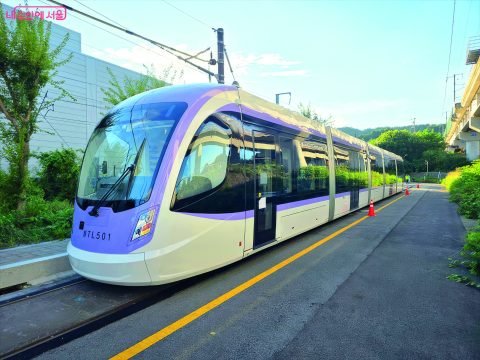
The 10 five-section trams developed by Woojin Industrial Systems to operate the Wirye route are 100% low-floor vehicles, 33.9 m long and and 2 650 mm wide. They have high-capacity roof-mounted lithium-ion batteries, and both high and low-level headlights.
They are being fitted with a collision warning system that combines radar and camera sensors to warn the driver when an obstacle is detected and activate the emergency brake if there is no response. The lavender livery was selected by residents through a local poll.
Meanwhile, Hyundai Rotem announced on July 16 that it had completed the development of an obstacle-detection system for its light rail portfolio. Its Autonomous Driving Assistance System tool is able to detect objects on the track by considering track dimensions and the operating environment, and it alerts the driver if a high-risk situation is detected. The technology uses LiDAR sensors and cameras.
This article first appeared in the September 2026 issue of Railway Gazette International
Read the issue
See also
Seoul & Incheon – city map
Wirye Line test runs aim to return trams to Seoul after 58 years
Hyundai Rotem to supply 34 hydrogen trams to Daejeon
Construction starts on hydrogen-powered tram line in Ulsan
Source: Railway Gazette