Aurizon opens A$60m Perth freight terminal to boost east-west freight
Transportationvia Railway Gazette
Quick Read
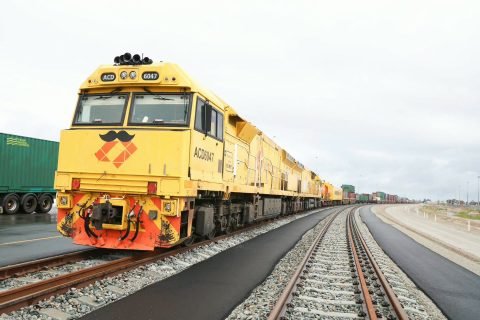
AUSTRALIA: Rail freight operator Aurizon’s A$60m terminal in the Kewdale suburb of Perth has been officially opened by Western Australia’s Minister for Transport & Major Infrastructure Rita Saffioti. Saffioti said the ability to handle 1 800 m long double-stacked interstate trains without the need for shunting or the train to be broken up would make a ‘huge difference’ to efficiency. She said the facility was the only terminal in WA to feature dual-gauge track, providing direct access to both the northern and southern freight networks, improving flexibility and network connectivity. ‘With container stacking capacity of 250 000 TEU per year, this facility will play a critical role in meeting future freight growth and increasing demand for rail services in WA and importantly, help get more more trucks off our roads to improve safety for our regional communities’, said Saffioti. Aurizon said it had outgrown its Forrestfield site, which will be re-purposed to support rail services for Aurizon’s growing national motor vehicle distribution network. ‘Everything from supermarket goods and consumer products to industrial inputs and motor vehicles move on interstate rail freight services and as the economy and consumer demand continues to grow, so does the volume of freight we transport for our customers’, said Aurizon Managing Director & CEO Andrew Harding at the opening on September 30. ‘Perth is a critical node for these services and supports the high-volume east-west corridor.’
AUSTRALIA: Rail freight operator Aurizon’s A$60m terminal in the Kewdale suburb of Perth has been officially opened by Western Australia’s Minister for Transport & Major Infrastructure Rita Saffioti.
Saffioti said the ability to handle 1 800 m long double-stacked interstate trains without the need for shunting or the train to be broken up would make a ‘huge difference’ to efficiency. She said the facility was the only terminal in WA to feature dual-gauge track, providing direct access to both the northern and southern freight networks, improving flexibility and network connectivity.
‘With container stacking capacity of 250 000 TEU per year, this facility will play a critical role in meeting future freight growth and increasing demand for rail services in WA and importantly, help get more more trucks off our roads to improve safety for our regional communities’, said Saffioti.
Aurizon said it had outgrown its Forrestfield site, which will be re-purposed to support rail services for Aurizon’s growing national motor vehicle distribution network.
‘Everything from supermarket goods and consumer products to industrial inputs and motor vehicles move on interstate rail freight services and as the economy and consumer demand continues to grow, so does the volume of freight we transport for our customers’, said Aurizon Managing Director & CEO Andrew Harding at the opening on September 30. ‘Perth is a critical node for these services and supports the high-volume east-west corridor.’
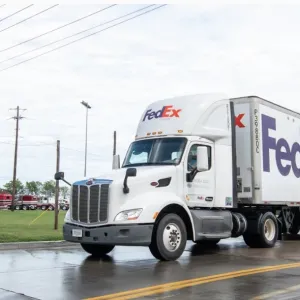
The nation’s largest less-than-truckload carrier, FedEx Freight, said Thursday that volumes have continued to stabilize and that it expects to see stronger operating leverage next year as a standalone company. Its local, dedicated LTL sales teams are seeing business wins and driving a better freight mix across the network. FedEx Freight (NYSE: FDXF) completed its spinoff from FedEx (NYSE: FDX) in June. FedEx reported financial results on Wednesday. The carrier reported four-month results (June through September) Thursday after the market closed as part of a transition to calendar-year financial reporting. Revenue in the period increased 9% year over year to $3.28 billion. Revenue per day was up 8%. Adjusted earnings per share of $2.15 were 70 cents lower y/y. The revenue increase was driven by a 9% increase in revenue per hundredweight (yield), while tonnage was level with the prior-year period. The tonnage result stemmed from a 1% decline in shipments per day, which was offset by a 1% increase in weight per shipment. Yield (ex-fuel) was up just 0.3% y/y. Revenue per shipment (ex-fuel) increased 2%. It has repriced approximately 25% of its contract business since the separation and said net revenue churn has improved. It expects both volumes and yield (ex-fuel) to increase in the fourth quarter. September marked the ninth straight month of expansion for the U.S. manufacturing complex, which is a significant source of LTL freight. FedEx Freight’s 2027 general rate increase is expected to average 6.9% and takes effect on Jan. 8. The company reported an 84.5% adjusted operating ratio (inverse of operating margin), which was 90 basis points better y/y. Guidance for the fourth quarter includes revenue of $2.3 billion to $2.37 billion, a 13% y/y increase at the midpoint of the range. Higher diesel fuel surcharges will be a primary driver of the increase. Diesel prices were 48% higher y/y in the third quarter. Adjusted operating income is expected to increase 20% y/y (at the midpoint) to a range of $185 million to $205 million. (The guide implies a 91.4% to 92% adjusted OR, 50 bps better y/y at the midpoint.) The company said it will soon decide on a dividend, and on buying back stock. It said that share repurchases would likely be executed to offset dilution as FedEx unwinds its equity position. Shares of FDXF were up 3% in after-hours trading on Thursday. Why it matters? FedEx Freight’s standalone results provide deeper context around its LTL operations and broader market trends. More FreightWaves articles by Todd Maiden: Saia’s expanded terminal network delivers record revenue, tonnage XPO’s pricing, operating initiatives drive Q3 beat Old Dominion’s tonnage turns positive; recovery needs demand inflection The post FedEx Freight sees volumes stabilize, eyes Q4 margin improvement appeared first on FreightWaves.
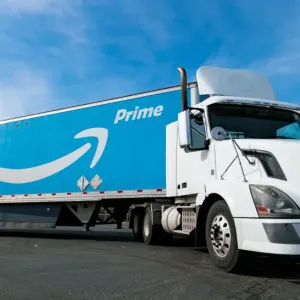
Amazon reported record operating profitability in the third quarter on Thursday after the market closed, as the e-commerce giant continued expanding its delivery network and robotics investments amid higher transportation costs. CEO Andy Jassy said investments in same-day fulfillment facilities and ultra-fast delivery services are helping the company attract more customers while lowering fulfillment expenditures. “We’re on track to reduce cost to serve per unit for the fourth consecutive year,” Jassy said during a call with analysts. The Seattle-based company reported third-quarter revenue of $201.9 billion, up 12% from $180.2 billion a year earlier. Operating income surged 61% to $28.1 billion, compared with $17.4 billion in the same period last year. window.googletag = window.googletag || {cmd: []}; googletag.cmd.push(function() { var gptSlot = googletag.defineSlot('/21776187881/FW-Responsive-Main_Content-Slot1', [[300, 100], [320, 50], [728, 90], [468, 60]], 'div-gpt-ad-1709668545404-0').defineSizeMapping(gptSizeMaps.banner1).addService(googletag.pubads()); googletag.pubads().enableSingleRequest(); googletag.pubads().collapseEmptyDivs(); googletag.enableServices(); setInterval(function() { if (!document.hidden) { googletag.pubads().refresh([gptSlot]); } }, 60000); }); googletag.cmd.push(function() { googletag.display('div-gpt-ad-1709668545404-0'); }); Revenue in the quarter came in below Wall Street estimates of $202.3 billion, while earnings per share came in at $1.89, lower than the expectation of $1.96. Amazon’s (Nasdaq: AMZN) operating margin reached 13.9%, its highest ever, as improvements across its retail and cloud computing businesses helped offset higher expenses. “In our fulfillment network, the team navigated higher transportation costs from fuel inflation and higher line haul rates,” Chief Financial Officer Brian Olsavsky said. Despite those pressures, Amazon lowered its overall cost to serve during the quarter through better inventory placement, shorter shipping distances and package consolidation, he said. Shipping costs increased 11% year over year, compared with 12% growth in units shipped. Excluding fuel and linehaul inflation, shipping costs rose 8%, approximately 4 percentage points slower than unit growth. Amazon’s North America segment, which includes its U.S. and Canadian retail operations, generated $112.9 billion in third-quarter revenue, up 6% year over year. Operating income in the segment jumped to $8.7 billion from $4.8 billion a year earlier, an increase of approximately 81%. window.googletag = window.googletag || {cmd: []}; googletag.cmd.push(function() { var gptSlot = googletag.defineSlot('/21776187881/fw-responsive-main_content-slot3', [[728, 90], [468, 60], [320, 50], [300, 100]], 'div-gpt-ad-1665767553440-0').defineSizeMapping(gptSizeMaps.banner1).addService(googletag.pubads()); googletag.pubads().enableSingleRequest(); googletag.pubads().collapseEmptyDivs(); googletag.enableServices(); setInterval(function() { if (!document.hidden) { googletag.pubads().refresh([gptSlot]); } }, 60000); }); googletag.cmd.push(function() { googletag.display('div-gpt-ad-1665767553440-0'); }); North America’s operating margin reached 7.7%. International revenue increased 5% to $43.1 billion, while operating income climbed to $1.6 billion from $1.2 billion. Amazon said the timing of Prime Day affected year-over-year comparisons because the shopping event occurred in the second quarter of 2026 for most major markets, compared with the third quarter in 2025. Excluding that timing change, Amazon estimated third-quarter revenue growth would have been approximately 4 percentage points higher. Amazon said it achieved its fastest third-quarter delivery speeds ever for Prime members, delivering more than 1.5 billion items on the same day or overnight during the three-month period ending Sept. 30. window.googletag = window.googletag || {cmd: []}; googletag.cmd.push(function() { var gptSlot = googletag.defineSlot('/21776187881/fw-responsive-main_content-slot4', [[300, 100], [320, 50], [728, 90], [468, 60]], 'div-gpt-ad-1709668086344-0').defineSizeMapping(gptSizeMaps.banner1).addService(googletag.pubads()); googletag.pubads().enableSingleRequest(); googletag.pubads().collapseEmptyDivs(); googletag.enableServices(); setInterval(function() { if (!document.hidden) { googletag.pubads().refresh([gptSlot]); } }, 60000); }); googletag.cmd.push(function() { googletag.display('div-gpt-ad-1709668086344-0'); }); Automation remains a major component of Amazon’s strategy to lower fulfillment expenses and increase productivity. Jassy told analysts the company now operates more than 1 million robots across its fulfillment network. He said robotics has contributed to improved productivity, reduced operating costs and record-low safety incident levels across its fulfillment operations. Amazon doubled its fleet of robotic arms, including Cardinal and Sparrow systems, during 2026, according to Olsavsky. The company is also developing robotics foundation models designed to help machines perform increasingly complex physical tasks. During the question-and-answer portion of Thursday’s earnings call, Jassy said that transportation cost pressures are expected to continue into the fourth quarter. window.googletag = window.googletag || {cmd: []}; googletag.cmd.push(function() { var gptSlot = googletag.defineSlot('/21776187881/fw-responsive-main_content-slot5', [[728, 90], [468, 60], [320, 50], [300, 100]], 'div-gpt-ad-1665767778941-0').defineSizeMapping(gptSizeMaps.banner1).addService(googletag.pubads()); googletag.pubads().enableSingleRequest(); googletag.pubads().collapseEmptyDivs(); googletag.enableServices(); setInterval(function() { if (!document.hidden) { googletag.pubads().refresh([gptSlot]); } }, 60000); }); googletag.cmd.push(function() { googletag.display('div-gpt-ad-1665767778941-0'); }); Responding to an analyst’s question about fuel and linehaul inflation, Jassy said the impact would be somewhat higher in the fourth quarter than in the third. Amazon implemented a fuel surcharge earlier this year for sellers using its Fulfillment by Amazon service, allowing the company to recover some of its higher fuel expenses. However, Jassy said the surcharge does not fully offset the increases, leaving Amazon exposed to higher costs for inbound retail shipments and outbound deliveries. Amazon expects fourth-quarter net sales between $240 billion and $247 billion, representing year-over-year growth of 12% to 16%. window.googletag = window.googletag || {cmd: []}; googletag.cmd.push(function() { var gptSlot = googletag.defineSlot('/21776187881/fw-responsive-main_content-slot6', [[728, 90], [468, 60], [320, 50], [300, 100]], 'div-gpt-ad-1665767872042-0').defineSizeMapping(gptSizeMaps.banner1).addService(googletag.pubads()); googletag.pubads().enableSingleRequest(); googletag.pubads().collapseEmptyDivs(); googletag.enableServices(); setInterval(function() { if (!document.hidden) { googletag.pubads().refresh([gptSlot]); } }, 60000); }); googletag.cmd.push(function() { googletag.display('div-gpt-ad-1665767872042-0'); }); The company forecast fourth-quarter operating income between $28.5 billion and $33.5 billion, compared with $25 billion in the year-earlier period. Amazon Q3 2026: Key financial and operating metrics The table below is suitable for inserting after the article’s opening financial results section. Why it matters: Amazon’s ability to lower per-unit delivery costs despite higher fuel and linehaul expenses illustrates how automation, inventory placement and transportation network optimization could reshape the economics of e-commerce fulfillment and parcel delivery. The post Amazon battles freight inflation as shipping costs jump 11% in Q3 appeared first on FreightWaves.
TFI International has tried to get investors to take notice of its Truckload operations, which are substantial but smaller than its more better-known LTL segment. The third quarter results may be the catalyst that gets that recognition to occur. Where the third quarter LTL segment at TFI (NYSE: TFII) saw its operating ratio rise compared to a year ago, the OR for Truckload strengthened. And it was the Truckload operations that led CEO Alain Bedard’s comments in the prepared statement released Thursday afternoon along with its earnings. Bedard described Truckload as having a “remarkably strong” quarter. “Our Truckload performance is particularly gratifying, with double digit top line growth despite fewer trucks and operating income that nearly doubled,” Bedard said. The overall impact of the higher LTL OR and the much improved truckload OR led to a company-wide OR of 89.5% compared to 91.2% from a year ago. The Truckload segment had operating income of $100.2 million, up 13.3% from a year ago, while LTL’s operating income was $44.4 million, up 6.6%. A year ago, LTL’s operating income was $77.7 million while Truckload was $52.6 million. TFI’s Logistics segment had operating income that surpassed LTL, coming in at $49.4 million. Diluted EPS of $1.28, compared to $1.02 a year earlier, is expected to be surpassed in the fourth quarter, TFI said, projecting EPS for the three months to be between $1.30 to $1.40. Several of the LTL metrics fell sharply, leading to the deterioration in adjusted OR. Revenue per hundred weight excluding fuel, the key yield figure, declined less than 1%. But revenue per shipment excluding fuel fell 22%. The average weight per shipment was down 3.58%. TFI did see its total LTL shipments rise 4.62%. With year-ago comparisons on revenue in Truckload impacted by the weak freight market of 2025, Truckload revenue rose 142.1%. But adjusted EBITDA in Truckload was up 24.7% and operating income rose more than 90%. The Truckload segment was much smaller in size than a year ago, with the truck count down almost 12%. The number of owner operators also declined about 4.8%. TFI International’s earnings call with analysts will be Friday at 9:30 am EDT. More articles by John Kingston FMCSA’s Elison addresses Motus again, still no date on full repair C.H Robinson and Landstar stock prices slammed; insurance a factor Jacobs, RXO’s creator, backs its acquisition by C.H. Robinson The post First look: TFI Truckload sparkles, but OR at LTL slips appeared first on FreightWaves.