Advances in rail fastening system design and installation methods are helping contractors to meet rising demand for new infrastructure despite a shortage of skilled track technicians, explains Cédric Van Schammelhout of Pandrol. The rail sector is on a roll. Networks are expanding across the Asia-Pacific region Africa and South America, North American railroads are renewing their aging main line freight corridors and Europe is pushing for more capacity to support modal shift of freight and passengers onto rail. Increased urbanisation everywhere requires more rapid transit, including new or expanded suburban, metro and light rail networks. All of these require the provision of safe, efficient and resilient infrastructure. Globally, we are building and maintaining more track than at any time in recent memory. The demand is there, but the workforce needed to deliver it is not. Skilled track engineers, technicians and certified welders are in short supply world-wide. Aging workforces, slow pipelines of new entrants and the physically demanding nature of track work have combined to create a persistent gap between the tasks that need doing and the people available to do them. For the infrastructure managers and their contractors, that gap has real consequences. The ongoing skills shortage is reflected in longer project timelines, higher budgets and increased risk. When certified labour is scarce, employment costs are higher, as railways and contractors are competing for the same resources. With fewer staff on the ground, installation work takes longer, which can lead to missed delivery dates. That in turn may trigger penalty clauses written into contracts. The result is lost revenue on top of higher labour costs. In those regions where experienced track crews are hardest to recruit, the problems of resourcing a single project can stall an entire programme. Part of the answer lies in engineering design and innovation, which can absorb some of the pressure. If a task can be reconfigured to require less skill and/or less manual intervention to deliver to the required standards, the pool of people able to undertake it is widened, while the time needed to complete it shrinks. That has been Pandrol’s thinking behind much of our fastening development work over many years. Automated installation As their primary function, rail fasteners are essential to maintaining the correct track geometry under dynamic loading, and as such they are safety-critical components. For decades, Pandrol has been producing its various threadless clip fastening systems aimed at simplifying installation, reducing manual intervention and ensuring more consistent track construction. The same principles are now being extended into threaded or screwed fastenings. Traditionally, these have demanded significant on-site labour for positioning, adjustment and applying the correct torque. With many designs, installation requires two people: one to hold the fastening clip in position and one to drive in the screw to secure it. Multiplied over a significant length of track, the labour requirements increase rapidly, and such physical work can be difficult to resource at a time when skilled labour is in short supply. In response, Pandrol has invested significant time and resources into developing a threaded fastening system that could achieve similar installation efficiencies to its classic threadless designs: reducing the time, labour and skill level required, whilst enabling a clip to be installed by one person, easily and effectively. Thanks to extensive research, testing and international collaboration between our technical teams, we have been able to apply the same concepts that have been utilised successfully in the FastClip concept into the new SD (Safe Driven) range of threaded rail fasteners. The SD-RE clip offers a durable and reliable threaded fastening that has been developed to fit in SKL shaped rail seats. At the heart of the concept is a ‘switch-on/switch-off’ function known as SD QuickFit, designed to make the installation of threaded fastening systems faster, simpler and less labour-intensive. This in turn facilitates rapid track construction and efficient ongoing maintenance. Switch-on/switch-off The concept is simple. When the coach screw holding the fastening in place is tightened, the pre-installed SD clip moves automatically from its parked position into its operational position on the rail. When the screw is loosened, the clip moves back to its parked position. This allows engineers to switch the fastening on or off using a single action, eliminating the need to position the individual clips manually. The clip can also be secured in a ‘secure parked’ position for sleeper delivery and handling, preventing it from accidentally intruding into the rail seat during transport. This means that sleepers can be delivered to site fully pre-assembled, with no loose components, ready for installation. Once the rail has been put in place, tightening the coach screw moves the clip directly from the secure parked position into the service position. Unlike conventional threaded fastening systems, which often require two skilled people to release, position and secure the clips, the SD design enables a single installer to complete the operation. As well as reducing the labour requirement, this supports the use of mechanised tracklaying equipment. The benefits extend beyond new construction. The same functionality also simplifies track maintenance activities, including rail replacement and rail stress management — which is particularly relevant as changing climatic conditions mean railways have to cope with more extreme temperature variations. It all helps the infrastructure managers to complete essential work more efficiently with smaller crews. Speed and consistency As part of the update to the SD clip, Pandrol has redesigned the plastic insulator which prevents electrical leakage into the sleeper. This also improves installation efficiency. As the screw is tightened, the clip moves along a built-in ramp which guides it into position, meaning that only one person is needed to install it. The insulators can be pre-assembled in a factory environment under controlled conditions, improving their dimensional consistency and further reducing the complexity of the on-site installation. This is particularly relevant for high speed line applications, where the positional tolerances are significantly tighter than those found in trackwork for heavy haul freight or mixed traffic lines. Hankyu applies FastClip While the QuickFit technology is new to the screwed market, this approach has been used for many years in threadless fastenings. One recent application has been the Hankyu Railway’s Awaji Station Continuous Grade Separation Project in Osaka. Approved in 2012, this has been underway since 2020 and is now expected to be completed by 2031. The US$496m scheme covers a 3·3 km section of Hankyu’s Kyoto Line from Sōzenji to Kami-Shinjō and 3·8 km of the Senri Line from Kunijima to Shimo-Shinjō, which intersect at Awaji. It will see 7·1 km of railway rebuilt on viaduct, enabling the removal of 17 level crossings. Many of these are classified as ‘never opening’ because the barriers could be closed for more 40 min in some peak hours. Elevating the track will improve railway operations whilst reconnecting previously divided communities and supporting urban revitalisation. The railway selected Pandrol’s FastClip FC1101 for its ability to deliver a consistent toe load without the need for manual adjustment — a key factor in minimising long-term maintenance requirements. This rubber-booted sleeper system incorporates the QuickFit functionality to simplify installation, resulting in construction and maintenance processes that are rapid, repeatable and less reliant on highly skilled manual intervention. Multi-layered approach The engineering response to the ongoing skills shortages within the rail sector is multi-layered, requiring both innovation by manufacturers and collaboration with contractors to ensure the successful and efficient delivery of projects. Pandrol has recognised over many years the value of pre-assembly, which can reduce on-site operational complexity and lower reliance on specialist skills. Recent technical advances such as the switch on/switch off functionality and the redesigned plastic insulators should all contribute to tackling the skills challenge, enabling trackwork to be installed and maintained to the required standards with smaller, less specialised teams. * Cédric Van Schammelhout is Product Line Director at Pandrol. This article first appeared in the September 2026 issue of Railway Gazette International Read the issue
Advances in rail fastening system design and installation methods are helping contractors to meet rising demand for new infrastructure despite a shortage of skilled track technicians, explains Cédric Van Schammelhout of Pandrol.
The rail sector is on a roll. Networks are expanding across the Asia-Pacific region Africa and South America, North American railroads are renewing their aging main line freight corridors and Europe is pushing for more capacity to support modal shift of freight and passengers onto rail. Increased urbanisation everywhere requires more rapid transit, including new or expanded suburban, metro and light rail networks.
All of these require the provision of safe, efficient and resilient infrastructure. Globally, we are building and maintaining more track than at any time in recent memory. The demand is there, but the workforce needed to deliver it is not.
Skilled track engineers, technicians and certified welders are in short supply world-wide. Aging workforces, slow pipelines of new entrants and the physically demanding nature of track work have combined to create a persistent gap between the tasks that need doing and the people available to do them. For the infrastructure managers and their contractors, that gap has real consequences.
The ongoing skills shortage is reflected in longer project timelines, higher budgets and increased risk. When certified labour is scarce, employment costs are higher, as railways and contractors are competing for the same resources. With fewer staff on the ground, installation work takes longer, which can lead to missed delivery dates. That in turn may trigger penalty clauses written into contracts. The result is lost revenue on top of higher labour costs. In those regions where experienced track crews are hardest to recruit, the problems of resourcing a single project can stall an entire programme.
Part of the answer lies in engineering design and innovation, which can absorb some of the pressure. If a task can be reconfigured to require less skill and/or less manual intervention to deliver to the required standards, the pool of people able to undertake it is widened, while the time needed to complete it shrinks. That has been Pandrol’s thinking behind much of our fastening development work over many years.
Automated installation
As their primary function, rail fasteners are essential to maintaining the correct track geometry under dynamic loading, and as such they are safety-critical components. For decades, Pandrol has been producing its various threadless clip fastening systems aimed at simplifying installation, reducing manual intervention and ensuring more consistent track construction.
The same principles are now being extended into threaded or screwed fastenings. Traditionally, these have demanded significant on-site labour for positioning, adjustment and applying the correct torque. With many designs, installation requires two people: one to hold the fastening clip in position and one to drive in the screw to secure it. Multiplied over a significant length of track, the labour requirements increase rapidly, and such physical work can be difficult to resource at a time when skilled labour is in short supply.
In response, Pandrol has invested significant time and resources into developing a threaded fastening system that could achieve similar installation efficiencies to its classic threadless designs: reducing the time, labour and skill level required, whilst enabling a clip to be installed by one person, easily and effectively.
Thanks to extensive research, testing and international collaboration between our technical teams, we have been able to apply the same concepts that have been utilised successfully in the FastClip concept into the new SD (Safe Driven) range of threaded rail fasteners. The SD-RE clip offers a durable and reliable threaded fastening that has been developed to fit in SKL shaped rail seats. At the heart of the concept is a ‘switch-on/switch-off’ function known as SD QuickFit, designed to make the installation of threaded fastening systems faster, simpler and less labour-intensive. This in turn facilitates rapid track construction and efficient ongoing maintenance.
Switch-on/switch-off
The concept is simple. When the coach screw holding the fastening in place is tightened, the pre-installed SD clip moves automatically from its parked position into its operational position on the rail. When the screw is loosened, the clip moves back to its parked position. This allows engineers to switch the fastening on or off using a single action, eliminating the need to position the individual clips manually.
The clip can also be secured in a ‘secure parked’ position for sleeper delivery and handling, preventing it from accidentally intruding into the rail seat during transport. This means that sleepers can be delivered to site fully pre-assembled, with no loose components, ready for installation. Once the rail has been put in place, tightening the coach screw moves the clip directly from the secure parked position into the service position.
Unlike conventional threaded fastening systems, which often require two skilled people to release, position and secure the clips, the SD design enables a single installer to complete the operation. As well as reducing the labour requirement, this supports the use of mechanised tracklaying equipment.
The benefits extend beyond new construction. The same functionality also simplifies track maintenance activities, including rail replacement and rail stress management — which is particularly relevant as changing climatic conditions mean railways have to cope with more extreme temperature variations. It all helps the infrastructure managers to complete essential work more efficiently with smaller crews.
Speed and consistency
As part of the update to the SD clip, Pandrol has redesigned the plastic insulator which prevents electrical leakage into the sleeper. This also improves installation efficiency.
As the screw is tightened, the clip moves along a built-in ramp which guides it into position, meaning that only one person is needed to install it. The insulators can be pre-assembled in a factory environment under controlled conditions, improving their dimensional consistency and further reducing the complexity of the on-site installation. This is particularly relevant for high speed line applications, where the positional tolerances are significantly tighter than those found in trackwork for heavy haul freight or mixed traffic lines.
Hankyu applies FastClip
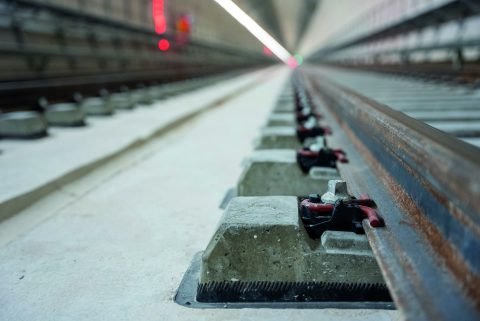
While the QuickFit technology is new to the screwed market, this approach has been used for many years in threadless fastenings. One recent application has been the Hankyu Railway’s Awaji Station Continuous Grade Separation Project in Osaka. Approved in 2012, this has been underway since 2020 and is now expected to be completed by 2031.
The US$496m scheme covers a 3·3 km section of Hankyu’s Kyoto Line from Sōzenji to Kami-Shinjō and 3·8 km of the Senri Line from Kunijima to Shimo-Shinjō, which intersect at Awaji. It will see 7·1 km of railway rebuilt on viaduct, enabling the removal of 17 level crossings. Many of these are classified as ‘never opening’ because the barriers could be closed for more 40 min in some peak hours. Elevating the track will improve railway operations whilst reconnecting previously divided communities and supporting urban revitalisation.
The railway selected Pandrol’s FastClip FC1101 for its ability to deliver a consistent toe load without the need for manual adjustment — a key factor in minimising long-term maintenance requirements. This rubber-booted sleeper system incorporates the QuickFit functionality to simplify installation, resulting in construction and maintenance processes that are rapid, repeatable and less reliant on highly skilled manual intervention.
Multi-layered approach
The engineering response to the ongoing skills shortages within the rail sector is multi-layered, requiring both innovation by manufacturers and collaboration with contractors to ensure the successful and efficient delivery of projects.
Pandrol has recognised over many years the value of pre-assembly, which can reduce on-site operational complexity and lower reliance on specialist skills. Recent technical advances such as the switch on/switch off functionality and the redesigned plastic insulators should all contribute to tackling the skills challenge, enabling trackwork to be installed and maintained to the required standards with smaller, less specialised teams.
* Cédric Van Schammelhout is Product Line Director at Pandrol.
This article first appeared in the September 2026 issue of Railway Gazette International
Read the issue
Source: Railway Gazette