ArXiv caps submissions at two per month as AI paper flood overwhelms the preprint server
AIvia The Decoder
Quick Read
Starting October 2026, arXiv will cap submissions at two per person per month. Monthly submissions have doubled in two years, and in the cs.AI category they've grown more than sixfold. According to arXiv, a small fraction of authors are flooding the platform with low-quality papers, overwhelming its volunteer moderators. The article ArXiv caps submissions at two per month as AI paper flood overwhelms the preprint server appeared first on The Decoder.
Starting October 2026, arXiv will cap submissions at two per person per month. Monthly submissions have doubled in two years, and in the cs.AI category they’ve grown more than sixfold. According to arXiv, a small fraction of authors are flooding the platform with low-quality papers, overwhelming its volunteer moderators.
The article ArXiv caps submissions at two per month as AI paper flood overwhelms the preprint server appeared first on The Decoder.
Stanford and UC Berkeley researchers released TokenGate, a module for long-context prefill. TokenGate learned token pruning lets an existing LLM skim its input. Only the tokens that matter get full processing. The research team reports 1.4x to 11.3x faster time-to-first-token (TTFT) with no accuracy loss. Peak prefill memory drops 1.5x to 3.4x. Code and checkpoints are on GitHub under Apache-2.0. TL;DR MLP gate: A small MLP gate and LoRA (r=16) added to Qwen3-1.7B or Qwen3.5-2B. Tested on contexts up to 128k tokens. Runs on: Paper timings use 1 A100 at batch size 1. Training used 4 A100s. Performance: Pareto-optimal on 5 tasks against 6 baselines. Best: NIAH 16k at 11.3x faster TTFT and 3.42x lower memory. TTFT gain hits 13.0x at 128k. Worst: Speedup drops to 1.4x on some tasks. What is TokenGate? TokenGate is a drop-in component that adds trainable token pruning to pretrained LLMs. Transformers push every token through every layer. Attention cost grows quadratically with length. Training-free pruning is cheap but loses accuracy at high pruning rates. Architectural changes often need pre-training from scratch. How does TokenGate learned token pruning work? The forward pass splits into 3 phases: Standard forward: layers below gate layer L process all N tokens as usual. Gate module: an MLP scores each token from its post-attention residual at layer L. A top-K selector keeps the highest-scoring tokens. Pruned forward: layers above L process only those K tokens and never create KV entries for pruned ones. Only the document part of the prompt is prunable. The question is never pruned. What is token-gated attention? Top-K selection is not differentiable, which blocks end-to-end training. TokenGate borrows the Mixture-of-Experts router trick. Each kept token’s score becomes a bias on attention logits above the gate. That bias gives gradients a path back to the scorer. A learnable per-head gain and a learnable temperature refine this. The temperature corrects for each query seeing fewer keys. Training uses plain next-token loss. Each step averages a full-context loss and a random-budget loss. So 1 trained gate works across budgets. window.addEventListener("message",function(e){if(e.data&&e.data.mtpH){var f=document.getElementById("mtp-tg-frame");if(f&&e.source===f.contentWindow){f.style.height=e.data.mtpH+"px";}}}); #mtp-tg-wrap hr,#mtp-tg-wrap p:empty,#mtp-tg-wrap del,#mtp-tg-wrap s{display:none!important} How does TokenGate perform on benchmarks? The research team tested Qwen3-1.7B on RepoBench-P, 2WikiMultihopQA, MultiNews, BioDEX and needle-in-a-haystack (NIAH). Baselines were FastKV, SlimInfer, DASH, GemFilter, FlexPrefill and MInference, on the same LoRA backbone. Versus full prefill: 1.4x to 11.3x faster TTFT and 1.5x to 3.4x lower memory. Versus the next-best baseline: 1.2x to 6.4x faster TTFT and up to 2.1x lower memory. 2WikiMultihopQA: at 95% of full-context accuracy, prefill runs 3.0x faster with 2.7x less memory. Longer contexts: a gate trained at 16k reaches 12.8x at 32k and 13.0x at 64k and 128k. Memory savings stay near 3.43x. The learned selector beats FastKV’s heuristic at the same layer. Even random-K selection scores higher on the TokenGate backbone. The research team credits backbone co-adaptation. Does it work on hybrid-attention models? Yes, Qwen3.5-2B mixes Gated DeltaNet and full-attention layers. On NIAH 32k, TokenGate at layer 3 matched full-prefill accuracy. It ran 3.8x faster than full prefill and 2.1x faster than FastKV. Gating at layers 1 or 2 reached 7.8x, within 6% accuracy. FastKV can only prune attention layers. TokenGate vs FastKV, SlimInfer, GemFilter and DASH Self-reported gains use different setups, so they are not directly comparable. Pruning layers come from TokenGate’s Appendix C.2. How do you deploy TokenGate? The GitHub Repo needs Python 3.10+ and CUDA PyTorch 2.9+. An optional FlashAttention-2 key-bias kernel speeds up dense Qwen3. It costs 1.0x to 1.1x a plain call. Without it, inference falls back to FlexAttention. A {state} placeholder marks the prunable document. generate takes a max_kept_prefill_tokens budget. Checkpoints cover all 5 tasks on Qwen3-1.7B, plus a Qwen3.5-2B NIAH gate. Example: liana313/tokengate-niah-qwen3-1.7b. Training mirrors a TRL/PEFT recipe. Each step is 1.3x slower than plain LoRA. Runs converged faster on 4 of 5 tasks. Mean training time was 1.8 versus 2.2 A100 hours. Key Takeaways TokenGate adds learned token pruning to existing LLMs via a small gate and LoRA. Prefill runs 1.4x to 11.3x faster with 1.5x to 3.4x lower peak memory. Token-gated attention makes top-K selection trainable, MoE-router style. It beats the next-best pruning baseline by up to 6.4x on TTFT. It works on hybrid Qwen3.5-2B, where FastKV cannot prune DeltaNet layers. Check out the Paper, GitHub repo and Hugging Face paper page. Also, feel free to follow us on Twitter and don’t forget to join our 150k+ML SubReddit and Subscribe to our Newsletter. Wait! are you on telegram? now you can join us on telegram as well. Need to partner with us for promoting your GitHub Repo OR Hugging Face Page OR Product Release OR Webinar etc.? Connect with us The post Researchers from Stanford and UC Berkeley Introduce TokenGate: Token-Gated Attention Makes Long-Context Prefill Up to 11.3x Faster appeared first on MarkTechPost.
Anthropic has launched OSS Scanner, a free, opt-in vulnerability scanner for critical open-source projects. The Anthropic OSS Scanner runs the company’s strongest models, including Claude Mythos, against enrolled codebases. Reports go straight to maintainers without human review. That trade delivers faster findings, but shifts triage work onto project teams. 11 days after the October 8 launch, Anthropic reported 77 critical and 803 high model-rated findings. TL;DR Scale: 114 projects accepted from about 650 applications, as of October 19. Runs on: Anthropic’s infrastructure, free. Maintainers supply a Dockerfile; audits run in an isolated VM with no Internet. Performance: 85 of 97 audited critical and high findings (88%) met Anthropic’s disclosure bar. Best: Only 1 of 97 audited findings was a false positive. wolfSSL says 72 of 74 reports were valid. Worst: No human review before delivery. 11 of 97 audited findings duplicated known issues; maintainers report inflated severity. What is Anthropic OSS Scanner? OSS Scanner is a free application from Anthropic that periodically audits open-source repositories with its strongest models. The Frontier Red Team and Safeguards Research team run it together. The design borrows from Google’s OSS-Fuzz, but swaps fuzzers for language models. The main goal is a review bottleneck. Over 6 months, Anthropic’s models surfaced over 29,000 candidate vulnerabilities. Human reviewers triaged roughly 6,000 of them. Nearly 5,000 more reports went directly to maintainers who asked for everything, validated or not. OSS Scanner turns that ad hoc request into an opt-in program. How does OSS Scanner work? Core maintainers enroll by opening a pull request on anthropics/oss-scanner. The PR adds projects//project.yaml, based on the project template. Required fields: repo, primary_contact, and a Dockerfile path. Optional fields: threat_model, pgp for encrypted reports, auto_ccs, homepage, and disabled. The Dockerfile builds the project with network access. The VM then moves to a network without Internet for the audit. Agents in the pipeline double-check bugs, run root cause analysis and propose patches. Each report contains a self-contained reproducer and an explanation of the bug. Where possible, it includes a bisection to the commit that introduced it. A candidate patch is attached when available. An optional threat_model.md defines adversarial inputs, out-of-scope code and a severity rubric. Without it, the scanner guesses. How accurate are OSS Scanner reports? Anthropic team asked its penetration testers to check 97 critical and high findings across 48 projects. 85 (88%) met the bar for Anthropic’s coordinated vulnerability disclosure (CVD) process. 11 were real but duplicated known issues or other scan findings. 1 was invalid. Maintainer data points in the same direction. wolfSSL received 74 reports; all but 2 were valid, and 5 became CVEs. curl patched CVE-2026-92392, a High-severity HTTP/2 upload use-after-free. It affects curl 8.12.0 to 8.22.0 and is fixed in 8.23.0, released October 14, 2026. Anthropic links the timing to benchmark progress. On CyberGym, LLMs went from finding under 20% of vulnerabilities to over 85%. Its broader CVD dashboard lists 6,157 disclosed vulnerabilities across 591 projects, as of October 2. 516 of those are patched. #mtp-oss-scanner-wrap iframe{width:100%!important;border:0!important;display:block!important;background:transparent!important;}#mtp-oss-scanner-wrap hr,#mtp-oss-scanner-wrap p:empty,#mtp-oss-scanner-wrap del,#mtp-oss-scanner-wrap s{display:none!important;}@media (max-width:640px){#mtp-oss-scanner-wrap{margin:16px auto!important;}} (function(){var f=document.getElementById('mtp-oss-scanner-frame');window.addEventListener('message',function(e){if(e.data&&e.data.mtpFrame==='mtp-oss-scanner'&&e.source===f.contentWindow){f.style.height=e.data.h+'px';}});})(); OSS Scanner vs other open-source security programs Sources: OSS-Fuzz disclosure guidelines, OpenAI Codex Security, DeepMind CodeMender. Key Takeaways OSS Scanner gives critical open-source projects free Claude Mythos audits. Reports skip human review; 88% of 97 audited critical/high findings were valid. First 11 days: 77 critical and 803 high model-rated findings. Enrollment is a PR with a Dockerfile; audits run offline. No 90-day deadline applies to unvalidated findings. Check out the launch post, the OSS Scanner FAQ and the GitHub repo. Also, feel free to follow us on Twitter and don’t forget to join our 150k+ML SubReddit and Subscribe to our Newsletter. Wait! are you on telegram? now you can join us on telegram as well. Need to partner with us for promoting your GitHub Repo OR Hugging Face Page OR Product Release OR Webinar etc.? Connect with us The post Anthropic Launches OSS Scanner, a Free AI Vulnerability Scanner appeared first on MarkTechPost.
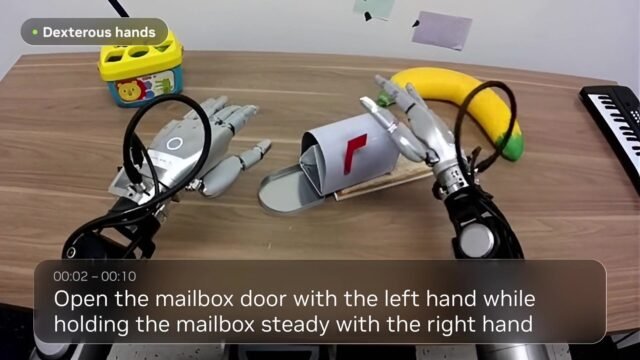
Nvidia's new data engine Flora labels one hour of robot video for 72 cents instead of $88 with GPT-6 Astra, while scoring slightly higher on quality. The open system, built on three fine-tuned Qwen3.5 models, catches errors in robot actions far more reliably than any competitor but sometimes falls short on descriptive accuracy. Nvidia is positioning Flora as a key piece of its strategy to control the entire robotics value chain. The article Nvidia open-sources Flora to make robot video labeling 125x cheaper than GPT-6 Astra appeared first on The Decoder.